


Daily 10 am to 7 pm
Daily 10 am to 7 pm

How to Tell If Your Jewelry Is Valuable: 8 Things to Check Before Selling
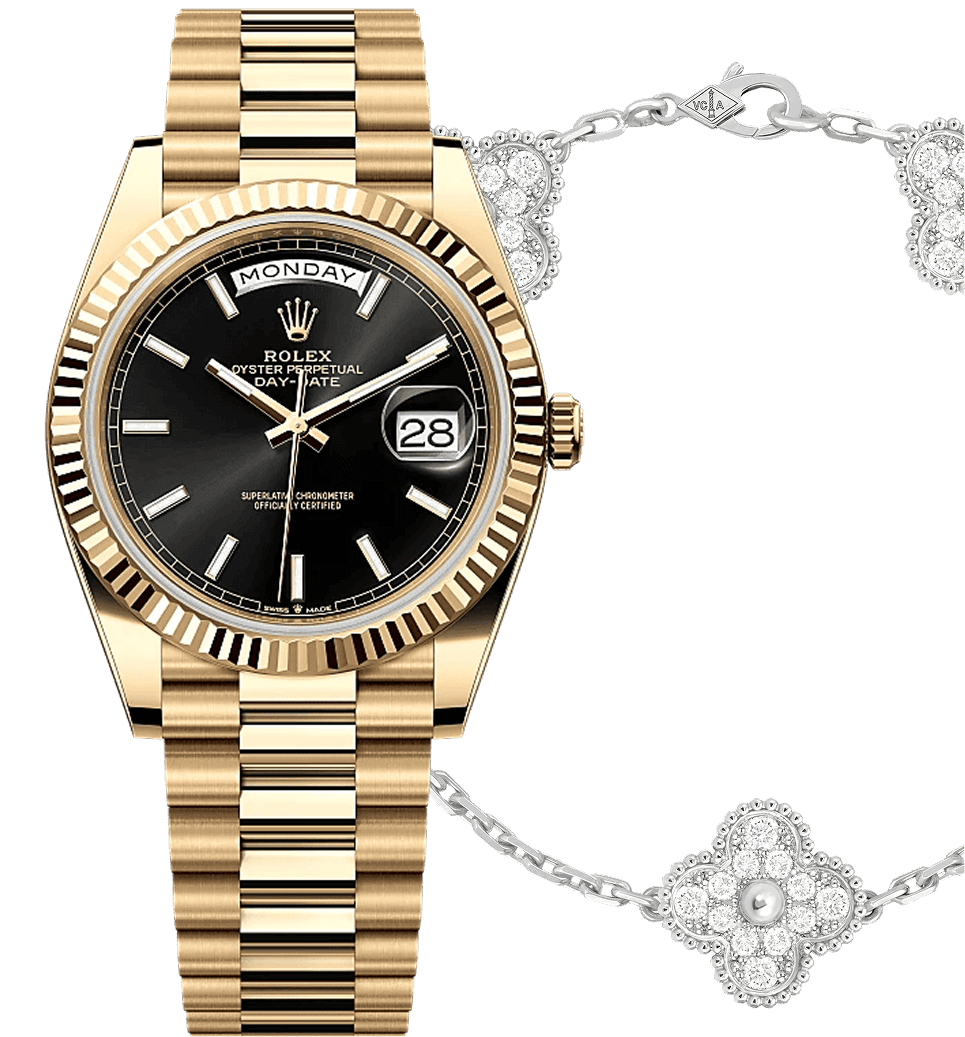
Valuable jewelry usually has one or more identifiable value drivers: precious-metal content, important diamonds or gemstones, a recognized maker, unusual craftsmanship, documented history, strong condition, or real demand in the secondary market.
Start with the marks, construction, stones, weight, condition, and paperwork—but treat each one as a clue, not proof. A 750 stamp does not establish authenticity, an old piece is not automatically valuable, and a designer name alone does not confirm that an item is genuine.
Here are eight things worth checking before you sell, clean, repair, or alter the piece.
Start with the marks, construction, stones, weight, condition, and paperwork—but treat each one as a clue, not proof. A 750 stamp does not establish authenticity, an old piece is not automatically valuable, and a designer name alone does not confirm that an item is genuine.
Here are eight things worth checking before you sell, clean, repair, or alter the piece.
JEWELRY VALUE & IDENTIFICATION
Quick Clues That Jewelry May Be Worth a Closer Look
585 / 14K
May tell you:
The piece may be approximately 14-karat gold.
Does not prove:
That the mark is genuine or the jewelry has a high resale value.
750 / 18K
May tell you:
The piece may be 18-karat gold.
Does not prove:
Designer authenticity or selling price.
Designer signature
May tell you:
The item may be associated with a known maker.
Does not prove:
Authenticity by itself.
PT950 / 950 Pt
May tell you:
The piece may be high-purity platinum.
Does not prove:
Overall value without considering the complete mark and item.
Diamond report
May tell you:
Documents gemstone characteristics when it matches the stone.
Does not prove:
A guaranteed resale price.
Original box or receipt
May tell you:
Can help establish identity and provenance.
Does not prove:
That the item is genuine on its own.
Older construction
May tell you:
May justify further research.
Does not prove:
That age automatically creates collector value.
Heavy weight
May tell you:
May indicate substantial precious-metal content.
Does not prove:
Metal type, purity, or final value.
Check the Hallmarks and Purity Marks
The smallest marks on a piece of jewelry can provide some of the most useful first clues.
Look inside the shank of a ring, near the clasp or tag of a bracelet or necklace, on the back of a pendant, and on earring posts or backs. A loupe or a phone camera in macro mode can make tiny markings easier to read.
You may find a quality or fineness mark, a maker's mark, a country or assay mark, or several marks together.
It is useful to distinguish these terms. A maker's or responsibility mark identifies the company or party associated with the piece. In countries with formal assay systems, a hallmark can be applied by an authorized assay office after testing the metal. Not every stamp found on jewelry is therefore the same type of “hallmark.”
Look inside the shank of a ring, near the clasp or tag of a bracelet or necklace, on the back of a pendant, and on earring posts or backs. A loupe or a phone camera in macro mode can make tiny markings easier to read.
You may find a quality or fineness mark, a maker's mark, a country or assay mark, or several marks together.
It is useful to distinguish these terms. A maker's or responsibility mark identifies the company or party associated with the piece. In countries with formal assay systems, a hallmark can be applied by an authorized assay office after testing the metal. Not every stamp found on jewelry is therefore the same type of “hallmark.”
585 indicates 585 parts of gold per 1,000 parts of alloy, or 58.5% gold.
It is commonly associated with 14K gold, which on the 24-part karat scale contains approximately 58.3% gold.
A 585 or 14K mark is a useful reason to investigate a piece further, but the mark should not be treated as independent proof of the metal content.
It is commonly associated with 14K gold, which on the 24-part karat scale contains approximately 58.3% gold.
A 585 or 14K mark is a useful reason to investigate a piece further, but the mark should not be treated as independent proof of the metal content.
750 indicates 750 parts gold per 1,000, or 75% gold.
That corresponds to 18K gold.
This mark is especially relevant when evaluating fine and designer jewelry because 18K gold is widely used in higher-end jewelry production.
That corresponds to 18K gold.
This mark is especially relevant when evaluating fine and designer jewelry because 18K gold is widely used in higher-end jewelry production.
With platinum jewelry, marks may include forms such as 950 Pt, Pt950, or related platinum designations.
Read the complete mark, not just the number 950, because context matters when identifying a metal.
Read the complete mark, not just the number 950, because context matters when identifying a metal.
Marks can wear away, become partially obscured during resizing or repair, be misread, or appear on counterfeit pieces.
Conversely, an older or handmade piece without an obvious mark should not automatically be dismissed.
If the metal itself may represent meaningful value, professional verification is safer than trying destructive home tests.
For a deeper explanation of gold purity and the relationship between karat and fineness, see the Gold Karat Guide.
Conversely, an older or handmade piece without an obvious mark should not automatically be dismissed.
If the metal itself may represent meaningful value, professional verification is safer than trying destructive home tests.
For a deeper explanation of gold purity and the relationship between karat and fineness, see the Gold Karat Guide.
What Does 585 Mean on Jewelry?
What Does 750 Mean on Jewelry?
What Does 950 Mean on Jewelry?
A Stamp Is a Starting Point, Not a Final Test
Look for Designer Signatures and Maker's Marks
A recognizable maker can change the way a piece should be evaluated.
A simple 18K bracelet and an authentic signed 18K bracelet from an established jewelry house may contain similar quantities of gold while participating in very different secondary markets.
Look carefully for:
Cartier, Tiffany & Co., Van Cleef & Arpels, Bulgari, Graff, and other established houses all have recognizable design histories and secondary-market demand. Luxe Brokers already evaluates signed pieces based on exact model or collection, condition, materials, completeness, and current brand demand rather than metal weight alone.
A simple 18K bracelet and an authentic signed 18K bracelet from an established jewelry house may contain similar quantities of gold while participating in very different secondary markets.
Look carefully for:
- a full brand name or signature;
- maker's initials or symbols;
- serial or reference numbers where appropriate;
- purity marks placed near the signature;
- consistent typography and engraving;
- construction details associated with the design;
- original receipts, certificates, service documentation, or packaging.
Cartier, Tiffany & Co., Van Cleef & Arpels, Bulgari, Graff, and other established houses all have recognizable design histories and secondary-market demand. Luxe Brokers already evaluates signed pieces based on exact model or collection, condition, materials, completeness, and current brand demand rather than metal weight alone.
This distinction is important.
Luxury jewelry is counterfeited, and a convincing logo can be copied. Authentication normally requires the complete piece to make sense: marks, dimensions, construction, materials, stones, hardware, serial information where applicable, and known design characteristics.
Even Tiffany & Co. warns consumers about counterfeit merchandise and currently states that it does not offer a general authentication program for merchandise. Tiffany & Co. US
So if you find Cartier, Tiffany & Co. or VAN CLEEF & ARPELS on a piece, do not assume you already know what it is worth.
Instead, treat the signature as a reason for a more careful designer jewelry evaluation.
Luxury jewelry is counterfeited, and a convincing logo can be copied. Authentication normally requires the complete piece to make sense: marks, dimensions, construction, materials, stones, hardware, serial information where applicable, and known design characteristics.
Even Tiffany & Co. warns consumers about counterfeit merchandise and currently states that it does not offer a general authentication program for merchandise. Tiffany & Co. US
So if you find Cartier, Tiffany & Co. or VAN CLEEF & ARPELS on a piece, do not assume you already know what it is worth.
Instead, treat the signature as a reason for a more careful designer jewelry evaluation.
A Designer Name Does Not Authenticate the Piece
Examine the Diamonds and Gemstones
A modest-looking piece can derive much of its value from a single important stone.
With diamonds, the familiar starting point is the 4Cs:
But resale evaluation can involve more than four labels. Shape, proportions, fluorescence, condition, whether the stone is natural or laboratory-grown, treatments, grading documentation, and current demand for that combination of characteristics can all matter.
GIA grading reports document characteristics such as shape, color, clarity, cut and carat weight for qualifying diamonds, along with additional identifying information. A grading report describes the stone; it is not the same thing as a monetary appraisal.
- carat weight;
- color;
- clarity;
- cut.
But resale evaluation can involve more than four labels. Shape, proportions, fluorescence, condition, whether the stone is natural or laboratory-grown, treatments, grading documentation, and current demand for that combination of characteristics can all matter.
GIA grading reports document characteristics such as shape, color, clarity, cut and carat weight for qualifying diamonds, along with additional identifying information. A grading report describes the stone; it is not the same thing as a monetary appraisal.
Ruby, sapphire, emerald and other colored gemstones cannot be valued simply by size or color seen in a photograph.
Important questions may include:
Do not rely on online “scratch,” “fog,” or similar DIY tests to establish identity or value.
A professional evaluation is particularly worthwhile when the center stone appears substantial, unusually colored, old, or accompanied by laboratory documentation.
Important questions may include:
- Is the stone natural, synthetic, or an imitation?
- Has it been treated?
- What is its color quality?
- How transparent or included is it?
- Is there visible damage?
- What is the cutting quality?
- Is origin relevant for this type of stone?
- Is there a respected laboratory report?
Do not rely on online “scratch,” “fog,” or similar DIY tests to establish identity or value.
A professional evaluation is particularly worthwhile when the center stone appears substantial, unusually colored, old, or accompanied by laboratory documentation.
Colored Gemstones Need Their Own Evaluation
Consider the Weight, Precious Metal, and Construction
Weight matters—but only after you understand what is being weighed.
For ordinary gold jewelry, a basic material-value calculation begins with:
weight × purity × current gold market reference
That is one reason a heavy 18K bracelet may deserve attention even if it is unbranded.
But this is only a baseline.
Two pieces of equal total weight can have different value because:
For ordinary gold jewelry, a basic material-value calculation begins with:
weight × purity × current gold market reference
That is one reason a heavy 18K bracelet may deserve attention even if it is unbranded.
But this is only a baseline.
Two pieces of equal total weight can have different value because:
- they have different gold purity;
- one contains significant stones;
- one is hollow and the other solid;
- one has a recognized designer;
- one has collector demand;
- their construction quality differs;
- their condition differs.
If a piece has a recognizable signature, unusual craftsmanship, meaningful gemstones, an antique or period design, or documentation, evaluate the whole object first.
Once a valuable piece has been dismantled purely for its gold content, part of the value may be impossible to recover.
Once a valuable piece has been dismantled purely for its gold content, part of the value may be impossible to recover.
Do Not Automatically Treat Fine Jewelry as Scrap
Look at the Condition—But Do Not Assume Worn Means Worthless
Condition can influence resale value, but its effect depends on what the jewelry is.
Check for:
A broken unbranded gold chain can still retain material value.
A heavily altered signed bracelet may lose part of the premium it would otherwise receive.
An antique piece may show wear yet remain interesting because of its craftsmanship, maker, rarity, or period character.
This is why “perfect condition” is not a universal requirement for value.
Check for:
- missing or chipped stones;
- bent or worn prongs;
- broken clasps;
- dents;
- deep scratches;
- cracked enamel;
- stretched links;
- previous soldering;
- altered ring sizing;
- replacement components;
- excessive previous polishing.
A broken unbranded gold chain can still retain material value.
A heavily altered signed bracelet may lose part of the premium it would otherwise receive.
An antique piece may show wear yet remain interesting because of its craftsmanship, maker, rarity, or period character.
This is why “perfect condition” is not a universal requirement for value.
Before polishing an old or signed item aggressively, consider whether the original finish, engraving, edges, patina, or construction details may be relevant to someone evaluating it.
Making an item look newer is not always the same thing as making it more valuable.
Making an item look newer is not always the same thing as making it more valuable.
Originality Can Matter as Much as Cosmetic Appearance
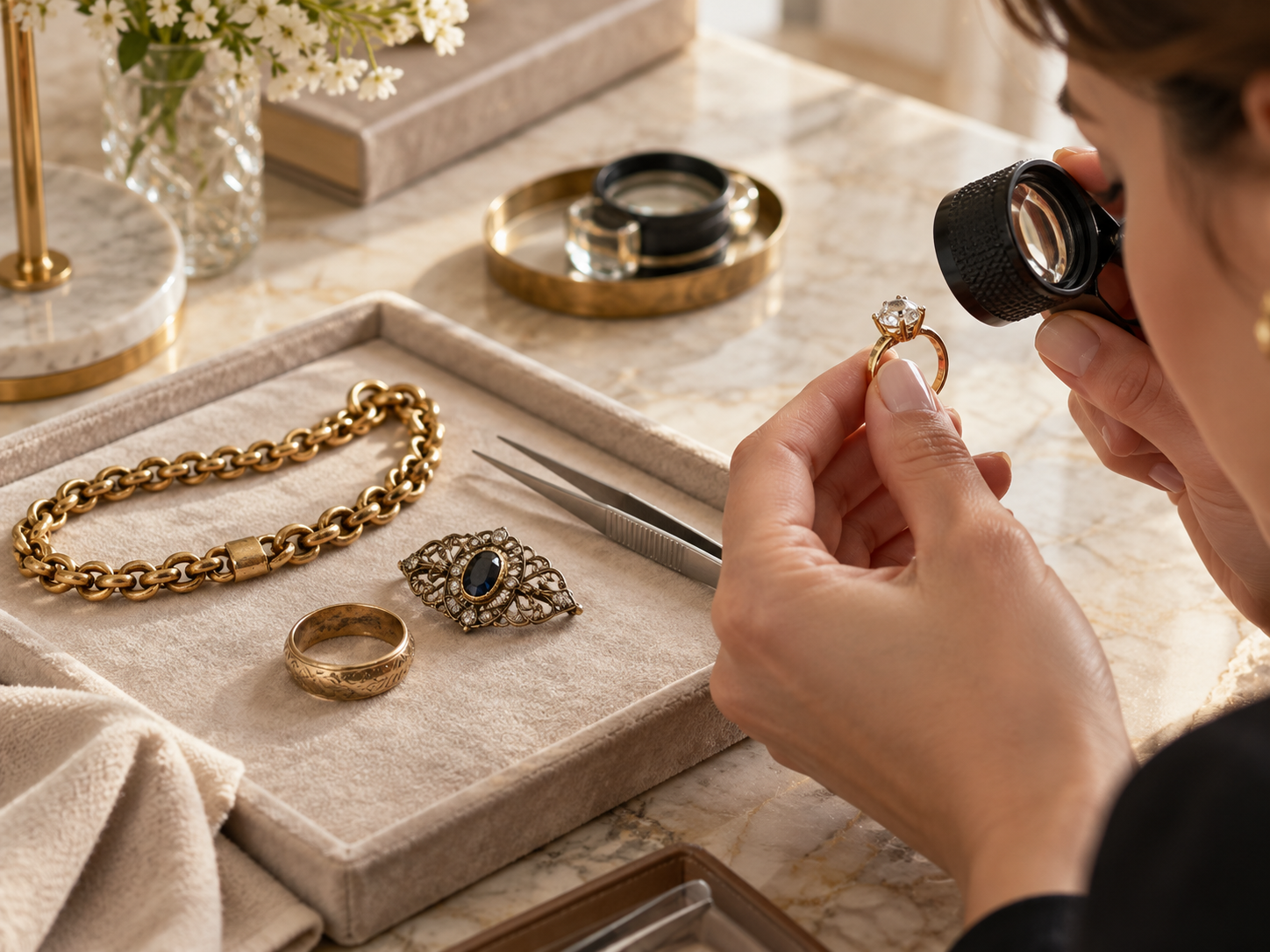
Check the Age, Rarity, and Provenance
Age becomes important when it combines with something else: maker, rarity, craftsmanship, design period, important gemstones, originality, or documented history.
A mass-produced piece can be decades old without attracting collector demand.
A seemingly simple older jewel may be important because of who made it, when it was produced, how rare the design is, or where it came from.
A mass-produced piece can be decades old without attracting collector demand.
A seemingly simple older jewel may be important because of who made it, when it was produced, how rare the design is, or where it came from.
Provenance is the documented ownership or history of an object.
Useful evidence can include:
Documentation matters. A family story can be useful as a lead, but a story and documented provenance are not equivalent.
For inherited, vintage, or antique pieces, an estate jewelry evaluation may be more appropriate than simply weighing the metal. Luxe Brokers' estate-jewelry page similarly treats maker, provenance, craftsmanship, gemstone quality, era, rarity, condition and collectability as distinct value drivers rather than reducing the item to scrap.
Useful evidence can include:
- dated receipts;
- old photographs showing the piece;
- estate inventories;
- correspondence;
- maker documentation;
- auction records;
- original certificates;
- documentation connecting the jewelry to a notable previous owner.
Documentation matters. A family story can be useful as a lead, but a story and documented provenance are not equivalent.
For inherited, vintage, or antique pieces, an estate jewelry evaluation may be more appropriate than simply weighing the metal. Luxe Brokers' estate-jewelry page similarly treats maker, provenance, craftsmanship, gemstone quality, era, rarity, condition and collectability as distinct value drivers rather than reducing the item to scrap.
Old jewelry is not automatically valuable.
What Is Provenance?
Gather the Original Box, Receipt, Certificate, and Previous Appraisal
Do not discard old jewelry paperwork simply because it looks outdated.
Before getting a value opinion, gather anything that may belong to the item:
These items can make identification easier and sometimes improve marketability.
They are not always required.
Luxe Brokers already notes on its designer jewelry and gold-jewelry pages that original packaging and documentation can help improve identification and accuracy, while jewelry can still be evaluated without them.
Before getting a value opinion, gather anything that may belong to the item:
- original receipt;
- branded box or pouch;
- warranty or service paperwork;
- diamond or gemstone grading report;
- prior appraisal;
- certificate;
- repair records;
- auction documentation;
- photographs of the piece being worn or owned historically.
These items can make identification easier and sometimes improve marketability.
They are not always required.
Luxe Brokers already notes on its designer jewelry and gold-jewelry pages that original packaging and documentation can help improve identification and accuracy, while jewelry can still be evaluated without them.
An older appraisal may contain extremely useful descriptive information: weight, stone measurements, metal type, maker, photographs, or identifying features.
But the dollar value may have been calculated for insurance or another purpose rather than current resale.
If you have already found an appraisal and are wondering why its number may differ from what the jewelry could sell for, the next logical article is Jewelry Appraisal vs. Resale Value.
But the dollar value may have been calculated for insurance or another purpose rather than current resale.
If you have already found an appraisal and are wondering why its number may differ from what the jewelry could sell for, the next logical article is Jewelry Appraisal vs. Resale Value.
Do Not Confuse a Previous Appraisal With Today's Selling Price
Ask Whether There Is a Real Secondary Market for the Piece
This is the step that turns “interesting jewelry” into a realistic market question.
Value is not determined only by what something cost to manufacture.
A buyer may consider:
This explains why two pieces made from similar amounts of gold can produce very different evaluations.
Diamond Banc similarly describes current demand, maker, style, craftsmanship and condition as important factors in liquid jewelry value, while Bob's Watches uses the same broader secondary-market principle in the watch category: identification and current market demand matter more than historical retail price alone.
Value is not determined only by what something cost to manufacture.
A buyer may consider:
- whether the maker is currently desirable;
- whether the exact collection has an established resale audience;
- demand for the design, size, metal and gemstone combination;
- condition;
- rarity;
- recent comparable market activity;
- how easily the piece can be identified and resold;
- whether the item has value as a complete piece or primarily as materials.
This explains why two pieces made from similar amounts of gold can produce very different evaluations.
Diamond Banc similarly describes current demand, maker, style, craftsmanship and condition as important factors in liquid jewelry value, while Bob's Watches uses the same broader secondary-market principle in the watch category: identification and current market demand matter more than historical retail price alone.
If you search for your item online, be careful with marketplace listings.
An asking price shows what a seller wants.
It does not prove that comparable pieces are actually selling for that amount.
A more useful evaluation looks at the exact item, realistic secondary-market demand, condition, selling channel, and evidence from comparable transactions where available.
That is also why the strongest next commercial step for this article is the Luxe Brokers jewelry evaluation and selling process, rather than trying to calculate a price from a hallmark alone.
An asking price shows what a seller wants.
It does not prove that comparable pieces are actually selling for that amount.
A more useful evaluation looks at the exact item, realistic secondary-market demand, condition, selling channel, and evidence from comparable transactions where available.
That is also why the strongest next commercial step for this article is the Luxe Brokers jewelry evaluation and selling process, rather than trying to calculate a price from a hallmark alone.
Asking Prices Are Not the Same as Market Value
What Not to Clean, Polish, or Repair Before an Evaluation
If you think a piece may be important, avoid making irreversible changes before someone knowledgeable has examined it.
Heavy polishing can alter:
A professional can decide whether cosmetic improvement would help the piece after identifying what it is.
- surface finish;
- engraving;
- crisp edges;
- maker's marks;
- hallmarks;
- original character.
A professional can decide whether cosmetic improvement would help the piece after identifying what it is.
Avoid unnecessary:
A repair that is completely reasonable for everyday wear may not be the best step immediately before a valuation.
- ring resizing;
- replating;
- stone replacement;
- clasp replacement;
- soldering;
- resetting;
- engraving removal.
A repair that is completely reasonable for everyday wear may not be the best step immediately before a valuation.
A setting may have value as part of the complete jewel.
Removing stones can also create damage and makes it harder to understand the piece in its original context.
Luxe Brokers' own Gold Karat Guide already advises sellers not to dismantle stone-set pieces before appraisal.
Removing stones can also create damage and makes it harder to understand the piece in its original context.
Luxe Brokers' own Gold Karat Guide already advises sellers not to dismantle stone-set pieces before appraisal.
Do Not Aggressively Polish Old or Designer Jewelry
Do Not Resize, Replate, or Replace Components First
Do Not Remove Stones Yourself
If you do not know what the stones or materials are, avoid harsh chemicals, toothpaste, abrasive cleaners, bleach, and improvised ultrasonic cleaning.
GIA notes that not every gemstone responds safely to the same cleaning method and that fragile settings and older estate jewelry require particular care. GIA 4Cs
If necessary, gently remove loose surface dust with a soft cloth and leave deeper cleaning until the materials and condition are understood.
GIA notes that not every gemstone responds safely to the same cleaning method and that fragile settings and older estate jewelry require particular care. GIA 4Cs
If necessary, gently remove loose surface dust with a soft cloth and leave deeper cleaning until the materials and condition are understood.
Be Careful With Home Cleaning
When a Professional Evaluation Makes Sense
You do not need a formal appraisal for every piece in a jewelry box.
Professional evaluation becomes particularly worthwhile when you find one or more meaningful signals:
It also makes sense when the important question is no longer “Could this be valuable?” but “What exactly is it, and what is its current market value?”
Professional evaluation becomes particularly worthwhile when you find one or more meaningful signals:
- 14K, 18K, 585, 750, PT950, or another precious-metal mark;
- an unfamiliar maker's mark;
- a recognizable luxury-house signature;
- a substantial diamond or colored gemstone;
- a laboratory report or old appraisal;
- unusually heavy precious-metal jewelry;
- an inherited or apparently antique piece;
- unusual craftsmanship;
- a complete designer box and paperwork set;
- conflicting marks or details you cannot interpret;
- a larger mixed estate or jewelry collection.
It also makes sense when the important question is no longer “Could this be valuable?” but “What exactly is it, and what is its current market value?”
If you are starting remotely, take clear photographs of:
That is consistent with the existing Luxe Brokers online evaluation process, which asks for clear photographs and available details such as brand, certificates, box/papers, and metal karat before an in-person final verification where necessary.
- the entire piece from the front;
- the back;
- all hallmarks and purity marks;
- brand signatures or maker's marks;
- stones and their settings;
- clasps, hinges, posts, and other construction details;
- visible damage;
- any box, receipt, grading report, certificate, or appraisal.
That is consistent with the existing Luxe Brokers online evaluation process, which asks for clear photographs and available details such as brand, certificates, box/papers, and metal karat before an in-person final verification where necessary.
What to Photograph for an Initial Review
The Bottom Line
You do not need to know the exact value of a piece before deciding whether it deserves a closer look.
Start by checking eight things:
None of these clues should be used in isolation.
A valuable jewel is usually identified by the way several pieces of evidence fit together: what the item is made from, who made it, how it was made, what condition it is in, how well its identity can be supported, and whether buyers currently want that particular type of piece.
If those clues suggest that your jewelry deserves a closer look, the next step is an item-specific evaluation rather than guessing from a stamp or an online listing.
Start by checking eight things:
- hallmarks and purity;
- designer or maker signatures;
- diamonds and gemstones;
- precious-metal weight and construction;
- condition;
- age, rarity and provenance;
- documentation and original accessories;
- actual secondary-market demand.
None of these clues should be used in isolation.
A valuable jewel is usually identified by the way several pieces of evidence fit together: what the item is made from, who made it, how it was made, what condition it is in, how well its identity can be supported, and whether buyers currently want that particular type of piece.
If those clues suggest that your jewelry deserves a closer look, the next step is an item-specific evaluation rather than guessing from a stamp or an online listing.
Not Sure What You Have?
A hallmark, maker's mark, gemstone, old certificate, or designer box can be a useful clue—but the complete piece still needs context.
Send clear photos of the jewelry from the front and back, close-ups of any stamps or signatures, the stones and settings, and any paperwork or packaging you have. Luxe Brokers can review the information for a preliminary market-based estimate, with in-person verification when needed.
Send clear photos of the jewelry from the front and back, close-ups of any stamps or signatures, the stones and settings, and any paperwork or packaging you have. Luxe Brokers can review the information for a preliminary market-based estimate, with in-person verification when needed.
Frequently Asked Questions
Marks such as 14K, 18K, 585, 750, Pt950, a recognizable maker's mark, or a designer signature can justify further evaluation. A mark is a clue, however, and should not be treated as proof of authenticity or final value.
Yes. 750 represents 750 parts gold per 1,000, or 75% gold, which corresponds to 18-karat gold.
585 means 58.5% gold and is commonly used as the fineness mark for approximately 14K gold.
Yes. Marks can wear away, be removed during resizing, or be absent on some older, handmade, or differently regulated pieces. Metal, gemstones, construction, maker and provenance may still justify professional evaluation.
A logo alone is not enough. Authentication can require examining the signature, metal marks, construction, dimensions, serial or reference information where applicable, gemstones, collection details and supporting documentation.
No. Age alone does not create market value. Maker, materials, rarity, craftsmanship, gemstones, condition, provenance and collector demand are usually more important.
Sometimes it can improve identification, completeness and marketability, especially for designer pieces. But packaging and paperwork do not authenticate an item by themselves and are not required for every valuable piece.
Avoid aggressive cleaning, polishing or repair when you do not know the materials or significance of the piece. Gentle handling is safer until the jewelry has been identified and its condition assessed.