


Daily 10 am to 7 pm
Daily 10 am to 7 pm

What Makes Designer Jewelry Valuable on the Resale Market?
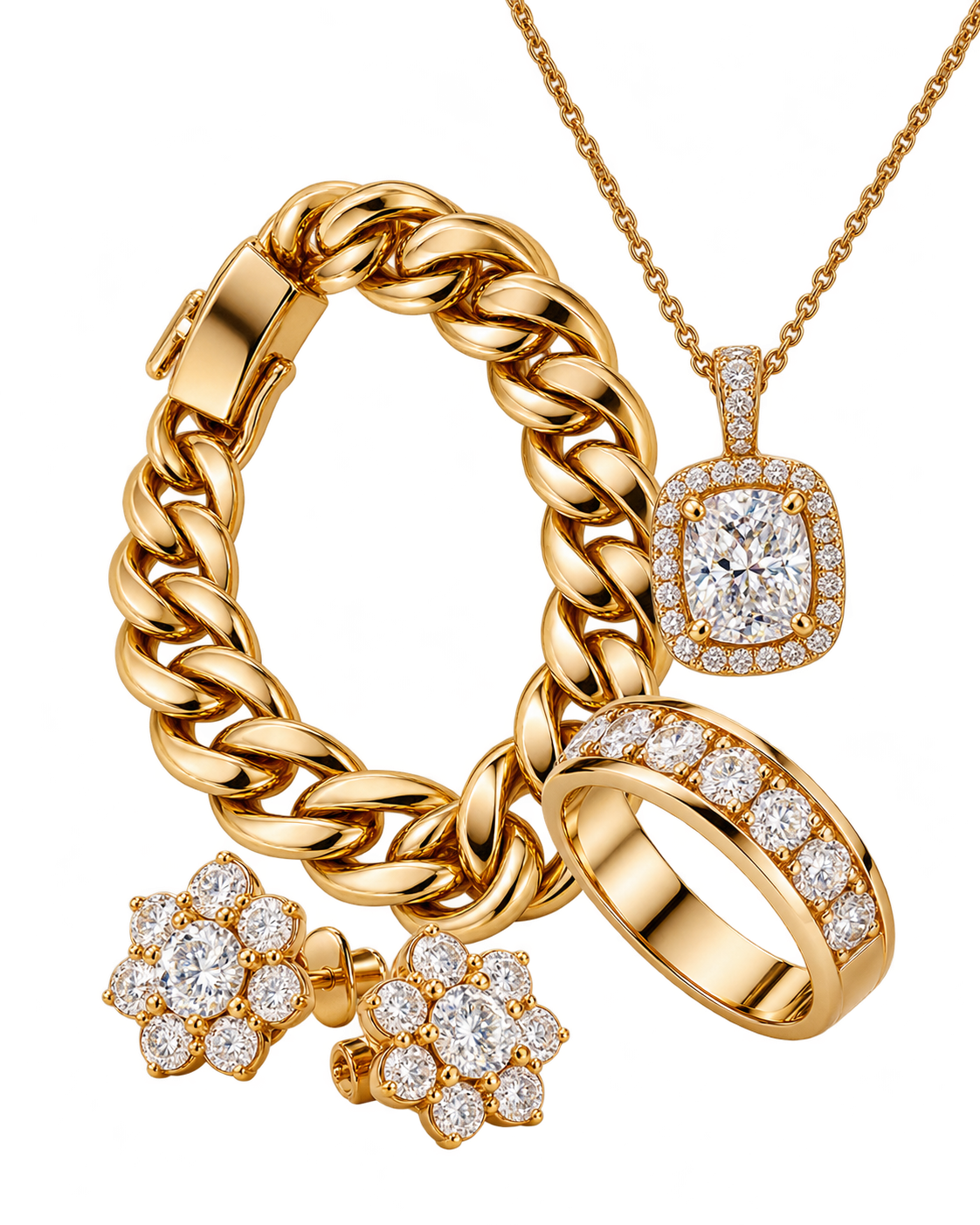
Designer jewelry can be worth substantially more than the gold, platinum, diamonds, or gemstones it contains—but the brand name alone does not determine resale value.
Buyers evaluate the exact maker, collection, variation, materials, stone quality, authenticity, condition, documentation, rarity, and current secondary-market demand. A recognizable Cartier bracelet, Van Cleef motif, Tiffany design, or Graff diamond jewel may have an established buyer market that an otherwise similar unsigned piece does not.
The important question is not simply “Which brand is this?”
It is:
“What exact piece is this, is it authentic and intact, and how does the market value that specific version today?”
Buyers evaluate the exact maker, collection, variation, materials, stone quality, authenticity, condition, documentation, rarity, and current secondary-market demand. A recognizable Cartier bracelet, Van Cleef motif, Tiffany design, or Graff diamond jewel may have an established buyer market that an otherwise similar unsigned piece does not.
The important question is not simply “Which brand is this?”
It is:
“What exact piece is this, is it authentic and intact, and how does the market value that specific version today?”
DESIGNER JEWELRY & RESALE VALUE
Why Signed Jewelry Is Different From Ordinary Jewelry
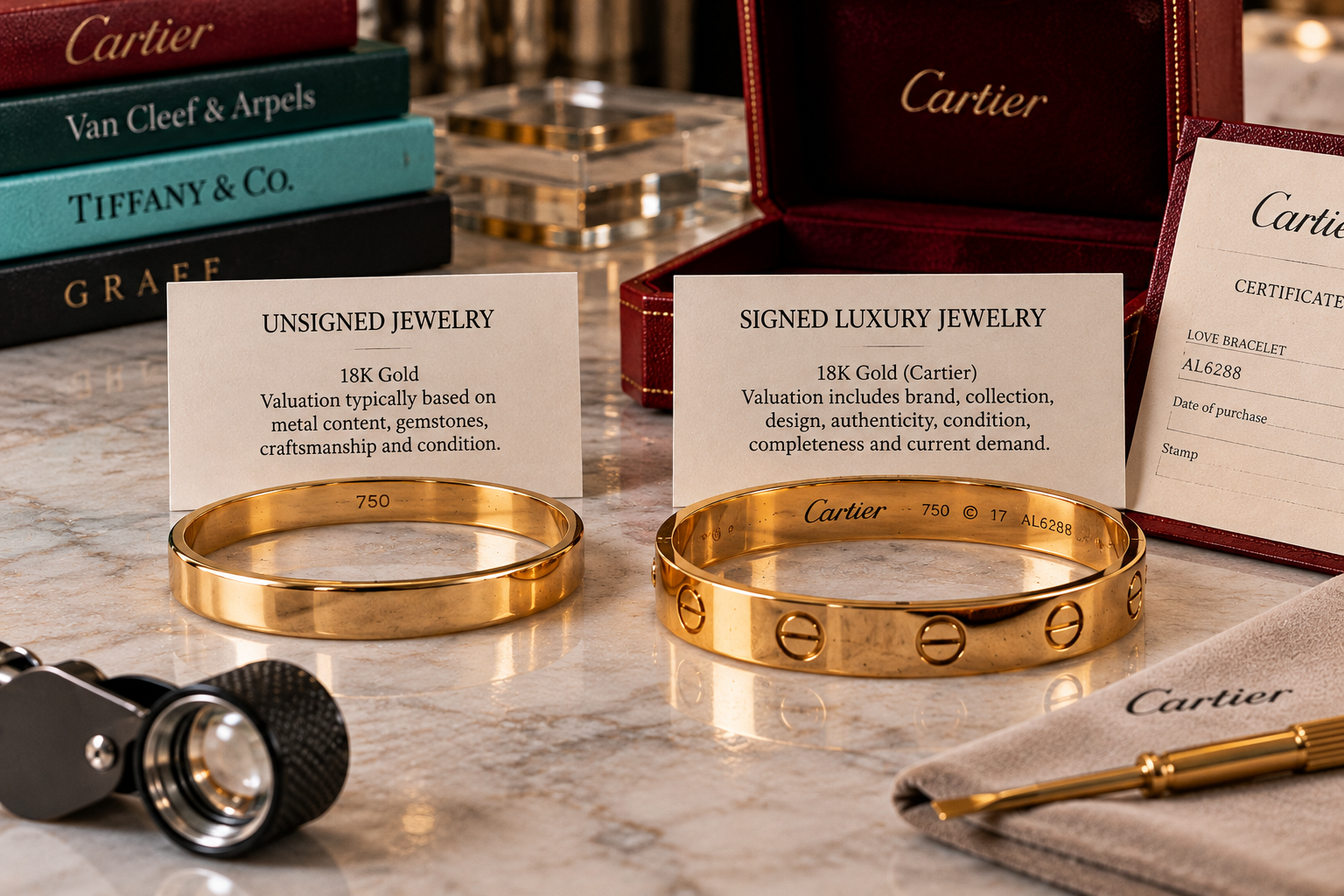
An unsigned 18K bracelet and a signed 18K bracelet can contain almost the same amount of gold.
That does not mean they belong to the same resale market.
For ordinary jewelry, valuation may lean heavily on:
Signed luxury jewelry adds another layer:
recognizable authorship.
Sotheby's describes recognized maison signatures as a source of market resilience and liquidity, particularly when the design itself is rare, collectible, or strongly associated with the house.
This is why designer jewelry should normally be evaluated as a complete object before anyone reduces it to gold and stone value.
That does not mean they belong to the same resale market.
For ordinary jewelry, valuation may lean heavily on:
- precious-metal content;
- diamonds or gemstones;
- craftsmanship;
- general design;
- condition.
Signed luxury jewelry adds another layer:
recognizable authorship.
Sotheby's describes recognized maison signatures as a source of market resilience and liquidity, particularly when the design itself is rare, collectible, or strongly associated with the house.
This is why designer jewelry should normally be evaluated as a complete object before anyone reduces it to gold and stone value.
Brand Premium Is Not Automatic
The presence of a luxury name does not create one fixed percentage premium.
A buyer still needs to ask:
Christie's makes the same distinction: even among important makers, the effect of the signature depends heavily on the actual piece, period, and design.
A buyer still needs to ask:
- Is the piece authentic?
- Is the design recognizable?
- Is it from a collection buyers currently seek?
- Is the exact version desirable?
- Is the condition appropriate?
- Has it been altered?
- Are the materials and gemstones significant?
- Is there an active resale market?
Christie's makes the same distinction: even among important makers, the effect of the signature depends heavily on the actual piece, period, and design.
Collection Recognition Can Matter More Than the Brand Name Alone
Luxury houses produce thousands of designs across decades.
The secondary market does not value all of them equally.
A buyer often tries to identify:
Brand → Collection → Exact version
rather than stopping at:
Brand.
For example, Luxe Brokers' own commercial pages distinguish:
The secondary market does not value all of them equally.
A buyer often tries to identify:
Brand → Collection → Exact version
rather than stopping at:
Brand.
For example, Luxe Brokers' own commercial pages distinguish:
- Cartier LOVE, Juste un Clou, Trinity, and Panthère;
- Van Cleef & Arpels Alhambra, Perlée, and Frivole;
- Tiffany T, HardWear, Return to Tiffany, Elsa Peretti, and Schlumberger;
- individual Graff diamond designs and configurations.
Why Collection Recognition Matters
A widely recognized design can have:
That does not guarantee a high selling price.
It simply gives the item a more clearly defined secondary market.
A less familiar design from the same house may be exceptionally well made but attract a narrower pool of buyers.
- more searchable comparables;
- more buyers who immediately understand the piece;
- an established pre-owned audience;
- clearer expectations around size and configuration;
- stronger liquidity.
That does not guarantee a high selling price.
It simply gives the item a more clearly defined secondary market.
A less familiar design from the same house may be exceptionally well made but attract a narrower pool of buyers.
Materials Still Matter
A designer signature does not replace the physical value of the jewelry.
Buyers still evaluate:
Buyers still evaluate:
- gold purity;
- platinum;
- metal weight where relevant;
- diamond quality;
- colored gemstones;
- craftsmanship;
- setting construction.
Plain Designer Gold Jewelry
For a recognizable gold bracelet or ring, the metal establishes a baseline.
The secondary market may then assign additional value to:
The secondary market may then assign additional value to:
- collection;
- design;
- authentication;
- condition;
- demand.
Diamond-Set Designer Jewelry
With diamond jewelry, more of the value may be concentrated in:
- center-stone carat weight;
- color;
- clarity;
- cut;
- shape;
- grading documentation;
- total stone quality.
High Jewelry
At the highest level, the distinction between “brand value” and “gemstone value” becomes increasingly artificial.
Important designer high jewelry is often valued as an integrated work involving:
Sotheby's describes top Van Cleef & Arpels pieces in exactly this holistic way: the strongest examples combine recognizable design, technical execution, stone selection, condition, and intact originality rather than relying on any single attribute.
Important designer high jewelry is often valued as an integrated work involving:
- exceptional stones;
- design;
- workmanship;
- rarity;
- maker;
- provenance.
Sotheby's describes top Van Cleef & Arpels pieces in exactly this holistic way: the strongest examples combine recognizable design, technical execution, stone selection, condition, and intact originality rather than relying on any single attribute.
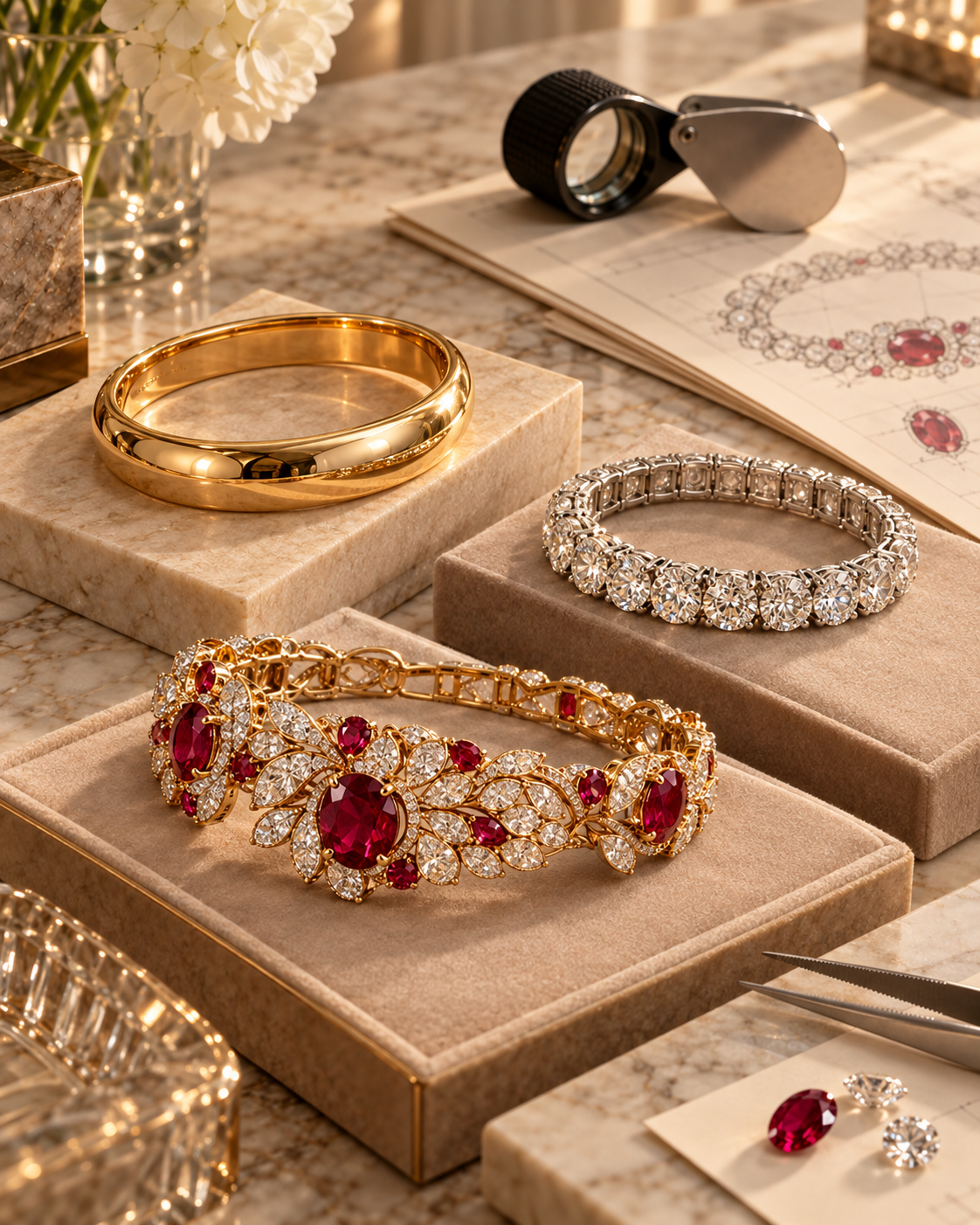
Diamonds and Gemstones Can Change the Entire Valuation
Do not assume that two pieces from the same designer should have similar resale behavior because they look alike.
A plain gold version and a diamond-set version can belong to different price categories.
For diamond-set pieces, buyers may consider:
This is especially important with Graff, where diamond quality can be one of the dominant value drivers rather than merely an accessory to the brand. Diamond Banc's current Graff evaluation page specifically emphasizes diamond characteristics, stone size, certification, design composition, condition, provenance, and market demand.
A plain gold version and a diamond-set version can belong to different price categories.
For diamond-set pieces, buyers may consider:
- individual stone sizes;
- total carat weight;
- color;
- clarity;
- cut quality;
- matching across multiple stones;
- natural versus laboratory-grown origin where relevant;
- laboratory reports;
- condition of the settings.
- treatment questions;
- origin considerations;
- color quality;
- rarity;
- laboratory documentation.
This is especially important with Graff, where diamond quality can be one of the dominant value drivers rather than merely an accessory to the brand. Diamond Banc's current Graff evaluation page specifically emphasizes diamond characteristics, stone size, certification, design composition, condition, provenance, and market demand.
Authenticity Comes Before the Brand Premium
There is no designer resale premium until the buyer is comfortable with what the piece actually is.
Luxury jewelry is frequently counterfeited.
A professional review may look at:
Luxury jewelry is frequently counterfeited.
A professional review may look at:
- maker's mark;
- metal fineness mark;
- serial or reference information where applicable;
- typography;
- dimensions;
- weight;
- construction;
- clasp;
- stone setting;
- finishing;
- design consistency;
- gemstones;
- documentation.
A Signature Is Evidence, Not Proof by Itself
This distinction is critical.
Counterfeit jewelry can carry copied logos, signatures, hallmarks, and serial numbers.
Revere's current hallmark guide explicitly warns that marks can be forged and that authentication must consider the complete piece—construction, dimensions, typography, materials, stones, and finishing.
Counterfeit jewelry can carry copied logos, signatures, hallmarks, and serial numbers.
Revere's current hallmark guide explicitly warns that marks can be forged and that authentication must consider the complete piece—construction, dimensions, typography, materials, stones, and finishing.
Luxury Houses Do Not Necessarily Authenticate Secondhand Pieces for You
Do not assume you can simply walk into the original boutique with a pre-owned piece and request an authentication letter.
Tiffany & Co. currently states that it does not offer a general authentication program. Cartier likewise says it cannot authenticate items acquired outside Cartier boutiques or authorized retailers.
For resale, authentication often requires an experienced secondary-market specialist who understands the house and the specific design.
Tiffany & Co. currently states that it does not offer a general authentication program. Cartier likewise says it cannot authenticate items acquired outside Cartier boutiques or authorized retailers.
For resale, authentication often requires an experienced secondary-market specialist who understands the house and the specific design.
Signatures, Hallmarks, and Serial Numbers
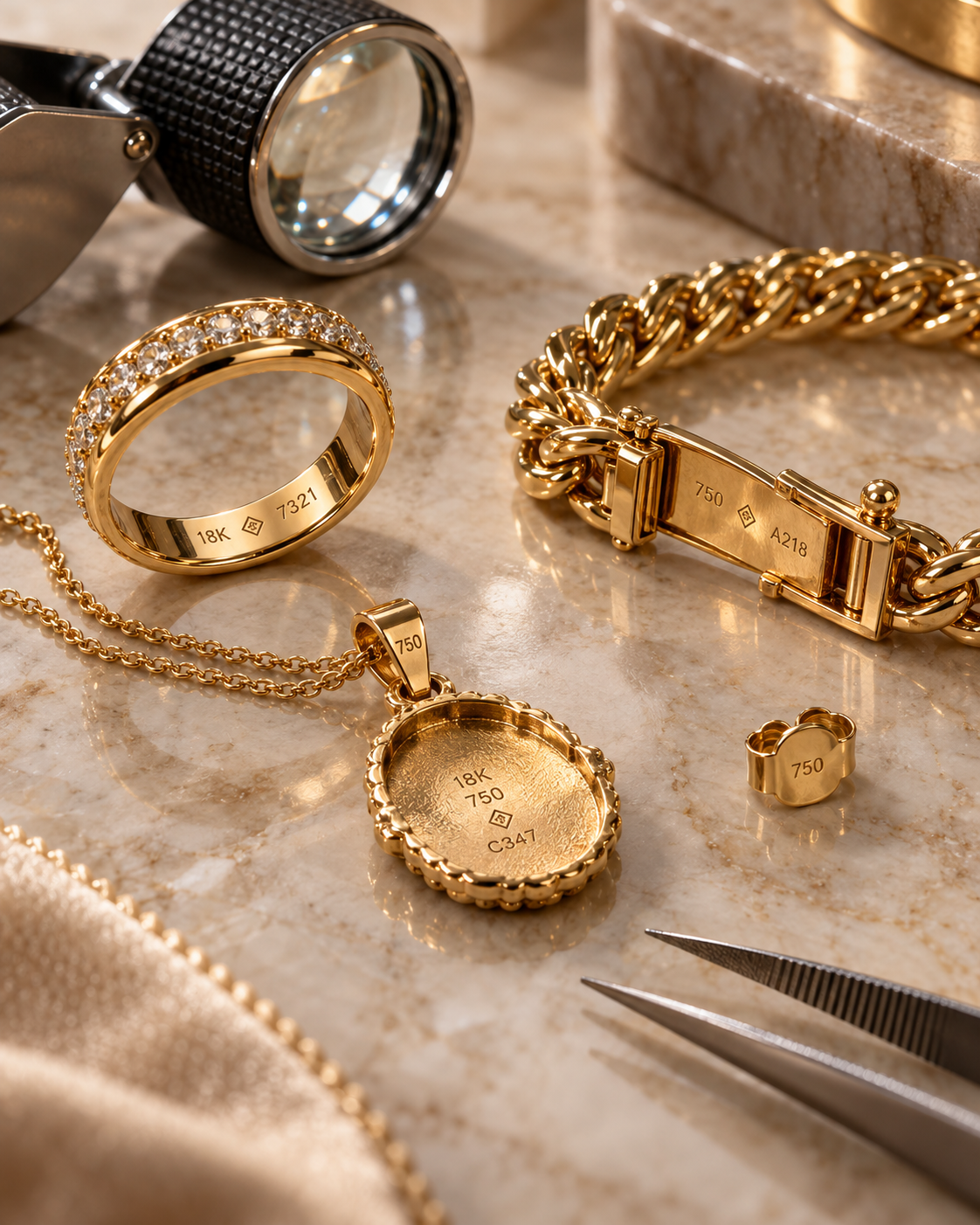
When examining designer jewelry, look carefully at the areas buyers will inspect.
These can include:
These can include:
- inner ring shank;
- bracelet interior;
- clasp;
- necklace tag;
- earring back;
- pendant reverse.
- maker signature;
- brand name;
- purity mark;
- serial number;
- model or reference number;
- workshop or responsibility mark.
Not Every Piece Uses the Same Identification System
Do not expect every designer or every era to use:
That is why online advice such as:
“If the serial has X digits, it is authentic”
should be treated cautiously unless it refers to a documented exact model and period.
The marks need to agree with the complete physical piece.
- the same serial format;
- the same signature typography;
- the same placement;
- the same combination of marks.
That is why online advice such as:
“If the serial has X digits, it is authentic”
should be treated cautiously unless it refers to a documented exact model and period.
The marks need to agree with the complete physical piece.
Box, Receipt, Certificate, and Paperwork
Original paperwork is useful—but its value should not be exaggerated.
Helpful items can include:
Helpful items can include:
- original box;
- pouch;
- purchase receipt;
- authenticity documentation;
- diamond grading report;
- gemstone report;
- service records;
- previous appraisal;
- original tags or accessory components.
Why Documentation Helps
Documentation can support:
Original documentation can support identification and marketability, but it is not required for a professional designer jewelry evaluation.
- provenance;
- model identification;
- original configuration;
- purchase history;
- gemstone specifications;
- buyer confidence.
Original documentation can support identification and marketability, but it is not required for a professional designer jewelry evaluation.
Box and Papers Do Not Create Authenticity
A counterfeit piece can be paired with counterfeit packaging.
A genuine piece can lose its box.
Therefore:
complete packaging supports the story
but:
the jewelry itself still has to pass inspection.
This is especially important when evaluating high-value pieces.
A genuine piece can lose its box.
Therefore:
complete packaging supports the story
but:
the jewelry itself still has to pass inspection.
This is especially important when evaluating high-value pieces.
Condition Affects More Than Appearance
Pre-owned jewelry is expected to show wear.
The question is whether that wear changes:
Buyers may examine:
The question is whether that wear changes:
- structural integrity;
- visual presentation;
- originality;
- marketability.
Buyers may examine:
- scratches;
- dents;
- worn edges;
- broken clasps;
- loose stones;
- missing stones;
- chipped gemstones;
- cracked enamel;
- stretched chains;
- repaired links;
- resizing;
- soldering;
- excessive polishing;
- aftermarket modifications.
Normal Wear vs. Alteration
A lightly worn authentic piece may be more attractive than a heavily restored example whose proportions or original details have been changed.
This is why sellers should not automatically:
The effect of a repair depends on the piece.
A necessary professional repair can preserve usefulness.
A poor alteration can reduce the appeal of a collectible designer item.
This is why sellers should not automatically:
- polish aggressively;
- replate;
- reset stones;
- replace clasps;
- resize;
- add aftermarket diamonds
The effect of a repair depends on the piece.
A necessary professional repair can preserve usefulness.
A poor alteration can reduce the appeal of a collectible designer item.
Aftermarket Modifications Can Change the Resale Market
Luxury jewelry sometimes receives modifications after purchase:
These changes do not automatically make an item worthless.
But they can change what the buyer is actually purchasing.
For a strongly collection-driven design, factory configuration can matter.
An aftermarket-diamond Cartier piece, for example, may not trade in exactly the same market as an original factory diamond version.
This is why the evaluator needs to distinguish:
authentic base item
from:
original factory configuration.
- added diamonds;
- replacement gemstones;
- altered clasp;
- resized structure;
- engraving removal;
- custom parts;
- replating.
These changes do not automatically make an item worthless.
But they can change what the buyer is actually purchasing.
For a strongly collection-driven design, factory configuration can matter.
An aftermarket-diamond Cartier piece, for example, may not trade in exactly the same market as an original factory diamond version.
This is why the evaluator needs to distinguish:
authentic base item
from:
original factory configuration.
Discontinued Does Not Automatically Mean Valuable
“Discontinued” is often treated online as a synonym for “rare.”
It is not.
A discontinued collection can become more interesting because supply no longer grows.
But resale value still depends on whether buyers actually want it.
A discontinued piece with:
A discontinued design with little market demand may simply be harder to sell.
Suttons' 2026 resale research reports strong performance among certain discontinued pieces, while Sotheby's consistently emphasizes rarity together with maker, design, condition, and collector interest—not scarcity alone.
The correct framework is:
scarcity + desirability
rather than:
scarcity = value.
It is not.
A discontinued collection can become more interesting because supply no longer grows.
But resale value still depends on whether buyers actually want it.
A discontinued piece with:
- recognizable design;
- limited availability;
- collector interest;
- strong brand history
A discontinued design with little market demand may simply be harder to sell.
Suttons' 2026 resale research reports strong performance among certain discontinued pieces, while Sotheby's consistently emphasizes rarity together with maker, design, condition, and collector interest—not scarcity alone.
The correct framework is:
scarcity + desirability
rather than:
scarcity = value.
Secondary-Market Demand Is the Final Test
A piece can be:
Conversely, a highly recognizable piece with a large active buyer pool may be much easier to place.
Demand affects:
A luxury house can increase its retail prices while the pre-owned demand for individual collections moves differently.
- authentic;
- beautiful;
- expensive at retail;
- made from excellent materials;
Conversely, a highly recognizable piece with a large active buyer pool may be much easier to place.
Demand affects:
- liquidity;
- time to sale;
- resale channel;
- inventory risk;
- realistic purchase offers.
A luxury house can increase its retail prices while the pre-owned demand for individual collections moves differently.
Asking Price Is Not the Same as Resale Evidence
Online listings show seller expectations.
They do not automatically show completed market transactions.
A serious evaluation looks at:
They do not automatically show completed market transactions.
A serious evaluation looks at:
- actual comparable items;
- exact collection;
- exact material;
- exact size/version;
- condition;
- completeness;
- current buyer activity.
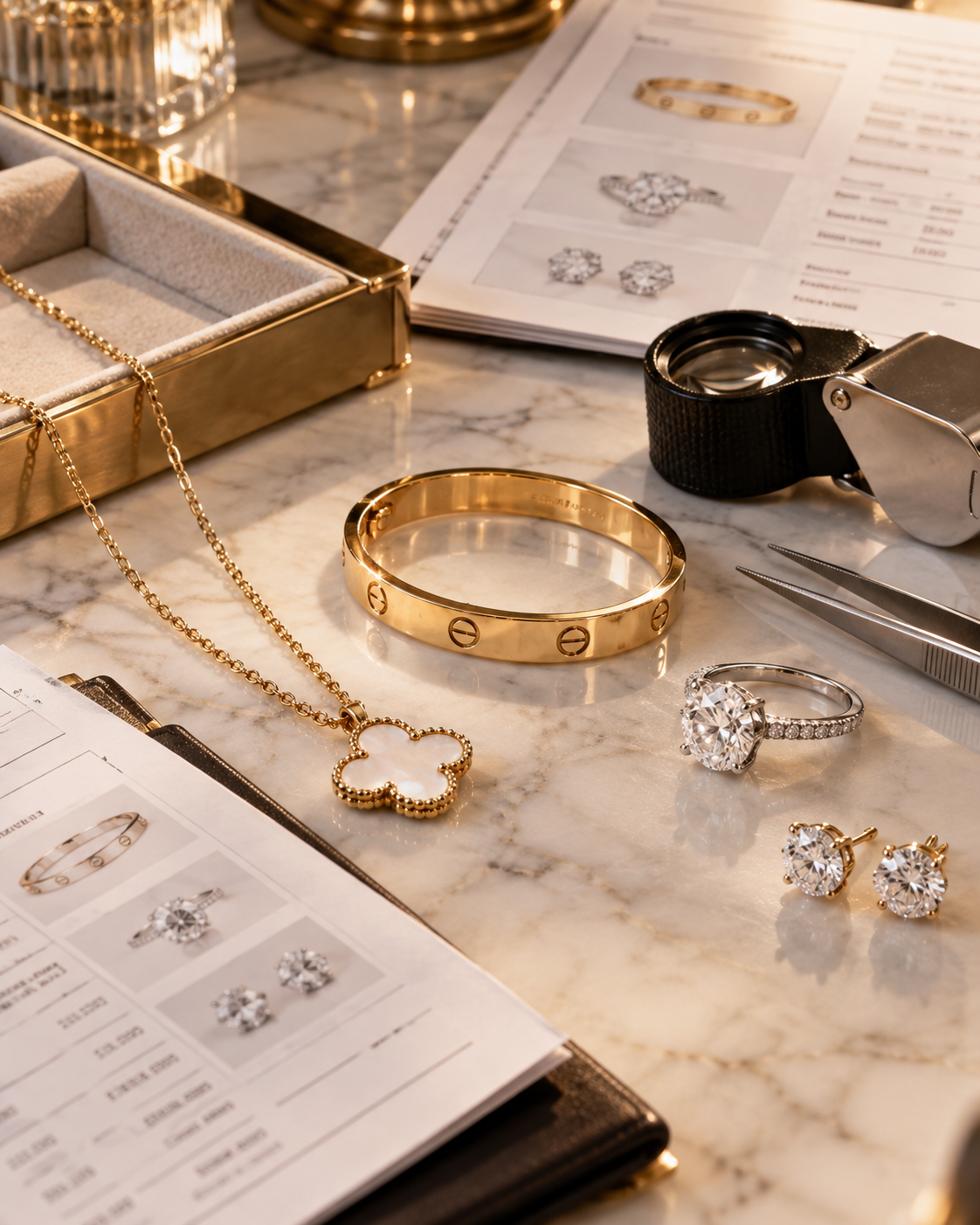
Cartier Resale Value: Collection Recognition Matters
Cartier is one of the clearest examples of why a brand should not be treated as one homogeneous market.
Luxe Brokers regularly identifies collections such as:
Luxe Brokers regularly identifies collections such as:
- LOVE;
- Juste un Clou;
- Trinity;
- Panthère;
- other diamond-set and less common designs.
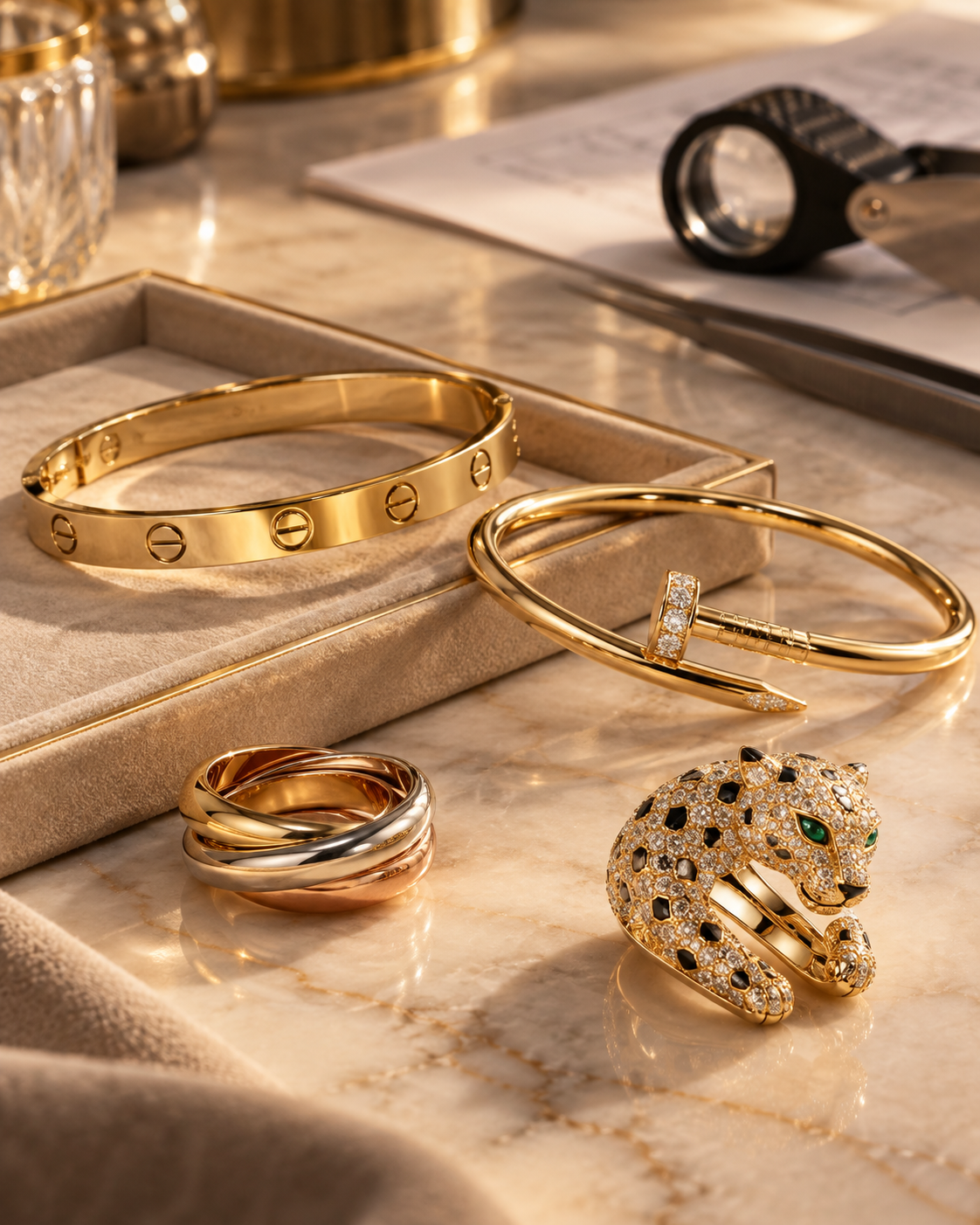
What Buyers Look At
For Cartier, resale evaluation may include:
- exact collection;
- bracelet or ring size;
- gold color;
- plain vs. diamond-set version;
- condition;
- screw or closure integrity;
- engraving and hallmarks;
- authenticity;
- box and documentation;
- current demand.
LOVE Is Not the Same as Every Cartier Piece
The secondary market immediately recognizes certain Cartier designs.
That does not mean every Cartier item follows the same liquidity or premium.
A standard production piece, vintage signed jewel, High Jewelry creation, and rare period piece may require entirely different valuation methods.
For an item-specific sale process, see the Luxe Brokers Cartier jewelry page.
That does not mean every Cartier item follows the same liquidity or premium.
A standard production piece, vintage signed jewel, High Jewelry creation, and rare period piece may require entirely different valuation methods.
For an item-specific sale process, see the Luxe Brokers Cartier jewelry page.
Van Cleef & Arpels Resale Value: Small Variations Can Matter
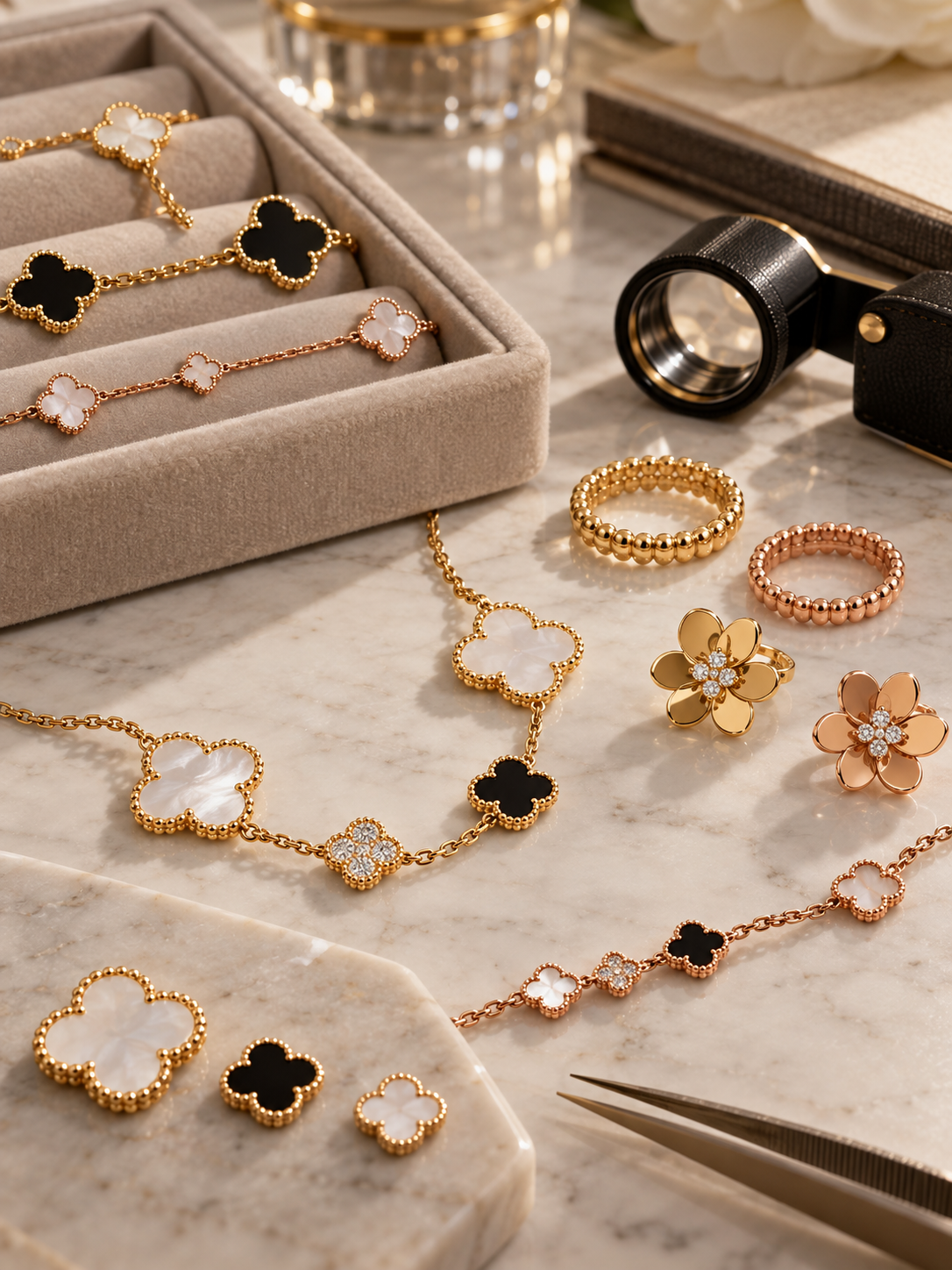
Van Cleef & Arpels is particularly collection- and variation-sensitive.
Luxe Brokers commonly sees:
With motifs such as Alhambra, apparently small differences can matter:
Luxe Brokers commonly sees:
- Alhambra;
- Perlée;
- Frivole;
- other recognizable VCA designs.
With motifs such as Alhambra, apparently small differences can matter:
- motif size;
- stone or material;
- gold color;
- number of motifs;
- bracelet vs. necklace;
- exact variation;
- condition;
- completeness.
Materials Can Be Central to the Design
Van Cleef frequently integrates ornamental and precious materials directly into the visual identity of a collection.
That means a buyer may need to verify not only:
Is it Van Cleef?
but:
Which exact Van Cleef variation is it?
Sotheby's current Van Cleef valuation guidance considers condition, comparable auction results, gemstone quality, and ownership history, while its 2026 editorial analysis emphasizes design identity, craftsmanship, materials, condition, and rarity.
For a sale-specific evaluation, use the Luxe Brokers Van Cleef & Arpels jewelry page.
That means a buyer may need to verify not only:
Is it Van Cleef?
but:
Which exact Van Cleef variation is it?
Sotheby's current Van Cleef valuation guidance considers condition, comparable auction results, gemstone quality, and ownership history, while its 2026 editorial analysis emphasizes design identity, craftsmanship, materials, condition, and rarity.
For a sale-specific evaluation, use the Luxe Brokers Van Cleef & Arpels jewelry page.
Tiffany & Co. Resale Value: The Collection Changes the Market
Tiffany covers a particularly wide spectrum:
- sterling silver;
- gold jewelry;
- platinum;
- engagement rings;
- high jewelry;
- named designer collections.
- Tiffany T;
- HardWear;
- Return to Tiffany;
- Elsa Peretti;
- Jean Schlumberger.
Sterling Silver Can Still Have Branded Resale Value
A Tiffany silver item may have relatively modest raw metal value but still trade as an identifiable Tiffany design.
In this situation the secondary-market value comes from:
design + authenticity + demand
rather than:
silver weight alone.
In this situation the secondary-market value comes from:
design + authenticity + demand
rather than:
silver weight alone.
Diamond Tiffany Jewelry Is Different Again
An engagement ring or important Tiffany diamond piece may require analysis of:
Sotheby's says its Tiffany estimates consider condition, Tiffany signature, gemstone quality, provenance, and comparable auction results.
For transaction-focused intent, see the Luxe Brokers Tiffany & Co. jewelry page.
- center diamond;
- grading documentation;
- mounting;
- Tiffany design;
- condition;
- provenance;
- current demand.
Sotheby's says its Tiffany estimates consider condition, Tiffany signature, gemstone quality, provenance, and comparable auction results.
For transaction-focused intent, see the Luxe Brokers Tiffany & Co. jewelry page.
Graff Resale Value: The Diamonds Can Be the Main Story
Graff behaves differently from many everyday branded-gold collections.
The brand is closely associated with important diamonds and high jewelry.
For many Graff pieces, buyers may place especially strong weight on:
Diamond Banc reaches the same conclusion: brand matters, but gemstone quality, overall composition, certification, condition, alterations, provenance, and current demand can dominate pricing.
Sotheby's also considers Graff signature, condition, diamond quality, ownership history, and comparable auction results when preparing estimates.
The brand is closely associated with important diamonds and high jewelry.
For many Graff pieces, buyers may place especially strong weight on:
- center diamond quality;
- total diamond weight;
- color;
- clarity;
- cut;
- shape;
- matching in multi-stone pieces;
- GIA or other documentation;
- design;
- condition;
- provenance.
Diamond Banc reaches the same conclusion: brand matters, but gemstone quality, overall composition, certification, condition, alterations, provenance, and current demand can dominate pricing.
Sotheby's also considers Graff signature, condition, diamond quality, ownership history, and comparable auction results when preparing estimates.
A Graff Signature Does Not Replace Diamond Analysis
For a plain gold designer bracelet, brand and collection may account for a large share of the premium over material value.
For an important Graff diamond ring, much of the absolute value may still be concentrated in the gemstone.
That is why Graff resale value cannot responsibly be answered with one brand-wide percentage.
For an item-specific selling evaluation, use the Luxe Brokers Graff jewelry page.
For an important Graff diamond ring, much of the absolute value may still be concentrated in the gemstone.
That is why Graff resale value cannot responsibly be answered with one brand-wide percentage.
For an item-specific selling evaluation, use the Luxe Brokers Graff jewelry page.
Which Jewelry Brands Hold Value?
There is no permanent ranking that applies to every piece.
Established houses with active collector and resale markets include:
Which logo ranks first?
It is:
Does this specific piece combine a respected maker with a recognizable or desirable design, strong materials, authentic construction, good condition, and active demand?
A lesser-known but rare period jewel can outperform an ordinary production piece from a globally famous brand.
Sotheby's current signed-jewelry analysis makes the same broader point: house signatures matter, but the specific jewel, period, design, condition, and rarity determine how powerful that signature becomes in the market.
Established houses with active collector and resale markets include:
- Cartier;
- Van Cleef & Arpels;
- Tiffany & Co.;
- Graff;
- Bulgari;
- Harry Winston;
- Boucheron;
- Buccellati;
- other important signed makers.
Which logo ranks first?
It is:
Does this specific piece combine a respected maker with a recognizable or desirable design, strong materials, authentic construction, good condition, and active demand?
A lesser-known but rare period jewel can outperform an ordinary production piece from a globally famous brand.
Sotheby's current signed-jewelry analysis makes the same broader point: house signatures matter, but the specific jewel, period, design, condition, and rarity determine how powerful that signature becomes in the market.
How Buyers Evaluate Designer Jewelry Before Making an Offer
A disciplined evaluation generally follows this sequence.
Step 1 — Identify the Maker
Examine:
- signature;
- hallmark;
- serial/reference details;
- workmanship.
Step 2 — Identify the Collection and Exact Version
Determine:
- collection;
- model;
- size;
- material;
- motif;
- diamond configuration.
Step 3 — Assess Authenticity
Check whether:
- marks;
- dimensions;
- construction;
- weight;
- finishing;
- materials
Step 4 — Evaluate Materials and Stones
Assess:
- gold/platinum;
- diamonds;
- gemstones;
- laboratory documentation.
Step 5 — Assess Condition and Originality
Look for:
- wear;
- repairs;
- resizing;
- replaced parts;
- aftermarket stones;
- excessive polishing.
Step 6 — Review Documentation
Consider:
- box;
- certificate;
- receipt;
- grading report;
- service records.
Step 7 — Compare the Correct Secondary Market
Use comparables from:
- the same maker;
- same or similar collection;
- comparable variation;
- similar condition.
Step 8 — Account for the Selling Channel
A direct purchase offer, auction estimate, consignment asking price, and private-sale expectation can all differ.
The correct number depends on what transaction is being discussed.
The correct number depends on what transaction is being discussed.
What to Gather Before a Designer Jewelry Evaluation
Bring or photograph:
Do not worry if the paperwork is missing.
A missing box does not erase the jewelry's identity.
But any genuine documentation that survives may make the evaluation more efficient.
- entire piece;
- front and back;
- clasp;
- signature;
- hallmarks;
- serial/reference markings;
- stones;
- damaged areas;
- original box;
- pouch;
- receipt;
- certificates;
- gemstone reports;
- prior appraisal;
- service or repair documents.
Do not worry if the paperwork is missing.
A missing box does not erase the jewelry's identity.
But any genuine documentation that survives may make the evaluation more efficient.
Do Not Repair or Alter Designer Jewelry Just to Sell It
Before you:
The buyer may prefer:
Even when a repair is appropriate, it is better to understand the economics before paying for it.
- resize a ring;
- replace a clasp;
- polish heavily;
- replate;
- reset stones;
- add diamonds;
- remove engraving;
The buyer may prefer:
- original configuration;
- original components;
- honest condition.
Even when a repair is appropriate, it is better to understand the economics before paying for it.
The Bottom Line
Designer jewelry resale value is not created by a logo alone.
The strongest evaluation considers:
Cartier, Tiffany & Co., Van Cleef & Arpels, and Graff all have active resale markets—but they do not behave identically, and even two pieces from the same house can have very different values.
The most useful question is therefore:
What does the market want from this exact piece today?
If you are preparing to sell, start with an item-specific designer jewelry evaluation rather than relying on a generic brand percentage or original retail price.
The strongest evaluation considers:
- maker and signature;
- exact collection;
- variation and configuration;
- materials;
- diamonds and gemstones;
- authenticity;
- condition and originality;
- box, papers, and provenance;
- rarity or discontinued status;
- current secondary-market demand.
Cartier, Tiffany & Co., Van Cleef & Arpels, and Graff all have active resale markets—but they do not behave identically, and even two pieces from the same house can have very different values.
The most useful question is therefore:
What does the market want from this exact piece today?
If you are preparing to sell, start with an item-specific designer jewelry evaluation rather than relying on a generic brand percentage or original retail price.
Want to Know What Your Designer Jewelry Is Worth Today?
Brand is only the beginning. A realistic resale evaluation should consider the exact collection, variation, materials, gemstones, authenticity, condition, documentation, and current demand for the piece you actually own.
Send clear photos of the jewelry, including the front and back, maker signatures, hallmarks, serial or reference markings, stones, and any original box, receipt, certificate, or grading report you still have.
Luxe Brokers can review the piece and determine how it fits the current designer-jewelry resale market.
Send clear photos of the jewelry, including the front and back, maker signatures, hallmarks, serial or reference markings, stones, and any original box, receipt, certificate, or grading report you still have.
Luxe Brokers can review the piece and determine how it fits the current designer-jewelry resale market.
Frequently Asked Questions
Some designer jewelry has strong secondary-market demand, but value retention varies by maker, collection, materials, condition, authenticity, and current demand. A recognizable brand name alone does not guarantee a particular resale result.
Cartier, Van Cleef & Arpels, Tiffany & Co., Graff, Bulgari, Harry Winston, Boucheron, Buccellati, and other established signed makers can have active secondary markets. The exact piece and collection are more important than a brand ranking alone.
Yes, authentic Cartier jewelry has an established secondary market. Collection, exact variation, condition, materials, diamond configuration, completeness, and current demand all affect value.
Many Van Cleef & Arpels pieces have active resale demand, particularly recognizable collections. Motif, size, material, exact version, condition, authenticity, and documentation can all affect how an individual piece is valued.
Yes, but Tiffany covers a wide range of categories, from sterling silver to important diamond jewelry. Resale value depends heavily on the collection, material, stone quality, condition, and authenticity.
Graff value can be especially diamond-driven. Buyers may examine carat weight, color, clarity, cut, design, documentation, condition, signature, provenance, and market demand in addition to the brand.
They can support identification, provenance, completeness, and buyer confidence, but they do not guarantee authenticity or a specific premium. Authentic designer jewelry can still be evaluated without its original packaging.
No. Serial numbers and signatures are useful identifying evidence, but counterfeit pieces can carry copied marks. Authentication should consider construction, materials, dimensions, typography, gemstones, finishing, and the complete piece.
Sometimes, but not automatically. Discontinuation limits future supply, while resale value still depends on demand, rarity, condition, collection recognition, and the number of comparable pieces available.