


Daily 10 am to 7 pm
Daily 10 am to 7 pm

How Is Gold Jewelry Valued When You Sell It? Spot Price vs. Melt Value vs. Resale Value
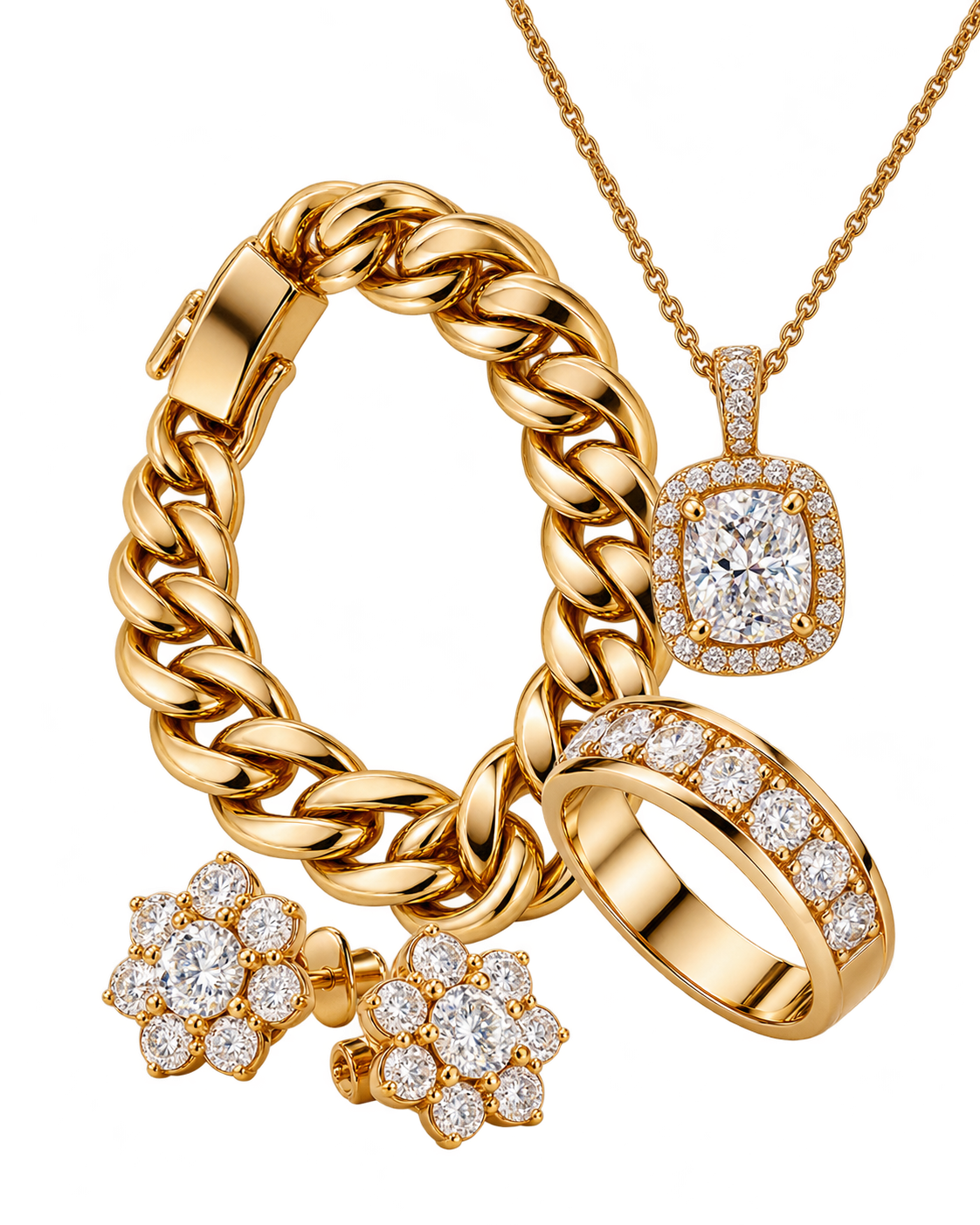
Gold jewelry is usually valued by first determining how much actual gold the piece contains: its metal weight, multiplied by its gold purity, measured against the current gold market price. That produces an approximate melt value.
But melt value is not automatically the same as resale value—or the offer you will receive.
A plain 14K chain may be primarily metal-driven. An authentic Cartier bracelet, an antique 18K brooch, or a gold ring with an important diamond can have value that cannot be explained by gold weight alone.
The key is knowing which type of value applies to the piece you have.
But melt value is not automatically the same as resale value—or the offer you will receive.
A plain 14K chain may be primarily metal-driven. An authentic Cartier bracelet, an antique 18K brooch, or a gold ring with an important diamond can have value that cannot be explained by gold weight alone.
The key is knowing which type of value applies to the piece you have.
GOLD JEWELRY VALUE & RESALE
Spot Price, Melt Value, Resale Value, and Cash Offer Are Different Numbers
Understanding these five layers prevents one of the most common mistakes in gold selling:
Seeing the spot price and assuming that number should equal what your jewelry is worth.
It cannot, because the spot price describes pure gold in a market context, while your jewelry is an individual object with a specific purity, weight, construction, and resale path.
Seeing the spot price and assuming that number should equal what your jewelry is worth.
It cannot, because the spot price describes pure gold in a market context, while your jewelry is an individual object with a specific purity, weight, construction, and resale path.
The Basic Gold Jewelry Valuation Chain
For jewelry whose value is mainly driven by its metal content, the process can be summarized as:
Gold market reference
↓
Determine purity
↓
Determine metal weight
↓
Calculate pure gold content
↓
Estimate melt value
↓
Account for the actual item and selling model
↓
Determine the purchase offer
The first four steps are largely mathematical.
The later steps require judgment.
↓
Determine purity
↓
Determine metal weight
↓
Calculate pure gold content
↓
Estimate melt value
↓
Account for the actual item and selling model
↓
Determine the purchase offer
The first four steps are largely mathematical.
The later steps require judgment.
1. Start With the Gold Market Price
Gold trades internationally.
Prices are commonly quoted in U.S. dollars per troy ounce, and live market prices can change during the trading day.
There is not just one type of gold-market reference.
The World Gold Council distinguishes live spot pricing from benchmark prices, while the LBMA Gold Price is an internationally recognized benchmark set twice each business day through an independently administered auction.
Prices are commonly quoted in U.S. dollars per troy ounce, and live market prices can change during the trading day.
There is not just one type of gold-market reference.
The World Gold Council distinguishes live spot pricing from benchmark prices, while the LBMA Gold Price is an internationally recognized benchmark set twice each business day through an independently administered auction.
Spot Price Is a Reference, Not a Jewelry Offer
If a market screen shows a gold price per troy ounce, that number relates to high-purity gold.
Your bracelet may be:
and it may also contain:
So the market price cannot simply be multiplied by the total weight of the finished piece.
The first job is to determine how much of that item is actually gold.
For live-market context, the Luxe Brokers Gold Price in Los Angeles guide explains the difference between a market reference and an item-specific offer. The existing page already ranks strongly for local gold-price queries and should remain the site's main resource for current price intent.
Your bracelet may be:
- 10K;
- 14K;
- 18K;
- 22K;
and it may also contain:
- alloy metals;
- gemstones;
- clasps or non-gold components.
So the market price cannot simply be multiplied by the total weight of the finished piece.
The first job is to determine how much of that item is actually gold.
For live-market context, the Luxe Brokers Gold Price in Los Angeles guide explains the difference between a market reference and an item-specific offer. The existing page already ranks strongly for local gold-price queries and should remain the site's main resource for current price intent.
2. Determine Gold Purity
Gold used in jewelry is normally alloyed with other metals.
Karat tells you what proportion of the alloy is gold on a 24-part scale.
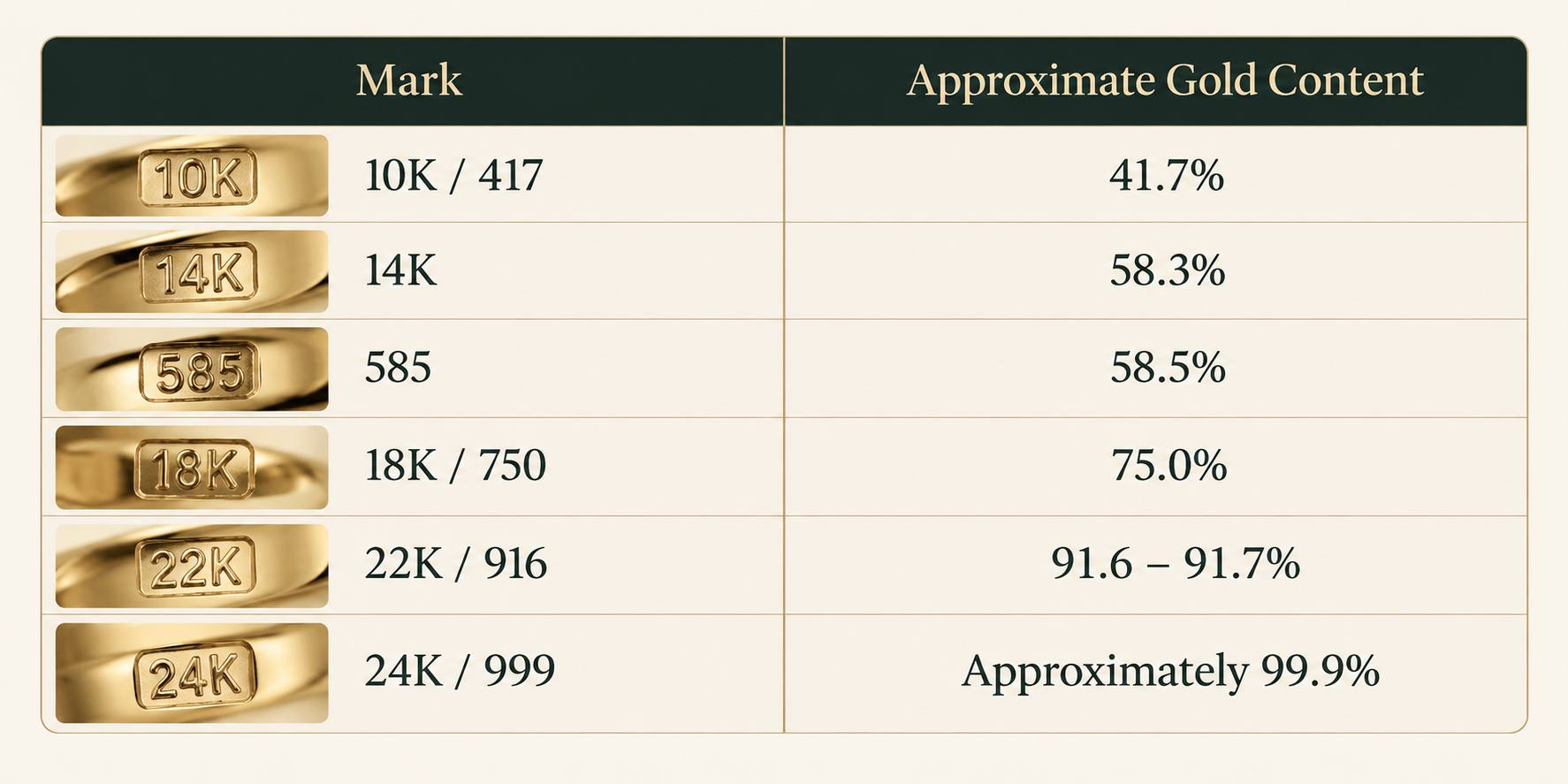
Common U.S. jewelry purities include:
Karat tells you what proportion of the alloy is gold on a 24-part scale.
Common U.S. jewelry purities include:
World Gold Council references common fineness standards including .417, .585, .750, and .999.
Why 585 and 750 Matter
You may not see 14K or 18K stamped on the jewelry.
Instead, you may see:
585
or:
750
These are fineness markings.
585 means approximately 585 parts gold per 1,000.
750 means 750 parts gold per 1,000, or 75% gold.
The existing Luxe Brokers Gold Karat Guide should remain the primary internal resource for detailed purity, karat, and hallmark education.
Instead, you may see:
585
or:
750
These are fineness markings.
585 means approximately 585 parts gold per 1,000.
750 means 750 parts gold per 1,000, or 75% gold.
The existing Luxe Brokers Gold Karat Guide should remain the primary internal resource for detailed purity, karat, and hallmark education.
A Hallmark Is Helpful, but Buyers May Still Test the Piece
A stamp is useful evidence.
It is not always sufficient on its own.
Marks can be:
A professional gold buyer may therefore verify purity rather than relying exclusively on the visible stamp.
It is not always sufficient on its own.
Marks can be:
- worn;
- difficult to read;
- altered during repair;
- incorrect;
- applied to plated or filled objects in a misleading context;
- present on only one component of a mixed-metal piece.
A professional gold buyer may therefore verify purity rather than relying exclusively on the visible stamp.
3. Determine the Actual Metal Weight
After purity, weight is the next major input.
Gold buyers normally work in grams for jewelry, while gold market references are often quoted per troy ounce.
But the important number is not always the total scale weight of the entire finished item.
Gold buyers normally work in grams for jewelry, while gold market references are often quoted per troy ounce.
But the important number is not always the total scale weight of the entire finished item.
A Plain Gold Chain
If a plain 14K chain contains no meaningful non-gold components, the scale weight is a useful starting point.
If it weighs 20 grams:
20 g × 58.3% ≈ 11.7 g of pure gold content
That does not mean the jewelry contains 11.7 grams of visible “pure gold.” It means the alloy contains approximately that quantity of gold by weight.
If it weighs 20 grams:
20 g × 58.3% ≈ 11.7 g of pure gold content
That does not mean the jewelry contains 11.7 grams of visible “pure gold.” It means the alloy contains approximately that quantity of gold by weight.
A Diamond Ring Is Different
Imagine a ring weighs 10 grams on a scale.
The 10 grams may include:
Using the full 10 grams as gold weight would overstate the amount of metal.
A buyer therefore needs to consider how much of the measured weight actually belongs to the gold portion of the item.
The 10 grams may include:
- gold alloy;
- center diamond;
- side stones;
- non-gold components.
Using the full 10 grams as gold weight would overstate the amount of metal.
A buyer therefore needs to consider how much of the measured weight actually belongs to the gold portion of the item.
Do Not Remove Stones Yourself
If your jewelry contains diamonds or gemstones, do not dismantle it simply to calculate gold weight.
The complete piece may be worth more intact, and unnecessary removal can create damage.
The existing Luxe Brokers Gold Karat Guide likewise recommends keeping stone-set jewelry intact until it has been evaluated.
The complete piece may be worth more intact, and unnecessary removal can create damage.
The existing Luxe Brokers Gold Karat Guide likewise recommends keeping stone-set jewelry intact until it has been evaluated.
4. Calculate Pure Gold Content
The basic calculation is:
Metal weight × purity = approximate pure gold content
For a simple 20-gram 18K bracelet:
20 g × 0.75 = 15 g fine-gold content
For a simple 20-gram nominal 14K bracelet:
20 g × approximately 0.583 = approximately 11.7 g fine-gold content
This already explains why two bracelets with exactly the same physical weight can have different raw-metal values.
The 18K piece contains a greater proportion of gold.
Metal weight × purity = approximate pure gold content
For a simple 20-gram 18K bracelet:
20 g × 0.75 = 15 g fine-gold content
For a simple 20-gram nominal 14K bracelet:
20 g × approximately 0.583 = approximately 11.7 g fine-gold content
This already explains why two bracelets with exactly the same physical weight can have different raw-metal values.
The 18K piece contains a greater proportion of gold.
5. Calculate Approximate Melt Value
Once the approximate fine-gold content is known, it can be compared with the current pure-gold market reference.
A simplified formula is:
Pure gold content in grams × current pure-gold reference price per gram = approximate melt value
If you start with a per-troy-ounce price:
Market price per troy ounce ÷ 31.1035 = approximate price per gram of pure gold
Then:
Metal weight × purity × pure-gold price per gram = theoretical melt value
A simplified formula is:
Pure gold content in grams × current pure-gold reference price per gram = approximate melt value
If you start with a per-troy-ounce price:
Market price per troy ounce ÷ 31.1035 = approximate price per gram of pure gold
Then:
Metal weight × purity × pure-gold price per gram = theoretical melt value
Example Without Using a Temporary Gold Price
Take an all-metal 18K bracelet weighing 20 grams.
Step 1
20 g × 0.75 = 15 g of fine gold
Step 2
Take whatever the current pure-gold market reference is per gram.
Step 3
15 g × current pure-gold price per gram = approximate raw metal value
No fixed dollar figure should be printed in an evergreen article because the gold market changes.
Step 1
20 g × 0.75 = 15 g of fine gold
Step 2
Take whatever the current pure-gold market reference is per gram.
Step 3
15 g × current pure-gold price per gram = approximate raw metal value
No fixed dollar figure should be printed in an evergreen article because the gold market changes.
Melt Value Is a Reference, Not a Guaranteed Payment
This distinction is essential.
Melt value estimates the market value of the contained gold.
It does not automatically account for:
So melt value should be viewed as an analytical benchmark, not a guaranteed cash offer.
Melt value estimates the market value of the contained gold.
It does not automatically account for:
- verification;
- refining;
- handling;
- market movement;
- transaction costs;
- buyer overhead;
- inventory or settlement risk;
- the buyer's business model.
So melt value should be viewed as an analytical benchmark, not a guaranteed cash offer.
Spot Price vs. Melt Value
This is the distinction many sellers are really trying to understand.
Spot Price
Spot tells you roughly:
What is pure gold worth in the current market?
What is pure gold worth in the current market?
Melt Value
Melt value tells you:
What is the approximate gold content inside this particular piece worth at that market reference?
A 14K bracelet does not contain one gram of pure gold for every gram it weighs.
An 18K bracelet does not contain one troy ounce of pure gold for every troy ounce of jewelry.
Purity is what connects the two numbers.
What is the approximate gold content inside this particular piece worth at that market reference?
A 14K bracelet does not contain one gram of pure gold for every gram it weighs.
An 18K bracelet does not contain one troy ounce of pure gold for every troy ounce of jewelry.
Purity is what connects the two numbers.
Example
If two plain bracelets each weigh 20 grams:
14K bracelet
20 g × approximately 58.3% gold
18K bracelet
20 g × 75% gold
The market reference is the same.
The amount of fine gold is different.
Therefore their melt values are different.
14K bracelet
20 g × approximately 58.3% gold
18K bracelet
20 g × 75% gold
The market reference is the same.
The amount of fine gold is different.
Therefore their melt values are different.
What Is 14K Gold Jewelry Worth When You Sell It?
For an ordinary 14K piece whose value is primarily material-based, buyers begin with:
Nominal 14K gold contains approximately 58.3% pure gold by the 14/24 karat calculation. A 585 fineness mark indicates 58.5%.
But 14K resale value is not one universal per-gram figure.
Why?
Because one 14K item might be:
Only the first two may be primarily metal-driven.
- verified purity;
- metal weight;
- current gold market conditions.
Nominal 14K gold contains approximately 58.3% pure gold by the 14/24 karat calculation. A 585 fineness mark indicates 58.5%.
But 14K resale value is not one universal per-gram figure.
Why?
Because one 14K item might be:
- a broken generic chain;
- an ordinary wedding band;
- a diamond ring;
- a vintage brooch;
- a signed designer bracelet.
Only the first two may be primarily metal-driven.
What Is 18K Gold Jewelry Worth When You Sell It?
18K contains 75% gold.
That gives it a higher raw gold-content baseline than the same metal weight of 14K jewelry.
But the same rule applies:
purity determines metal content, not complete resale value.
An unbranded 18K ring and an authentic signed 18K Cartier ring may contain similar amounts of gold while belonging to entirely different resale markets.
That is why the answer to:
“How much is 18K gold worth?”
and:
“How much is this 18K bracelet worth?”
may be very different.
That gives it a higher raw gold-content baseline than the same metal weight of 14K jewelry.
But the same rule applies:
purity determines metal content, not complete resale value.
An unbranded 18K ring and an authentic signed 18K Cartier ring may contain similar amounts of gold while belonging to entirely different resale markets.
That is why the answer to:
“How much is 18K gold worth?”
and:
“How much is this 18K bracelet worth?”
may be very different.
Why the Cash Offer May Differ From Melt Value
For ordinary metal-led jewelry, a buyer does not simply convert your item into pure gold instantaneously and without cost.
Depending on the buying model, the business may need to account for:
Depending on the buying model, the business may need to account for:
- purity testing;
- precise weighing;
- sorting;
- settlement risk from changing market prices;
- refining or downstream sale;
- shipping or handling;
- operating expenses;
- business margin.
This Does Not Mean Every Jewelry Offer Must Be Below Melt
That is an equally important nuance.
If the jewelry has a secondary market as a complete finished object, its valuation may follow a different path entirely.
A designer piece can be worth more than its contained metal.
An important gemstone may contribute substantial standalone value.
An antique piece may attract buyers because of its maker, design, period, rarity, or provenance.
So the correct question is not:
“What percentage of melt should everyone pay?”
It is:
“Is this item actually being valued as scrap gold—or should it be valued as jewelry?”
If the jewelry has a secondary market as a complete finished object, its valuation may follow a different path entirely.
A designer piece can be worth more than its contained metal.
An important gemstone may contribute substantial standalone value.
An antique piece may attract buyers because of its maker, design, period, rarity, or provenance.
So the correct question is not:
“What percentage of melt should everyone pay?”
It is:
“Is this item actually being valued as scrap gold—or should it be valued as jewelry?”
Two Different Valuation Paths
Route A — Metal-Led Jewelry
Examples:
Here the gold calculation usually carries most of the economic weight.
- broken generic chain;
- single unbranded earring;
- damaged plain band;
- mismatched ordinary jewelry;
- scrap lot.
Here the gold calculation usually carries most of the economic weight.
Route B — Resale-Led Jewelry
Examples:
Here, gold content may still provide a useful material baseline, but it is not necessarily the correct basis for the final valuation.
Luxe Brokers' existing gold-jewelry page already follows this principle: purity and weight establish a baseline, while designer demand, craftsmanship, stones, and collectability can move a piece above a scrap-only valuation.
- Cartier bracelet;
- Tiffany & Co. gold jewelry;
- Van Cleef & Arpels piece;
- collectible vintage jewel;
- important estate jewelry;
- diamond-set luxury jewelry.
Here, gold content may still provide a useful material baseline, but it is not necessarily the correct basis for the final valuation.
Luxe Brokers' existing gold-jewelry page already follows this principle: purity and weight establish a baseline, while designer demand, craftsmanship, stones, and collectability can move a piece above a scrap-only valuation.
Why a Cartier Bracelet Should Not Automatically Be Valued as Scrap Gold
Consider an authentic 18K Cartier bracelet.
A buyer can calculate its metal content:
weight × 75% × gold market reference
That tells us something useful.
It does not tell us everything.
The buyer should also determine:
Cartier jewelry has a recognizable secondary market independent of raw gold value.
A buyer interested only in refining the bracelet may calculate one number.
A specialist capable of reselling the complete authenticated bracelet may calculate value using an entirely different market.
Revere and Diamond Banc both emphasize the same general distinction for signed jewelry: a brand or collectible market can create value beyond the precious-metal content.
A buyer can calculate its metal content:
weight × 75% × gold market reference
That tells us something useful.
It does not tell us everything.
The buyer should also determine:
- whether the piece is authentic;
- exact Cartier collection;
- model or variation;
- size;
- condition;
- completeness;
- original box and paperwork;
- diamond configuration where applicable;
- current demand for that specific piece.
Cartier jewelry has a recognizable secondary market independent of raw gold value.
A buyer interested only in refining the bracelet may calculate one number.
A specialist capable of reselling the complete authenticated bracelet may calculate value using an entirely different market.
Revere and Diamond Banc both emphasize the same general distinction for signed jewelry: a brand or collectible market can create value beyond the precious-metal content.
Do Not Melt or Dismantle a Potentially Designer Piece First
Once a collectible piece has been destroyed for metal recovery, its finished-jewelry value cannot be recreated simply by putting the gold back together.
Identification should come first.
Identification should come first.
How Diamonds and Gemstones Affect Gold Jewelry Value
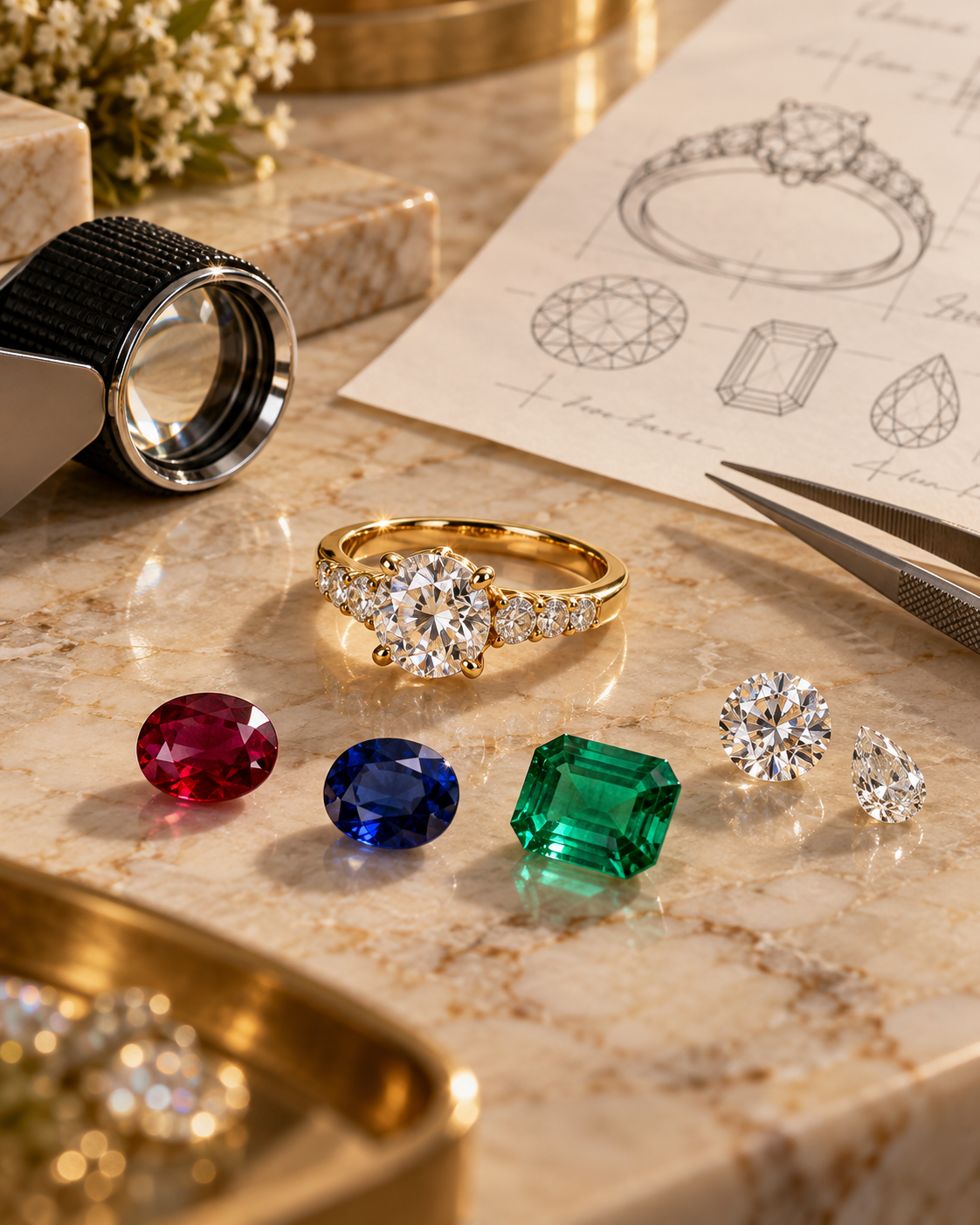
A stone-set gold item requires more than one calculation.
For example, a diamond ring may contain value from:
For example, a diamond ring may contain value from:
- gold
- center diamond
- side diamonds
- setting
- designer or estate premium
Gemstone Weight Is Not Gold Weight
As explained earlier, a scale weighs the entire object.
A buyer calculating gold content has to account for non-gold materials.
A buyer calculating gold content has to account for non-gold materials.
Important Stones Should Be Evaluated Separately
A meaningful natural diamond, ruby, sapphire, emerald, or another valuable gemstone should not simply disappear into a scrap-gold calculation.
Its quality and marketability need their own assessment.
The result may be that:
metal value is the secondary component, not the primary one.
Its quality and marketability need their own assessment.
The result may be that:
metal value is the secondary component, not the primary one.
Vintage and Estate Gold Jewelry
Age alone does not automatically create a premium.
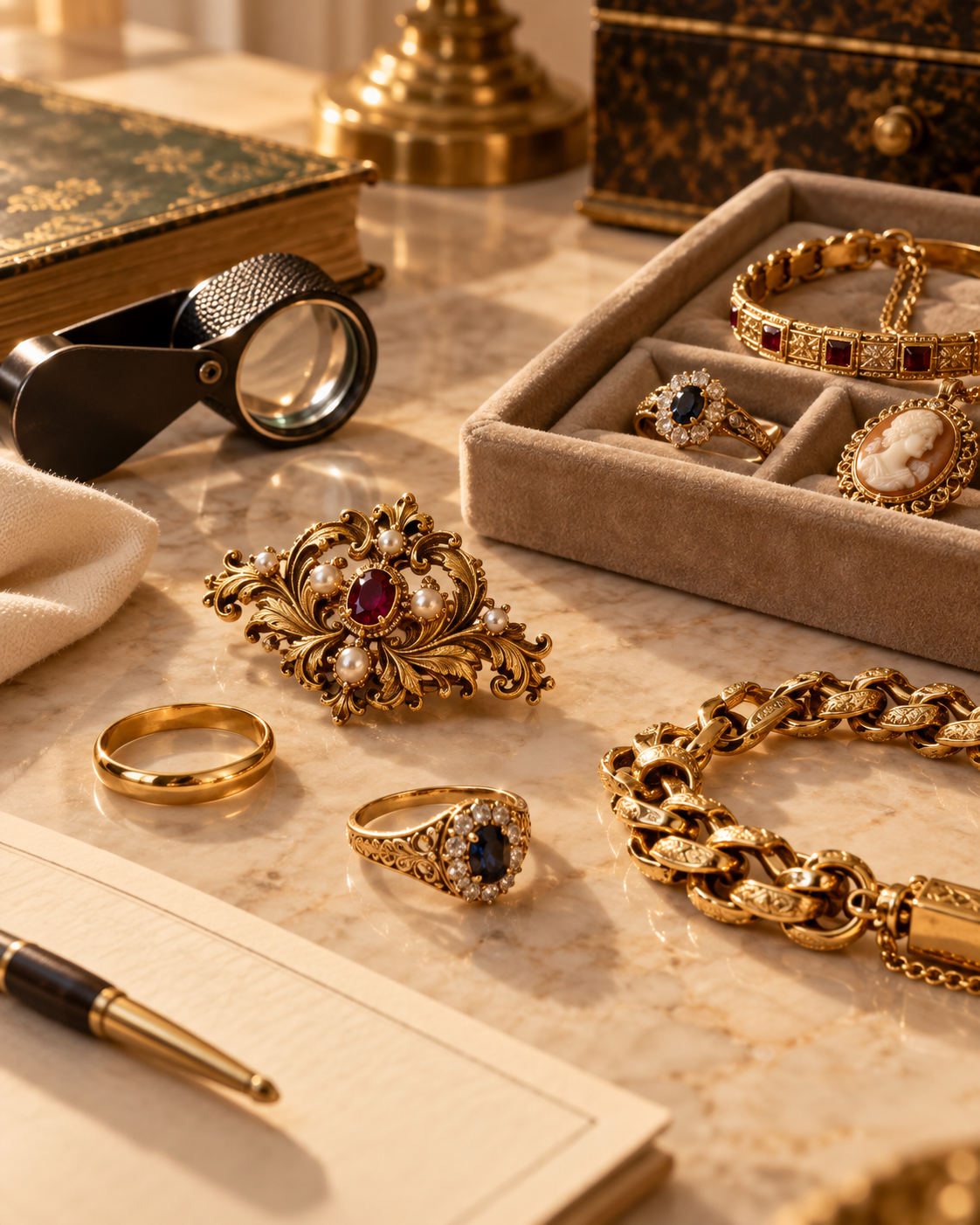
But older gold jewelry may be worth more than melt when it has:
An important signed vintage brooch may not be.
This is another reason every estate collection should be sorted before anyone treats the whole lot as scrap.
But older gold jewelry may be worth more than melt when it has:
- a known maker;
- period craftsmanship;
- desirable design;
- rarity;
- provenance;
- important gemstones;
- collector demand.
An important signed vintage brooch may not be.
This is another reason every estate collection should be sorted before anyone treats the whole lot as scrap.
What About Broken Gold Jewelry?
Broken gold is not worthless.
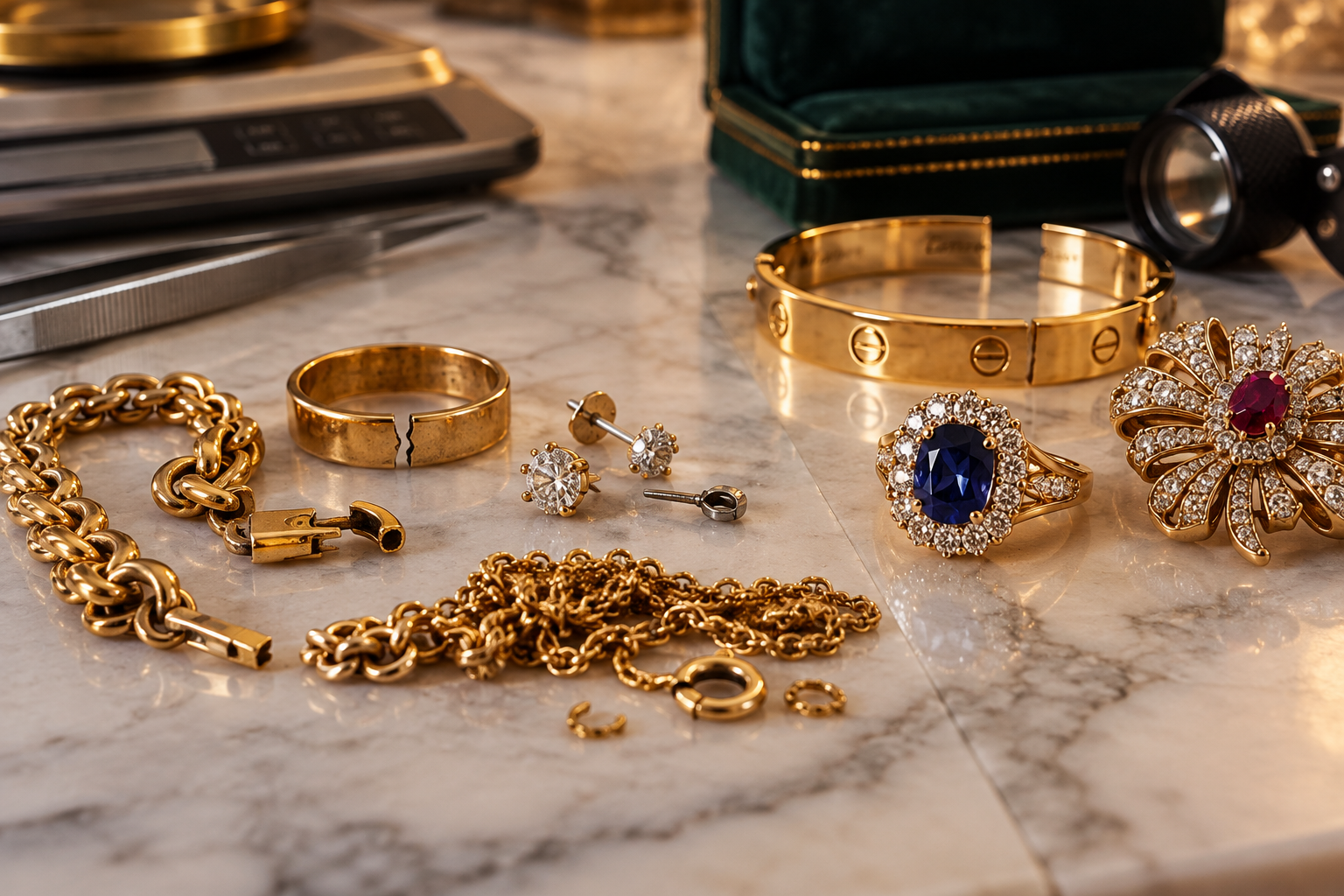
For material-led pieces, a:
If the primary value is recoverable metal, the gold is still present.
For material-led pieces, a:
- broken clasp;
- snapped chain;
- missing matching earring;
- bent ring;
If the primary value is recoverable metal, the gold is still present.
But Damage Matters More for Resale-Led Jewelry
A broken Cartier bracelet, antique brooch, or gemstone-set piece is different.
The buyer may need to consider:
So:
condition matters less when the item is being valued mainly for metal
and:
condition matters more when the item is being sold as finished jewelry.
The buyer may need to consider:
- repair cost;
- completeness;
- replaced components;
- resale presentation;
- whether restoration is economically worthwhile.
So:
condition matters less when the item is being valued mainly for metal
and:
condition matters more when the item is being sold as finished jewelry.
How Gold Buyers Verify Purity
A professional buyer may use several indicators or testing methods depending on the piece.
The process begins with visible information:
Common marks include:
Testing may still be appropriate when the mark is:
The seller does not need to perform aggressive home testing before requesting an evaluation.
Acid, filing, cutting, or other destructive testing can damage an item that might be worth more intact.
The process begins with visible information:
- karat stamps;
- fineness marks;
- maker marks;
- construction;
- item type.
Common marks include:
- 10K
- 14K
- 585
- 18K
- 750
- 22K
- 916
Testing may still be appropriate when the mark is:
- missing;
- unclear;
- inconsistent;
- questionable;
- on an older item;
- part of a mixed collection.
The seller does not need to perform aggressive home testing before requesting an evaluation.
Acid, filing, cutting, or other destructive testing can damage an item that might be worth more intact.
How Gold Buyers Calculate an Offer
A transparent evaluation should make it possible to understand the logic behind the number.
For ordinary gold jewelry, the process may look like:
For ordinary gold jewelry, the process may look like:
Step 1 — Identify the Item
Is it:
- ordinary gold jewelry;
- designer;
- estate;
- stone-set;
- scrap?
Step 2 — Verify Purity
Determine whether the piece is:
- 10K;
- 14K;
- 18K;
- another purity.
Step 3 — Determine Relevant Weight
Establish the metal weight or a defensible approximation where stones or non-gold components are present.
Step 4 — Establish Pure Gold Content
Weight × purity
Step 5 — Reference Current Gold Market Conditions
Use the current market price—not an old price from an appraisal or receipt.
Step 6 — Determine the Correct Valuation Path
Should the item be treated as:
metal
or:
finished jewelry?
metal
or:
finished jewelry?
Step 7 — Make the Actual Purchase Offer
The final offer reflects the specific buyer's transaction model and what they are prepared to pay for the item now.
This framework is more useful than a generic calculator percentage because it works for both a broken 14K chain and a signed 18K luxury bracelet.
This framework is more useful than a generic calculator percentage because it works for both a broken 14K chain and a signed 18K luxury bracelet.
How to Estimate Gold Jewelry Value at Home
You can calculate a useful rough metal baseline before visiting a buyer.
You need:
You need:
- a readable purity mark;
- an approximate weight;
- a current reputable gold market reference.
Step 1 — Find the Purity Mark
Look:
- inside a ring;
- near a necklace clasp;
- on the bracelet clasp;
- on the back of a pendant;
- on an earring post.
Step 2 — Weigh the Piece
Use grams.
A household scale can provide a rough figure, although professional jewelry scales are more precise.
A household scale can provide a rough figure, although professional jewelry scales are more precise.
Step 3 — Convert Purity
Example:
18K = 0.75
14K ≈ 0.583
18K = 0.75
14K ≈ 0.583
Step 4 — Calculate Pure Gold Content
Example:
20 g of 18K:
20 × 0.75 = 15 g
20 g of 18K:
20 × 0.75 = 15 g
Step 5 — Apply the Current Gold Reference
Multiply fine-gold content by the current pure-gold reference per gram.
Step 6 — Stop Before Calling It a “Selling Price”
The result is a raw-material estimate.
Before treating it as the value of the actual jewelry, ask:
Before treating it as the value of the actual jewelry, ask:
- Is it signed?
- Is it designer?
- Are there significant stones?
- Is it antique?
- Is the design collectible?
- Does it have a secondary market intact?
Why Original Retail Price Does Not Determine Gold Resale Value
The original jewelry price may have included:
Those components do not all transfer into resale.
For ordinary generic jewelry, the secondary-market value may therefore be much more closely tied to materials than to the original receipt.
For designer jewelry, some brand and design premium may remain—but the amount depends on the exact piece and current demand.
This is why:
retail price
insurance appraisal
melt value
and:
cash offer
can all be valid numbers for the same bracelet while answering completely different questions.
For a deeper explanation of those definitions, see Jewelry Appraisal vs. Resale Value.
- design;
- manufacturing;
- brand premium;
- retail overhead;
- marketing;
- gemstones;
- store margin;
- taxes.
Those components do not all transfer into resale.
For ordinary generic jewelry, the secondary-market value may therefore be much more closely tied to materials than to the original receipt.
For designer jewelry, some brand and design premium may remain—but the amount depends on the exact piece and current demand.
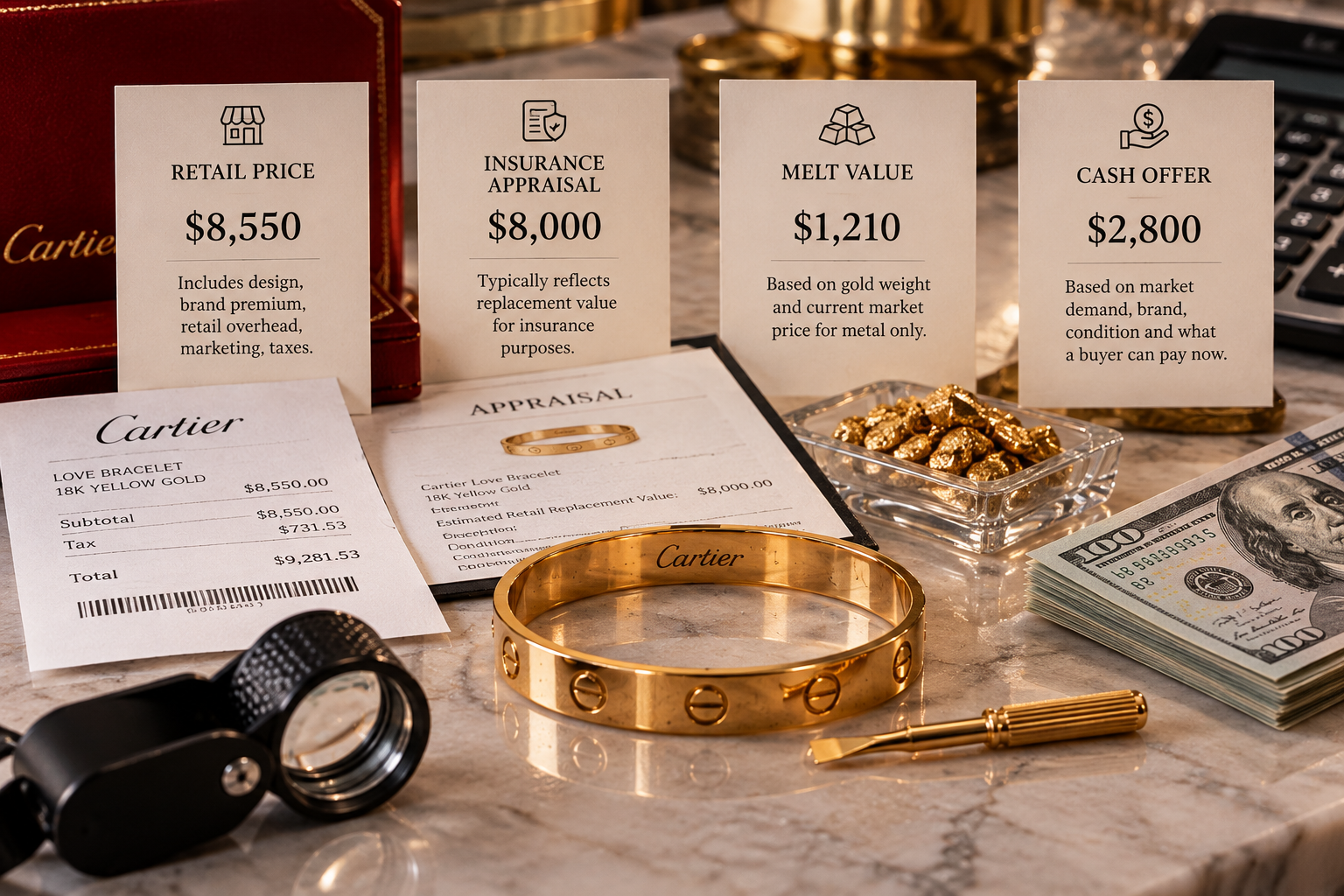
This is why:
retail price
insurance appraisal
melt value
and:
cash offer
can all be valid numbers for the same bracelet while answering completely different questions.
For a deeper explanation of those definitions, see Jewelry Appraisal vs. Resale Value.
Is Melt Value the Same as Resale Value?
No.
Melt Value
Answers:
What is the recoverable gold content approximately worth?
What is the recoverable gold content approximately worth?
Resale Value
Answers:
What is the complete item worth in the relevant secondary market?
For a generic broken gold chain, those values may be relatively closely connected.
For a designer bracelet, they may be very different.
What is the complete item worth in the relevant secondary market?
For a generic broken gold chain, those values may be relatively closely connected.
For a designer bracelet, they may be very different.
Resale Value Can Also Be Limited
Being finished jewelry does not automatically create a premium.
A generic design with little pre-owned demand may still be worth primarily for its metal.
This is why a buyer has to determine whether there is a functioning market for the piece as jewelry, not merely whether it is wearable.
A generic design with little pre-owned demand may still be worth primarily for its metal.
This is why a buyer has to determine whether there is a functioning market for the piece as jewelry, not merely whether it is wearable.
What Should You Ask a Gold Buyer?
Before accepting an offer, ask enough questions to understand the basis of the valuation.
What Purity Did You Determine?
If you believed the item was 18K and it is being priced as 14K, ask why.
What Weight Is Being Used?
For stone-set pieces, ask whether the stated weight includes non-gold components.
What Gold Price Reference Is Being Used?
The buyer should be able to explain the market context.
Is This Being Valued as Scrap or Finished Jewelry?
This may be the most important question.
Are the Stones Being Valued?
Do not assume diamonds or gemstones are included just because they are physically attached.
Does the Brand or Maker Affect the Offer?
Particularly important for signed luxury pieces.
Are There Seller Fees?
Compare the amount you actually receive.
What to Bring to a Gold Jewelry Evaluation
Documentation is not required for every gold piece, but useful information can help.
Bring:
For multiple items, keep obvious categories together if possible:
designer jewelry
ordinary gold jewelry
diamond/gemstone jewelry
broken or scrap items
This reduces the chance that a mixed collection is treated as a single undifferentiated metal lot.
Bring:
- the jewelry itself;
- matching pieces or sets;
- receipts;
- old appraisals;
- designer boxes or pouches;
- authenticity-related documents;
- diamond or gemstone reports;
- repair records;
- any removed original components.
For multiple items, keep obvious categories together if possible:
designer jewelry
ordinary gold jewelry
diamond/gemstone jewelry
broken or scrap items
This reduces the chance that a mixed collection is treated as a single undifferentiated metal lot.
How to Prepare Gold Jewelry Before Selling
You do not need to:
Keep the piece intact until you know what it is.
This is especially important if you find:
A potentially valuable complete piece should be evaluated before it is converted into scrap.
- polish aggressively;
- remove stones;
- cut the item;
- perform acid testing yourself;
- melt anything;
- repair every broken clasp.
Keep the piece intact until you know what it is.
This is especially important if you find:
- Cartier;
- Tiffany & Co.;
- Van Cleef & Arpels;
- Bulgari;
- Graff;
- unusual maker marks;
- significant gemstones;
- antique construction.
A potentially valuable complete piece should be evaluated before it is converted into scrap.
How to Compare Gold Offers Properly
Do not compare every offer with only one metric.
For a plain scrap-oriented piece, compare:
For designer or estate jewelry, also compare:
A buyer offering a larger percentage of melt is not automatically offering more for a Cartier bracelet if another buyer recognizes a legitimate secondary-market premium.
The correct comparison depends on what is actually being sold.
For a plain scrap-oriented piece, compare:
- tested purity;
- weight;
- market price used;
- net offer.
For designer or estate jewelry, also compare:
- item identification;
- gemstone valuation;
- brand recognition;
- market demand;
- whether the offer values the complete piece.
A buyer offering a larger percentage of melt is not automatically offering more for a Cartier bracelet if another buyer recognizes a legitimate secondary-market premium.
The correct comparison depends on what is actually being sold.
The Bottom Line
Gold jewelry valuation begins with mathematics, but it does not always end there.
For metal-led jewelry:
Spot / market price
↓
Purity
↓
Metal weight
↓
Pure gold content
↓
Melt value
↓
Buyer economics
↓
Cash offer
But before applying that formula blindly, determine whether the item has value as a complete piece.
An authentic designer bracelet, estate jewel, or gemstone-set piece may follow a different path:
Materials
=
Finished-jewelry resale value
That is why the most useful question is not simply:
“What is today's gold price?”
It is:
“Is my jewelry being valued for its gold—or for the complete piece?”
For purity and hallmark questions, start with the Gold Karat Guide. For current gold-market context, use the Gold Price in Los Angeles guide. When you are ready for an item-specific evaluation, the next step is a gold jewelry evaluation based on the actual piece you own.
For metal-led jewelry:
Spot / market price
↓
Purity
↓
Metal weight
↓
Pure gold content
↓
Melt value
↓
Buyer economics
↓
Cash offer
But before applying that formula blindly, determine whether the item has value as a complete piece.
An authentic designer bracelet, estate jewel, or gemstone-set piece may follow a different path:
Materials
=
Finished-jewelry resale value
That is why the most useful question is not simply:
“What is today's gold price?”
It is:
“Is my jewelry being valued for its gold—or for the complete piece?”
For purity and hallmark questions, start with the Gold Karat Guide. For current gold-market context, use the Gold Price in Los Angeles guide. When you are ready for an item-specific evaluation, the next step is a gold jewelry evaluation based on the actual piece you own.
Want to Know Whether Your Gold Jewelry Is Worth More Than Melt Value?
A purity stamp and scale can help estimate the metal value, but they cannot tell you whether a designer name, gemstones, craftsmanship, age, or secondary-market demand changes the way the complete piece should be evaluated.
Send clear photos of your jewelry, including any hallmarks, maker signatures, diamonds or gemstones, and any box, receipt, appraisal, or paperwork you still have. Luxe Brokers can review the item and determine whether its value is primarily metal-based or whether it should be evaluated as finished jewelry.
Send clear photos of your jewelry, including any hallmarks, maker signatures, diamonds or gemstones, and any box, receipt, appraisal, or paperwork you still have. Luxe Brokers can review the item and determine whether its value is primarily metal-based or whether it should be evaluated as finished jewelry.
Frequently Asked Questions
For ordinary metal-led jewelry, buyers usually start with the item's gold purity, relevant metal weight, and current gold market price. Those inputs produce an approximate melt value. Designer brand, gemstones, craftsmanship, age, condition, and collector demand may add value beyond the metal.
Spot price is a market reference for pure gold. Melt value applies that reference to the actual fine-gold content in a specific item after accounting for its purity and relevant metal weight.
Not necessarily. Melt value is a raw-metal reference, not a guaranteed purchase offer. The buyer's transaction model, verification and processing costs, market conditions, and whether the item has resale value as finished jewelry can all affect the final offer.
Nominal 14K gold is approximately 58.3% gold by the 14/24 karat calculation. Jewelry marked 585 indicates 58.5% fineness.
18K gold is 75% pure gold and may also be marked 750.
For the same relevant metal weight and market conditions, 18K has a higher raw gold-content value because it contains a greater proportion of gold. The complete jewelry piece can still differ in value because of brand, stones, design, condition, or demand.
It can be. Authentic signed jewelry from a recognized maker may have a secondary market based on brand, collection, design, condition, and demand. The effect is item-specific and should not be assumed from the gold content alone.
Yes. Broken ordinary gold jewelry can retain material value because the gold remains present. Damage can matter more if the item has designer, gemstone, antique, or collectible value as a complete piece.
No. Have the complete item evaluated first. Stones may have standalone value, and removing them can damage the jewelry or destroy value associated with the complete piece.