


Daily 10 am to 7 pm
Daily 10 am to 7 pm

What Determines a Diamond's Resale Value? 9 Factors Buyers Evaluate
A diamond's resale value depends on more than the 4Cs. Buyers start with carat weight, cut, color, and clarity, then consider shape, grading documentation, whether the diamond is natural or laboratory-grown, fluorescence, physical condition, and current market demand. If the stone is mounted, the setting and designer can matter too.
No single grade determines the selling price. Resale value reflects how the complete quality profile of a specific diamond fits the market at the time it is sold.
No single grade determines the selling price. Resale value reflects how the complete quality profile of a specific diamond fits the market at the time it is sold.
DIAMOND VALUE & RESALE
The 9 Factors That Affect Diamond Resale Value
A buyer evaluates the complete quality and market profile of the diamond rather than relying on one grade alone.
1. Carat Weight
Actual weight of the diamond
Larger stones can enter different rarity and demand categories.
2. Cut Quality
Proportions, light performance, polish, symmetry
Strong visual performance generally improves marketability.
3. Color
D-to-Z grade or fancy-color characteristics
Buyers price the exact color category rather than simply “white” or “yellow.”
4. Clarity
Type, size, number, location, and visibility of inclusions
Two diamonds with the same clarity grade can still present differently.
5. Shape & Demand
Round, oval, emerald, cushion, pear, etc.
Buyer demand and liquidity vary by shape and change over time.
6. Grading Report
GIA or other laboratory documentation
Makes quality easier to verify and compare.
7. Natural vs. Lab-Grown
Origin of the diamond
The two categories trade in different markets.
8. Fluorescence & Report Details
Fluorescence, proportions, polish, symmetry, treatments
Secondary details can affect appearance and buyer preference.
9. Condition & Jewelry Context
Chips, abrasions, loose vs. mounted, setting, designer
The buyer may be valuing more—or less—than the center stone alone.
The important point is that these factors interact.
A larger diamond is not automatically worth more than every smaller diamond. A top color grade cannot compensate for every cut issue. A grading report improves certainty but does not guarantee an offer. And a diamond with excellent technical characteristics may still trade differently depending on shape and current market demand.
Actual weight of the diamond
Larger stones can enter different rarity and demand categories.
2. Cut Quality
Proportions, light performance, polish, symmetry
Strong visual performance generally improves marketability.
3. Color
D-to-Z grade or fancy-color characteristics
Buyers price the exact color category rather than simply “white” or “yellow.”
4. Clarity
Type, size, number, location, and visibility of inclusions
Two diamonds with the same clarity grade can still present differently.
5. Shape & Demand
Round, oval, emerald, cushion, pear, etc.
Buyer demand and liquidity vary by shape and change over time.
6. Grading Report
GIA or other laboratory documentation
Makes quality easier to verify and compare.
7. Natural vs. Lab-Grown
Origin of the diamond
The two categories trade in different markets.
8. Fluorescence & Report Details
Fluorescence, proportions, polish, symmetry, treatments
Secondary details can affect appearance and buyer preference.
9. Condition & Jewelry Context
Chips, abrasions, loose vs. mounted, setting, designer
The buyer may be valuing more—or less—than the center stone alone.
The important point is that these factors interact.
A larger diamond is not automatically worth more than every smaller diamond. A top color grade cannot compensate for every cut issue. A grading report improves certainty but does not guarantee an offer. And a diamond with excellent technical characteristics may still trade differently depending on shape and current market demand.
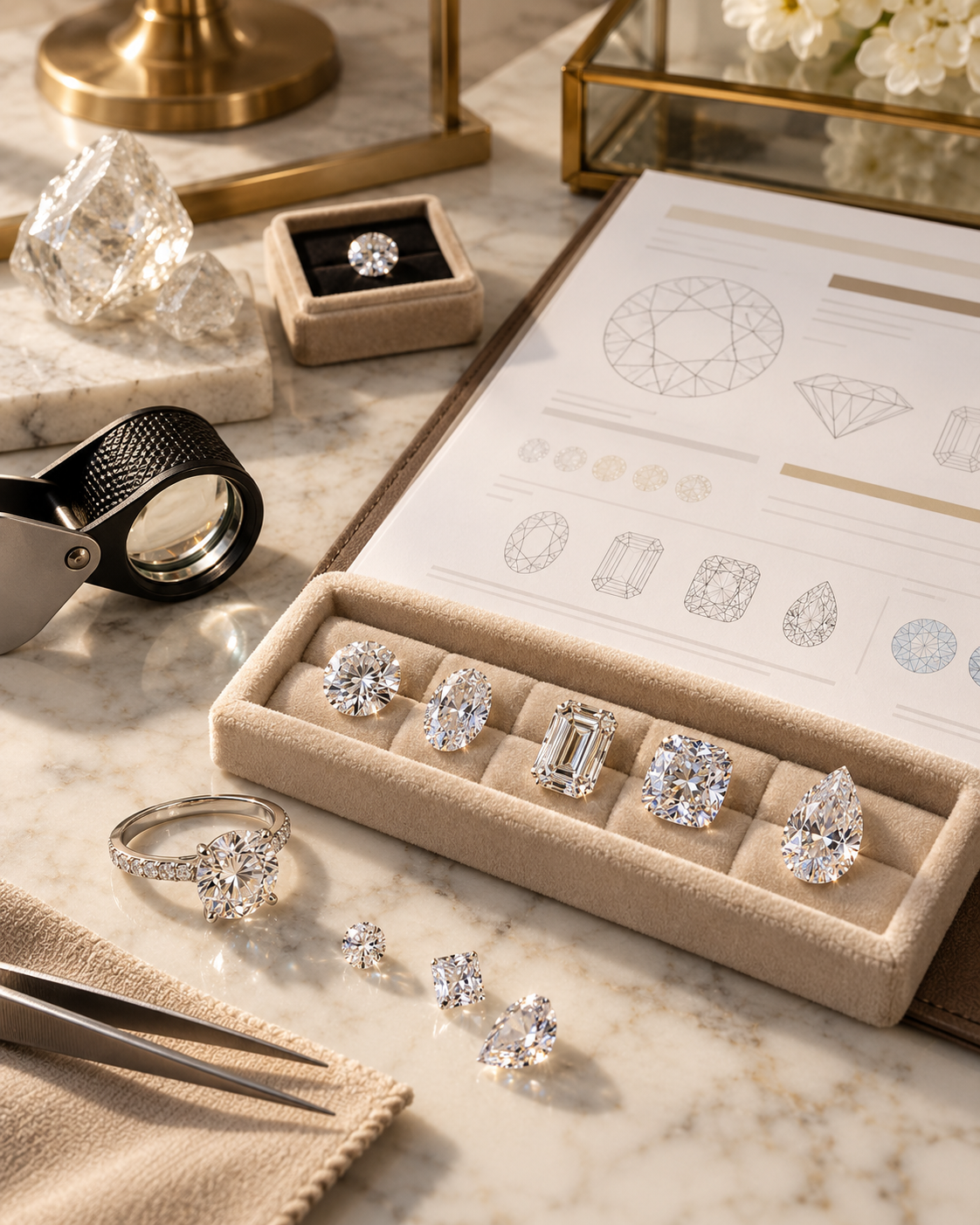
1. Carat Weight: Important, but Not a Price by Itself
Carat measures a diamond's weight, not its visual size.
One carat equals 0.2 grams. Two diamonds with the same carat weight can appear different in size because their proportions and shapes distribute that weight differently.
Carat matters in resale because larger natural diamonds generally become scarcer as weight increases. But buyers do not evaluate carat independently.
A larger stone with weaker cut, noticeable color, lower clarity, damage, or limited market demand can be less attractive than a smaller diamond with a stronger overall profile.
One carat equals 0.2 grams. Two diamonds with the same carat weight can appear different in size because their proportions and shapes distribute that weight differently.
Carat matters in resale because larger natural diamonds generally become scarcer as weight increases. But buyers do not evaluate carat independently.
A larger stone with weaker cut, noticeable color, lower clarity, damage, or limited market demand can be less attractive than a smaller diamond with a stronger overall profile.
This distinction is especially important with rings and diamond jewelry.
A ring described as having several carats total weight may contain:
The market does not automatically value several small diamonds the same way as one significant diamond of the same combined weight.
When evaluating resale value, the center diamond is usually identified separately from the total weight of the smaller stones.
A ring described as having several carats total weight may contain:
- one center diamond;
- numerous small accent diamonds;
- a halo;
- side stones;
- pavé.
The market does not automatically value several small diamonds the same way as one significant diamond of the same combined weight.
When evaluating resale value, the center diamond is usually identified separately from the total weight of the smaller stones.
Diamond pricing is not a simple calculation such as:
carat weight × one universal price per carat
Different combinations of size, color, clarity, cut, shape, origin, and demand trade differently.
That is why using an online price-per-carat figure without matching the rest of the diamond's specifications can produce a misleading estimate.
carat weight × one universal price per carat
Different combinations of size, color, clarity, cut, shape, origin, and demand trade differently.
That is why using an online price-per-carat figure without matching the rest of the diamond's specifications can produce a misleading estimate.
Total Carat Weight Is Not the Same as Center-Stone Weight
Why Small Weight Differences Can Matter
2. Cut Quality: How Well the Diamond Performs
Cut is frequently confused with shape, but they describe different things.
Shape is the outline: round, oval, emerald, pear, cushion, marquise, radiant, and so on.
Cut quality describes how successfully the diamond's facets and proportions interact with light.
A well-proportioned diamond can return light efficiently and show strong brilliance, fire, and scintillation. A poorly proportioned stone can appear dark, dull, or less lively even when its color and clarity grades are strong.
GIA evaluates diamond cut using proportions and observed visual effects as part of its grading methodology.
Shape is the outline: round, oval, emerald, pear, cushion, marquise, radiant, and so on.
Cut quality describes how successfully the diamond's facets and proportions interact with light.
A well-proportioned diamond can return light efficiently and show strong brilliance, fire, and scintillation. A poorly proportioned stone can appear dark, dull, or less lively even when its color and clarity grades are strong.
GIA evaluates diamond cut using proportions and observed visual effects as part of its grading methodology.
Buyers eventually need another buyer for the diamond.
A stone with attractive visual performance is generally easier to present and market than one that looks weak despite impressive numbers elsewhere on the report.
For round brilliant diamonds, a laboratory cut grade provides an important standardized reference.
For many fancy shapes, buyers may rely more heavily on:
This is one reason a grading report should be read as a complete document instead of focusing on only carat, color, and clarity.
A stone with attractive visual performance is generally easier to present and market than one that looks weak despite impressive numbers elsewhere on the report.
For round brilliant diamonds, a laboratory cut grade provides an important standardized reference.
For many fancy shapes, buyers may rely more heavily on:
- proportions;
- symmetry;
- polish;
- outline;
- length-to-width relationship;
- facet pattern;
- bow-tie or other visual effects;
- overall appearance.
This is one reason a grading report should be read as a complete document instead of focusing on only carat, color, and clarity.
Why Cut Matters to Resale Buyers
3. Color: The Grade Has to Be Read in the Correct Category
For traditional colorless-to-light-yellow diamonds, GIA uses the D-to-Z color scale.
A diamond closer to the colorless end of that scale generally occupies a different market category from one with more visible body color.
But that does not mean every diamond becomes more valuable simply by having less color.
A diamond closer to the colorless end of that scale generally occupies a different market category from one with more visible body color.
But that does not mean every diamond becomes more valuable simply by having less color.
Diamonds with sufficiently distinct natural color—such as certain yellow, pink, blue, green, or other hues—are evaluated under a different color framework.
For fancy-color diamonds, qualities such as:
can become central to value.
GIA uses a separate colored-diamond grading framework rather than treating these diamonds as an extension of the standard D-to-Z scale.
For fancy-color diamonds, qualities such as:
- hue;
- tone;
- saturation;
- color origin;
can become central to value.
GIA uses a separate colored-diamond grading framework rather than treating these diamonds as an extension of the standard D-to-Z scale.
Small differences in diamond color can be difficult to judge without controlled lighting and comparison stones.
A photograph taken under warm indoor light, daylight, or a phone flash can make the same diamond appear different.
For an important diamond, professional grading information is much more useful than a visual guess such as “it looks colorless.”
A photograph taken under warm indoor light, daylight, or a phone flash can make the same diamond appear different.
For an important diamond, professional grading information is much more useful than a visual guess such as “it looks colorless.”
Fancy-Color Diamonds Are Different
Why Sellers Should Not Estimate Color From Photos
4. Clarity: The Grade Is Only Part of the Story
Clarity evaluates internal characteristics called inclusions and external characteristics called blemishes.
Professional grading considers more than whether an inclusion exists.
Relevant characteristics can include:
GIA clarity examination is performed under standardized conditions and 10× magnification.
Professional grading considers more than whether an inclusion exists.
Relevant characteristics can include:
- type;
- size;
- number;
- location;
- visibility;
- contrast;
- how they affect the diamond as a whole.
GIA clarity examination is performed under standardized conditions and 10× magnification.
A grade creates a standardized quality category, but buyers may also consider how the individual stone actually looks.
For example, an inclusion near the center of the table may present differently from a less noticeable inclusion near the perimeter.
Certain characteristics may be difficult to see without magnification, while others can affect transparency or visual appearance more noticeably.
For resale purposes, buyers consider both:
the documented clarity grade
and
how marketable the actual stone appears.
For example, an inclusion near the center of the table may present differently from a less noticeable inclusion near the perimeter.
Certain characteristics may be difficult to see without magnification, while others can affect transparency or visual appearance more noticeably.
For resale purposes, buyers consider both:
the documented clarity grade
and
how marketable the actual stone appears.
A diamond can reach a level where additional clarity differences are difficult to appreciate without magnification.
Market demand therefore matters.
The resale premium between two clarity categories depends on the rest of the diamond's characteristics and how buyers currently price that combination.
Market demand therefore matters.
The resale premium between two clarity categories depends on the rest of the diamond's characteristics and how buyers currently price that combination.
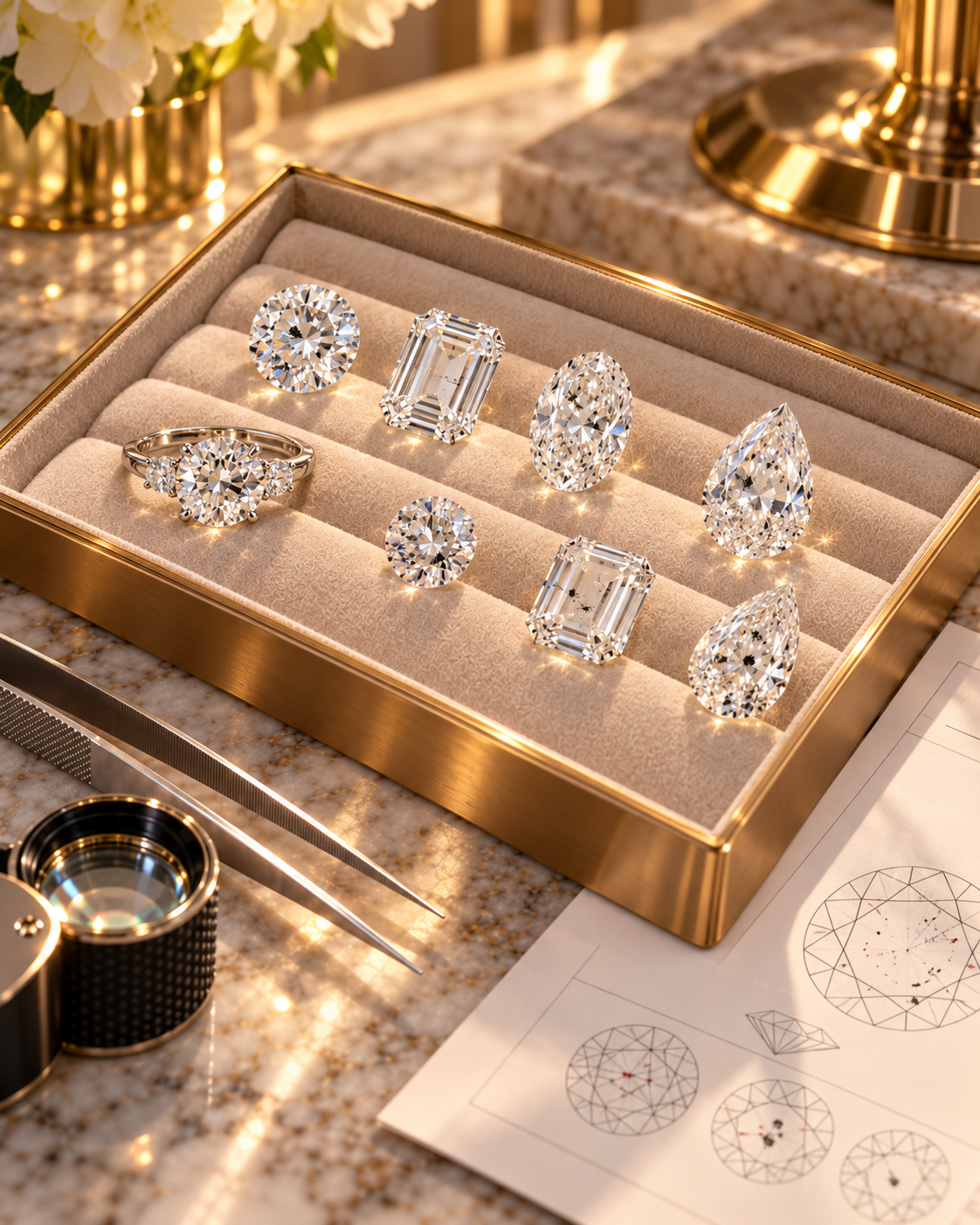
Two Diamonds With the Same Clarity Grade Can Still Present Differently
Higher Clarity Is Not Always the Most Important Upgrade
5. Shape and Current Market Demand
Shape is one of the most important factors missing from simplistic 4Cs-only explanations.
Common shapes include:
Shape changes both the appearance of a diamond and the pool of buyers likely to want it.
Revere, Diamond Banc, National Rarities and other diamond buyers all explicitly include shape or shape demand in their resale evaluations.
Common shapes include:
- round brilliant;
- oval;
- cushion;
- emerald;
- radiant;
- pear;
- princess;
- marquise;
- Asscher;
- heart.
Shape changes both the appearance of a diamond and the pool of buyers likely to want it.
Revere, Diamond Banc, National Rarities and other diamond buyers all explicitly include shape or shape demand in their resale evaluations.
A resale buyer is not only asking:
How good is this diamond?
The buyer also has to ask:
How readily can this exact type of diamond be placed with another buyer?
That is the difference between quality and liquidity.
A beautiful diamond in a niche shape may have excellent gemological characteristics but a smaller immediate buyer pool.
Another shape may currently have broader demand.
Those preferences can change.
This is why shape should never be converted into a permanent rule such as:
“Shape X is always worth more than shape Y.”
Market conditions, size, proportions, quality range, and buyer preferences all matter.
How good is this diamond?
The buyer also has to ask:
How readily can this exact type of diamond be placed with another buyer?
That is the difference between quality and liquidity.
A beautiful diamond in a niche shape may have excellent gemological characteristics but a smaller immediate buyer pool.
Another shape may currently have broader demand.
Those preferences can change.
This is why shape should never be converted into a permanent rule such as:
“Shape X is always worth more than shape Y.”
Market conditions, size, proportions, quality range, and buyer preferences all matter.
Demand can also vary by:
This is the part of diamond resale value that a grading report cannot answer by itself.
A grading report tells the market what the diamond is.
Current buyers determine what that particular diamond trades for now.
- carat range;
- color range;
- clarity range;
- combination of characteristics;
- natural vs. laboratory-grown origin;
- whether the stone is loose or in a desirable finished piece.
This is the part of diamond resale value that a grading report cannot answer by itself.
A grading report tells the market what the diamond is.
Current buyers determine what that particular diamond trades for now.
Why Demand Matters
Current Demand Extends Beyond Shape
6. Grading Report: Verification Matters
A respected laboratory grading report can make a resale evaluation significantly clearer because it creates a standardized description of the diamond.
People often call this document a “diamond certificate,” although grading report is the more accurate term.
A GIA Diamond Grading Report can document characteristics including:
GIA describes its reports as independent assessments of diamond quality and notes that they can help document a diamond for a future resale transaction.
People often call this document a “diamond certificate,” although grading report is the more accurate term.
A GIA Diamond Grading Report can document characteristics including:
- natural origin;
- shape and measurements;
- carat weight;
- color;
- clarity;
- cut information where applicable;
- proportions;
- polish;
- symmetry;
- fluorescence;
- treatments;
- identifying clarity characteristics.
GIA describes its reports as independent assessments of diamond quality and notes that they can help document a diamond for a future resale transaction.
This distinction is essential.
A GIA report describes the diamond.
It does not say:
“This diamond is worth $X today.”
That requires market analysis.
The same documented diamond can receive different monetary values depending on:
A GIA report describes the diamond.
It does not say:
“This diamond is worth $X today.”
That requires market analysis.
The same documented diamond can receive different monetary values depending on:
- date of evaluation;
- market conditions;
- transaction type;
- buyer;
- selling channel.
Not necessarily.
A report does not improve the diamond's underlying quality.
What it does improve is verification and comparability.
A professionally graded stone can be easier for buyers to position because important characteristics have already been documented by an independent laboratory.
That can reduce uncertainty in the evaluation.
A report does not improve the diamond's underlying quality.
What it does improve is verification and comparability.
A professionally graded stone can be easier for buyers to position because important characteristics have already been documented by an independent laboratory.
That can reduce uncertainty in the evaluation.
A diamond can still be evaluated and sold without one.
Luxe Brokers can evaluate diamonds with or without existing grading documentation. An undocumented stone may simply require more direct assessment before its characteristics can be compared with the current market.
For the broader selling process, the existing Diamond Selling Guide explains how documentation fits into preparing a diamond for sale.
Luxe Brokers can evaluate diamonds with or without existing grading documentation. An undocumented stone may simply require more direct assessment before its characteristics can be compared with the current market.
For the broader selling process, the existing Diamond Selling Guide explains how documentation fits into preparing a diamond for sale.
A Grading Report Does Not State Resale Value
Does Having a Report Automatically Make the Diamond More Valuable?
What If You Do Not Have a Report?
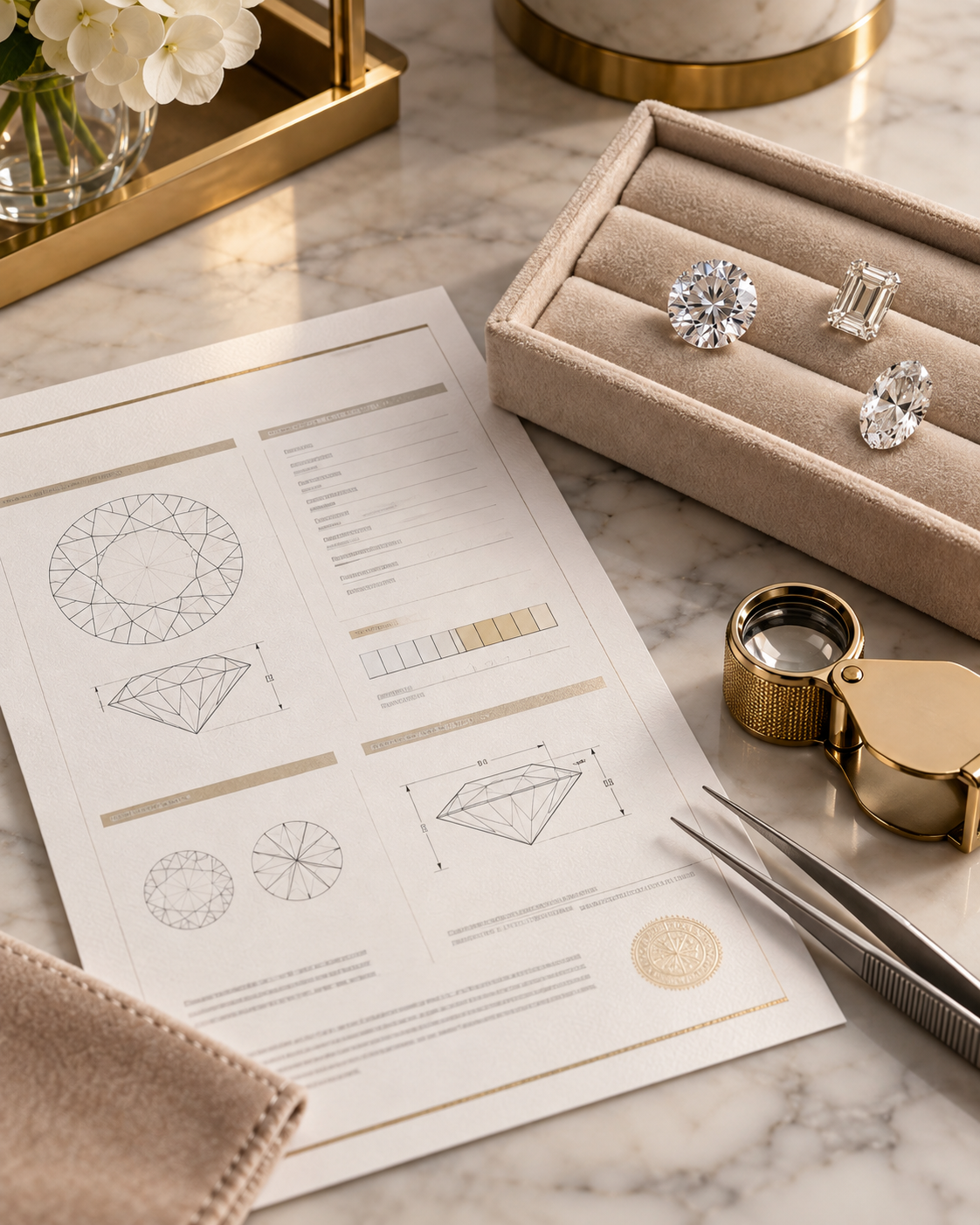
7. Natural vs. Laboratory-Grown: Two Different Resale Markets
A buyer first needs to establish whether the stone is a natural diamond or a laboratory-grown diamond.
The distinction cannot reliably be made by appearance alone.
Laboratory-grown diamonds have essentially the same chemical composition, crystal structure, optical characteristics, and physical properties as natural diamonds. Specialized testing can therefore be necessary to identify origin. GIA evaluates laboratory-grown diamonds separately and identifies them accordingly.
The distinction cannot reliably be made by appearance alone.
Laboratory-grown diamonds have essentially the same chemical composition, crystal structure, optical characteristics, and physical properties as natural diamonds. Specialized testing can therefore be necessary to identify origin. GIA evaluates laboratory-grown diamonds separately and identifies them accordingly.
A lab-grown diamond can have excellent cut, color, and clarity.
A natural diamond can have weak grades.
The distinction is instead about which market the diamond belongs to.
Professional resale buyers do not simply place a natural diamond and a laboratory-grown diamond with matching 4Cs into the same pricing category.
National Rarities, for example, notes that natural and lab-grown diamonds currently have different secondary-market dynamics and that the resale market for pre-owned laboratory-grown diamonds is more limited.
A natural diamond can have weak grades.
The distinction is instead about which market the diamond belongs to.
Professional resale buyers do not simply place a natural diamond and a laboratory-grown diamond with matching 4Cs into the same pricing category.
National Rarities, for example, notes that natural and lab-grown diamonds currently have different secondary-market dynamics and that the resale market for pre-owned laboratory-grown diamonds is more limited.
If you are researching comparable diamonds online, first confirm that you are comparing:
natural with natural
or
lab-grown with lab-grown.
Otherwise, the comparison can be meaningless even if carat, color, clarity, and shape look similar.
For sellers, this is one of the most important reasons to identify the stone accurately before trying to estimate resale value.
natural with natural
or
lab-grown with lab-grown.
Otherwise, the comparison can be meaningless even if carat, color, clarity, and shape look similar.
For sellers, this is one of the most important reasons to identify the stone accurately before trying to estimate resale value.
Origin Is Not a Quality Grade
Why This Matters Before You Compare Prices
8. Fluorescence and the Details Beyond the 4Cs
Fluorescence is the visible light some diamonds emit when exposed to ultraviolet radiation.
On a GIA report, fluorescence is described by its intensity.
On a GIA report, fluorescence is described by its intensity.
Not automatically.
This is one of the areas where oversimplified diamond advice causes problems.
GIA's research indicates that for the overwhelming majority of diamonds, fluorescence has no widely noticeable effect on appearance. In rare cases, some diamonds with very strong fluorescence can appear hazy or oily.
The resale effect therefore depends on:
A professional buyer should evaluate fluorescence in context, not apply a universal penalty.
This is one of the areas where oversimplified diamond advice causes problems.
GIA's research indicates that for the overwhelming majority of diamonds, fluorescence has no widely noticeable effect on appearance. In rare cases, some diamonds with very strong fluorescence can appear hazy or oily.
The resale effect therefore depends on:
- fluorescence strength;
- diamond color;
- visual appearance;
- the preferences of buyers in that market segment.
A professional buyer should evaluate fluorescence in context, not apply a universal penalty.
Does Fluorescence Lower Diamond Value?
The headline 4Cs are only the beginning of a detailed report.
Depending on the diamond, buyers may also pay attention to:
Not every field materially changes value for every diamond.
But for important stones, the details can explain why two diamonds with seemingly similar headline grades trade differently.
Depending on the diamond, buyers may also pay attention to:
- measurements;
- table percentage;
- depth percentage;
- crown and pavilion information;
- polish;
- symmetry;
- girdle;
- culet;
- treatments;
- laser inscription;
- comments on the report.
Not every field materially changes value for every diamond.
But for important stones, the details can explain why two diamonds with seemingly similar headline grades trade differently.
Other Report Details Buyers May Review
9. Condition and the Jewelry Around the Diamond
Diamonds are extremely durable, but they are not indestructible.
A resale evaluation can include inspection for:
Revere and Diamond Banc both include condition in their resale-value frameworks.
A resale evaluation can include inspection for:
- chips;
- abrasions;
- damaged facet junctions;
- girdle damage;
- surface wear;
- evidence of repair or alteration.
Revere and Diamond Banc both include condition in their resale-value frameworks.
Damage may affect:
A report documents a diamond at the time it was graded.
If the diamond has been damaged since then, the physical stone still needs to be inspected.
- appearance;
- durability;
- whether the stone could require recutting;
- marketability;
- whether an older grading report still describes the stone's present condition accurately.
A report documents a diamond at the time it was graded.
If the diamond has been damaged since then, the physical stone still needs to be inspected.
Whether a diamond is loose or set in jewelry changes the evaluation process.
A loose diamond generally allows more direct access to:
GIA's full natural-diamond grading services are performed on loose stones.
A mounted diamond can still be evaluated, but the setting may limit direct access to parts of the stone.
That does not mean sellers should remove a diamond themselves.
A ring may be worth more as a complete piece than as separate components.
If the stone is already loose, the Luxe Brokers loose diamonds page explains how that category is evaluated separately from finished diamond jewelry.
A loose diamond generally allows more direct access to:
- exact weight;
- measurements;
- girdle;
- inclusions;
- surface condition;
- proportions.
GIA's full natural-diamond grading services are performed on loose stones.
A mounted diamond can still be evaluated, but the setting may limit direct access to parts of the stone.
That does not mean sellers should remove a diamond themselves.
A ring may be worth more as a complete piece than as separate components.
If the stone is already loose, the Luxe Brokers loose diamonds page explains how that category is evaluated separately from finished diamond jewelry.
A common mistake is assuming that a diamond ring equals:
center diamond + scrap metal
Sometimes that approximation is reasonable.
Sometimes it misses a meaningful part of the market value.
A well-made platinum or gold setting can contribute value. Side diamonds can contribute value. And an authentic designer setting can create an entirely different resale proposition.
center diamond + scrap metal
Sometimes that approximation is reasonable.
Sometimes it misses a meaningful part of the market value.
A well-made platinum or gold setting can contribute value. Side diamonds can contribute value. And an authentic designer setting can create an entirely different resale proposition.
Consider an authentic diamond ring from a recognized house such as Cartier, Tiffany & Co., Graff, Van Cleef & Arpels, or another luxury maker.
The complete item may need to be evaluated according to:
In that situation, separating the center stone from the ring conceptually—or physically—too early may miss value attached to the complete jewel.
That is why Luxe Brokers evaluates diamond rings as finished jewelry as well as considering the center stone.
The complete item may need to be evaluated according to:
- brand;
- collection;
- authenticity;
- design;
- condition;
- original proportions;
- accompanying paperwork;
- box or packaging;
- secondary demand for the finished piece.
In that situation, separating the center stone from the ring conceptually—or physically—too early may miss value attached to the complete jewel.
That is why Luxe Brokers evaluates diamond rings as finished jewelry as well as considering the center stone.
Why a Chip Can Matter
Mounted vs. Loose Diamond
The Setting Can Add Value
Designer Diamond Settings
Why the Original Purchase Price Does Not Determine Today's Resale Value
One of the most common questions is:
“I paid $X. Why isn't my diamond worth that amount now?”
The original receipt records a retail transaction at a particular point in time.
It may include more than the diamond itself:
A resale buyer is answering a different question:
What does this specific asset trade for in today's secondary market?
That is why the original purchase price is useful historical information but not a formula for current resale value.
The same principle applies to an insurance appraisal.
An insurance replacement appraisal and a resale offer are measuring different things.
For a deeper explanation of that distinction, see Jewelry Appraisal vs. Resale Value.
“I paid $X. Why isn't my diamond worth that amount now?”
The original receipt records a retail transaction at a particular point in time.
It may include more than the diamond itself:
- retail margin;
- setting;
- craftsmanship;
- store overhead;
- marketing;
- services;
- warranty structure;
- taxes.
A resale buyer is answering a different question:
What does this specific asset trade for in today's secondary market?
That is why the original purchase price is useful historical information but not a formula for current resale value.
The same principle applies to an insurance appraisal.
An insurance replacement appraisal and a resale offer are measuring different things.
For a deeper explanation of that distinction, see Jewelry Appraisal vs. Resale Value.
Why There Is No Reliable “Percentage of Retail” Formula
You will often see claims that a diamond is “worth a certain percentage of what you paid.”
That approach is unreliable.
Imagine two people each receive the same current offer for comparable diamonds.
One originally purchased from a low-margin seller.
The other purchased through a high-overhead luxury retail channel.
Their resale offers could be similar while their apparent “percentage retained” is completely different.
The resale market does not know how efficiently you originally purchased the diamond.
What matters is the diamond being offered now.
A serious valuation therefore starts with:
Not a universal depreciation percentage.
That approach is unreliable.
Imagine two people each receive the same current offer for comparable diamonds.
One originally purchased from a low-margin seller.
The other purchased through a high-overhead luxury retail channel.
Their resale offers could be similar while their apparent “percentage retained” is completely different.
The resale market does not know how efficiently you originally purchased the diamond.
What matters is the diamond being offered now.
A serious valuation therefore starts with:
- identity;
- quality;
- documentation;
- condition;
- marketability;
- current demand.
Not a universal depreciation percentage.
How Buyers Turn Diamond Characteristics Into a Resale Offer
Professional diamond evaluation happens in two stages.
The buyer establishes or verifies:
If a grading report exists, the stone should be matched to the documentation.
- natural or laboratory-grown origin;
- carat weight;
- shape;
- cut characteristics;
- color;
- clarity;
- measurements;
- fluorescence;
- condition;
- report details.
If a grading report exists, the stone should be matched to the documentation.
The technical characteristics are then viewed against:
This second step explains why grading and valuation are related but not identical.
A laboratory can describe a diamond extremely precisely without telling you exactly what a particular buyer will pay for it today.
- current demand;
- comparable diamonds;
- buyer liquidity;
- shape preferences;
- size and quality category;
- resale channel;
- whether the item is loose or mounted;
- whether the complete jewelry piece has brand or design value.
This second step explains why grading and valuation are related but not identical.
A laboratory can describe a diamond extremely precisely without telling you exactly what a particular buyer will pay for it today.
Stage 1: Determine What the Diamond Is
Stage 2: Determine How the Market Values That Profile
How Much Is My Diamond Worth?
If you want a realistic resale estimate, start by gathering as much objective information as possible.
Useful items include:
Do not worry if some of these are missing.
A diamond can still be evaluated without an existing grading report.
Useful items include:
- grading report;
- report number;
- previous appraisal;
- original receipt;
- clear photographs;
- measurements if known;
- photographs of the entire setting;
- brand signatures or hallmarks;
- original box or designer paperwork.
Do not worry if some of these are missing.
A diamond can still be evaluated without an existing grading report.
Photograph:
See Luxe Brokers' loose diamond evaluation information for the commercial process.
- the stone face-up;
- side profile;
- girdle if possible;
- report and report number;
- any laser inscription you can document safely.
See Luxe Brokers' loose diamond evaluation information for the commercial process.
If the Diamond Is Loose
Photograph:
For finished jewelry, the diamond ring evaluation process considers both the center diamond and the complete setting.
- full ring;
- top view;
- side profile;
- inside of the shank;
- designer signatures;
- hallmarks;
- side stones;
- report and original documentation.
For finished jewelry, the diamond ring evaluation process considers both the center diamond and the complete setting.
If the Diamond Is in a Ring
What Should Matter Most When Comparing Diamond Offers?
If two buyers give you different numbers, do not compare the numbers alone.
Ask each buyer:
Ask each buyer:
You should understand whether the evaluation assumes:
- natural or lab-grown;
- exact or estimated carat weight;
- specific color and clarity;
- report grades;
- current condition.
The buyer should be able to explain why the diamond is positioned where it is in today's market.
For a mounted diamond, clarify whether the offer includes:
- center stone;
- side stones;
- precious metal;
- designer premium;
- complete finished piece.
These are not the same.
An online estimate can be useful for orientation, while final pricing may require physical verification.
An online estimate can be useful for orientation, while final pricing may require physical verification.
An old insurance appraisal can provide information about the item without representing today's resale price.
If you want an item-specific market evaluation rather than a generic online estimate, see how Luxe Brokers evaluates and buys diamonds.
If you want an item-specific market evaluation rather than a generic online estimate, see how Luxe Brokers evaluates and buys diamonds.
What characteristics are you using?
How is shape and current demand affecting the offer?
Is the setting included?
Is the number an estimate or a final purchase offer?
Is the appraisal number being used correctly?
The Bottom Line
A diamond's resale value cannot be reduced to carat weight or even the 4Cs alone.
Buyers evaluate nine broader areas:
Within that last category, whether the diamond is loose or mounted—and whether the setting has designer value—can materially change what is actually being sold.
The key distinction is simple:
Grading describes the diamond. Resale value reflects how that specific diamond is positioned in the market today.
If you are preparing to sell, use the existing Diamond Selling Guide for the full process, then obtain an item-specific evaluation rather than relying on a generic resale percentage or an old appraisal.
Buyers evaluate nine broader areas:
- carat weight;
- cut quality;
- color;
- clarity;
- shape and current demand;
- grading documentation;
- natural or laboratory-grown origin;
- fluorescence and other report details;
- condition and the context of the complete piece.
Within that last category, whether the diamond is loose or mounted—and whether the setting has designer value—can materially change what is actually being sold.
The key distinction is simple:
Grading describes the diamond. Resale value reflects how that specific diamond is positioned in the market today.
If you are preparing to sell, use the existing Diamond Selling Guide for the full process, then obtain an item-specific evaluation rather than relying on a generic resale percentage or an old appraisal.
Want to Know What Your Diamond Is Worth in Today's Market?
A grading report can tell you what your diamond is. A market evaluation can help you understand what that specific quality profile may be worth today.
Send clear photos of the diamond or complete piece, plus any GIA or other grading report, previous appraisal, brand information, and documentation you have. Luxe Brokers can review the details for a preliminary market-based estimate, with in-person verification available when needed.
Send clear photos of the diamond or complete piece, plus any GIA or other grading report, previous appraisal, brand information, and documentation you have. Luxe Brokers can review the details for a preliminary market-based estimate, with in-person verification available when needed.
Frequently Asked Questions
There is no reliable value based on carat weight or original retail price alone. Resale value depends on the diamond's quality, shape, origin, grading documentation, condition, current demand, and whether it is being sold loose or as part of a valuable finished piece.
A GIA report does not improve the diamond's underlying quality, but it can make its characteristics easier to verify and compare. That can reduce uncertainty during resale. The report itself does not assign a selling price.
Yes. A diamond can be evaluated without existing paperwork. The buyer will need to establish more of the stone's characteristics directly, which can make verification less standardized than with a recognized laboratory report.
Not automatically. The effect depends on fluorescence strength, the diamond's other characteristics, visual appearance, and buyer preferences. GIA reports that fluorescence has no widely noticeable effect on the appearance of the overwhelming majority of diamonds that exhibit it.
No. They are separate market categories. They can share the same physical and optical properties and the same types of quality characteristics, but buyers evaluate their resale potential against different market conditions.
Not necessarily. A loose diamond can be easier to inspect directly, but a high-quality or designer setting may add value to the complete ring. Each piece should be evaluated before assuming that separating the stone will improve the outcome.
Yes, because shape influences market demand and liquidity. However, shape should be considered together with the diamond's size, quality, proportions, condition, and current buyer demand rather than treated as a fixed ranking.
Many appraisals are prepared for insurance replacement rather than resale. Replacement value and a current secondary-market purchase offer answer different valuation questions.