


Daily 10 am to 7 pm
Daily 10 am to 7 pm

Do You Need a GIA Certificate to Sell a Diamond? What Buyers Check Instead
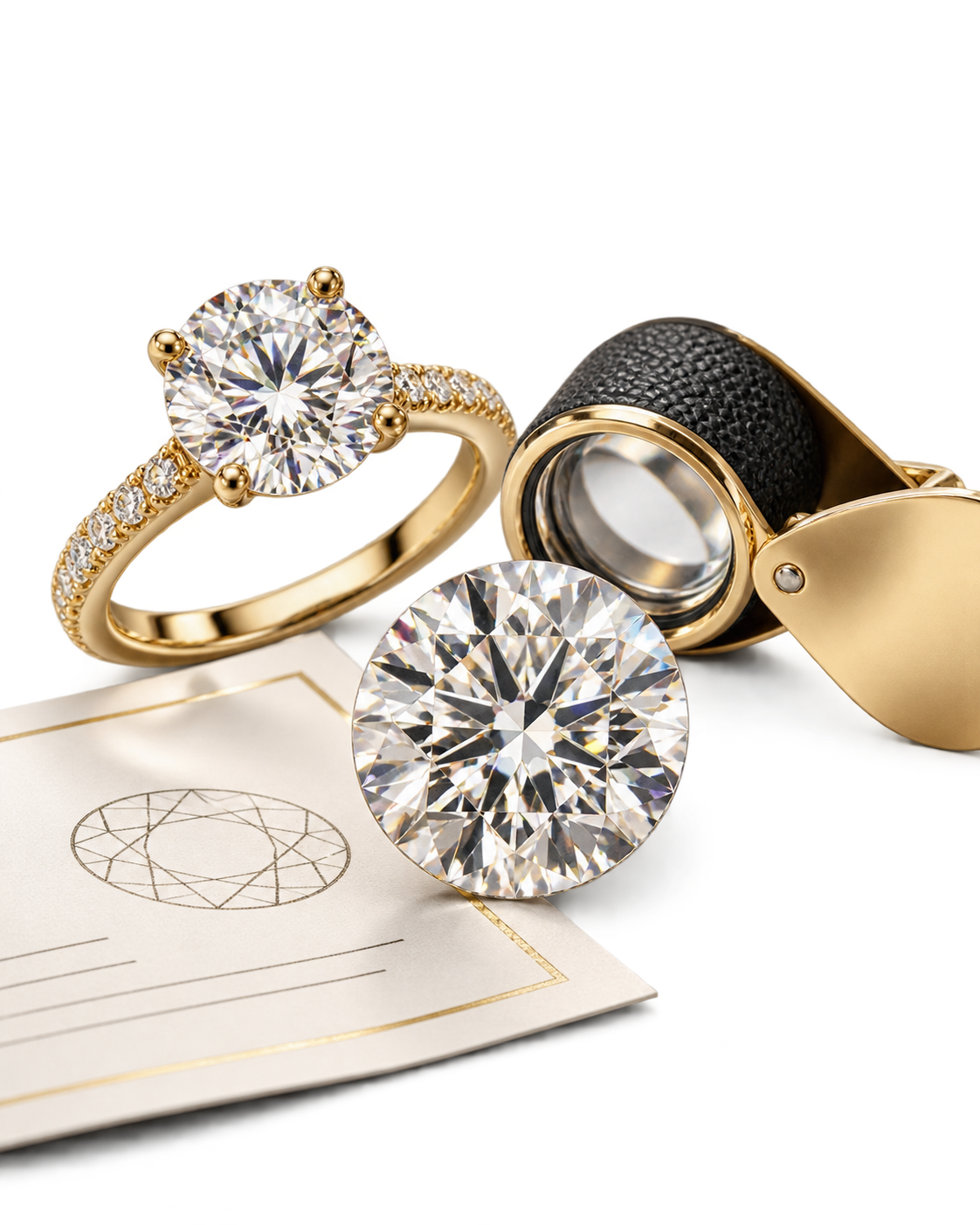
Yes, you can sell a diamond without a GIA certificate or other grading report. The paperwork helps buyers verify a diamond's characteristics, but it does not create the diamond's value. Without a report, a qualified buyer must establish more of those characteristics directly—such as whether the stone is natural or laboratory-grown, its approximate carat weight, color, clarity, cut characteristics, condition, and current marketability.
If your report was lost, however, do not immediately pay to have the diamond graded again. The original report information may still be accessible.
Terminology note: People commonly search for a “GIA certificate,” but GIA itself calls the document a grading report, not a certificate. GIA also does not assign a monetary appraisal value to the diamond.
If your report was lost, however, do not immediately pay to have the diamond graded again. The original report information may still be accessible.
Terminology note: People commonly search for a “GIA certificate,” but GIA itself calls the document a grading report, not a certificate. GIA also does not assign a monetary appraisal value to the diamond.
DIAMOND DOCUMENTATION & SELLING
Can You Sell a Diamond Without a Certificate?
Yes. The best next step depends on whether the report exists, was lost, or never existed at all.
Situation: GIA report available
Best Next Step: Bring the report with the diamond
Situation: Paper report lost, report number known
Best Next Step: Check GIA Report Check
Situation: Report lost, laser inscription visible
Best Next Step: Use the report number to look up the record
Situation: No grading report ever existed
Best Next Step: Have the diamond professionally evaluated
Situation: Diamond mounted in a ring
Best Next Step: Evaluate the complete ring before removing anything
Situation: Old appraisal but no lab report
Best Next Step: Bring it as supporting information, not as a grading report
Situation: Unsure whether a new report is worthwhile
Best Next Step: Ask the intended buyer before paying to unmount and regrade the stone
Best Next Step: Bring the report with the diamond
Situation: Paper report lost, report number known
Best Next Step: Check GIA Report Check
Situation: Report lost, laser inscription visible
Best Next Step: Use the report number to look up the record
Situation: No grading report ever existed
Best Next Step: Have the diamond professionally evaluated
Situation: Diamond mounted in a ring
Best Next Step: Evaluate the complete ring before removing anything
Situation: Old appraisal but no lab report
Best Next Step: Bring it as supporting information, not as a grading report
Situation: Unsure whether a new report is worthwhile
Best Next Step: Ask the intended buyer before paying to unmount and regrade the stone
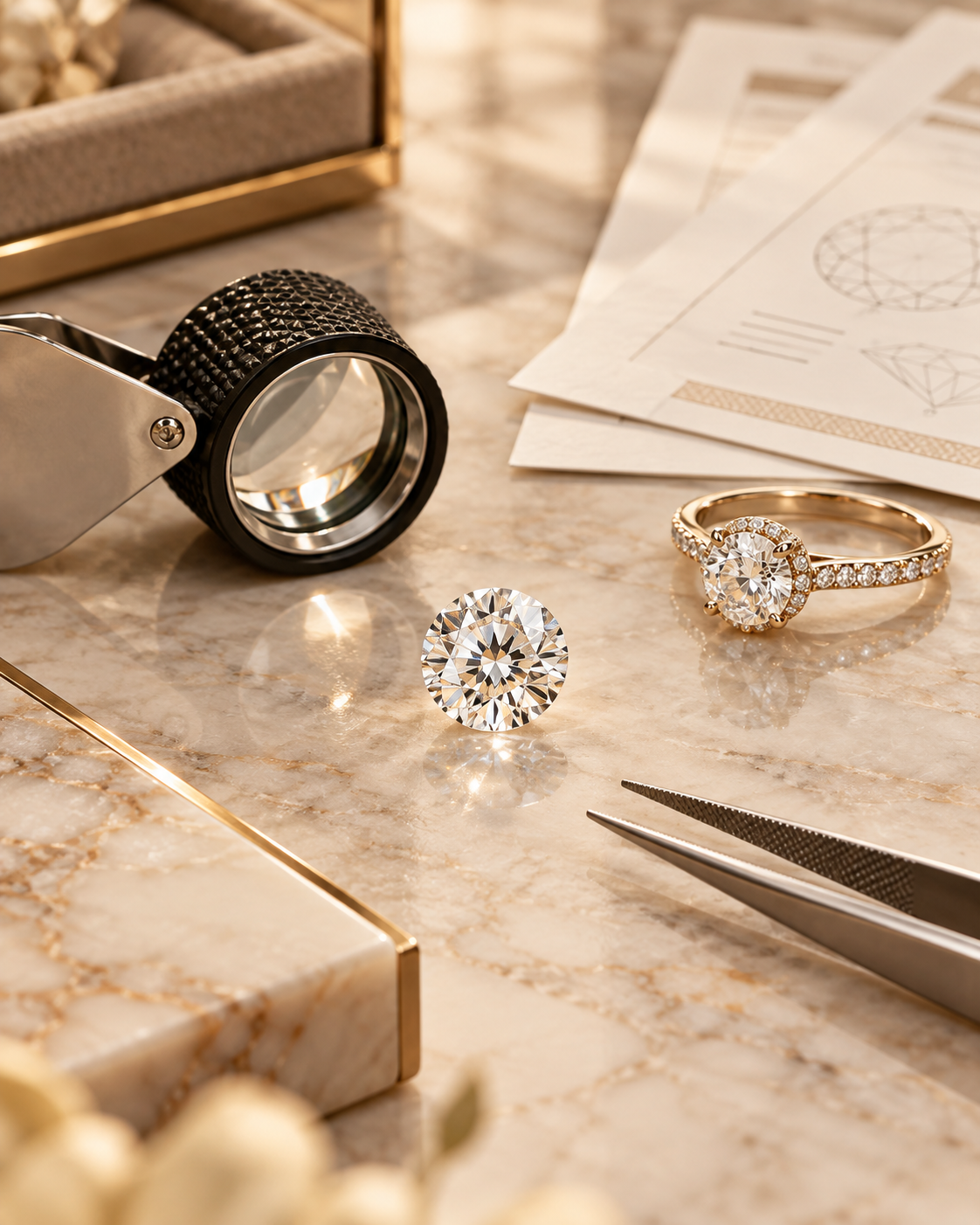
A grading report is useful documentation, but it is not a legal requirement for a diamond to have resale value.
Many diamonds reach the secondary market without their original paperwork.
Common situations include:
Luxe Brokers evaluates diamonds without certificates as both loose stones and mounted jewelry.
What changes is how much verification the buyer must perform.
With a recognized report, important characteristics already have an independent laboratory reference.
Without one, the buyer has to establish enough of that information directly to determine where the diamond fits in the current resale market.
Many diamonds reach the secondary market without their original paperwork.
Common situations include:
- inherited diamond rings;
- older engagement rings;
- lost or misplaced reports;
- stones purchased before the current owner was involved;
- loose diamonds that were never submitted to a laboratory;
- gifts without purchase documentation;
- estate jewelry with incomplete records.
Luxe Brokers evaluates diamonds without certificates as both loose stones and mounted jewelry.
What changes is how much verification the buyer must perform.
With a recognized report, important characteristics already have an independent laboratory reference.
Without one, the buyer has to establish enough of that information directly to determine where the diamond fits in the current resale market.
Yes, You Can Sell a Diamond Without a Certificate
A grading report does not tell you:
The report tells the market what the diamond is.
A resale evaluation then asks:
What is a diamond with this quality profile trading for in the current market?
That distinction is important when you are preparing to sell.
- what the diamond originally cost;
- what an insurance company should cover it for;
- what a retailer might charge for a comparable stone;
- what today's resale value is;
- what a specific buyer will offer.
The report tells the market what the diamond is.
A resale evaluation then asks:
What is a diamond with this quality profile trading for in the current market?
That distinction is important when you are preparing to sell.
What the Report Does Not Tell You
A grading report creates a standardized description of a specific diamond.
For a natural D-to-Z diamond, a full GIA Diamond Grading Report can document information including:
GIA describes its grading reports as technical assessments rather than certificates or monetary appraisals.
For a natural D-to-Z diamond, a full GIA Diamond Grading Report can document information including:
- carat weight;
- color grade;
- clarity grade;
- cut grade where applicable;
- shape and cutting style;
- measurements;
- proportions;
- polish;
- symmetry;
- fluorescence;
- identifying clarity characteristics;
- treatments where applicable.
GIA describes its grading reports as technical assessments rather than certificates or monetary appraisals.
What a Diamond Grading Report Actually Does
An appraisal answers a different question.
Depending on its purpose, an appraisal may state:
It is therefore possible to have:
a GIA report with no dollar value
and
an appraisal containing a dollar value but no independent laboratory grade.
One document does not automatically replace the other.
If an old appraisal is shaping your expectations about what the diamond should sell for, see Jewelry Appraisal vs. Resale Value before comparing it with a purchase offer.
Depending on its purpose, an appraisal may state:
- insurance replacement value;
- fair market value;
- another defined monetary value.
It is therefore possible to have:
a GIA report with no dollar value
and
an appraisal containing a dollar value but no independent laboratory grade.
One document does not automatically replace the other.
If an old appraisal is shaping your expectations about what the diamond should sell for, see Jewelry Appraisal vs. Resale Value before comparing it with a purchase offer.
Appraisal
IGI also issues diamond reports that document characteristics such as:
IGI also provides report verification online. Its own verification language clarifies that the laboratory report is not an appraisal or warranty.
- natural or laboratory-grown origin;
- carat weight;
- color;
- clarity;
- cut;
- measurements;
- polish and symmetry.
IGI also provides report verification online. Its own verification language clarifies that the laboratory report is not an appraisal or warranty.
IGI Report
GIA is one of the most widely recognized gemological laboratories.
Importantly, GIA itself states that it does not certify diamonds. It grades and analyzes them and issues laboratory reports.
For its standard full Diamond Grading Report, GIA currently requires the natural D-to-Z diamond to be submitted loose.
Importantly, GIA itself states that it does not certify diamonds. It grades and analyzes them and issues laboratory reports.
For its standard full Diamond Grading Report, GIA currently requires the natural D-to-Z diamond to be submitted loose.
GIA Report
These documents are often placed in the same folder, but they do not serve the same purpose.
GIA grading report
Independently documents diamond characteristics.
Does not state a selling price.
IGI grading report
Documents diamond identity and quality characteristics.
Does not state a selling price.
Jewelry appraisal
Assigns a monetary value for a defined purpose.
Purchase receipt / buyer offer
One records historical transaction; the other reflects what a buyer will pay now.
GIA grading report
Independently documents diamond characteristics.
Does not state a selling price.
IGI grading report
Documents diamond identity and quality characteristics.
Does not state a selling price.
Jewelry appraisal
Assigns a monetary value for a defined purpose.
Purchase receipt / buyer offer
One records historical transaction; the other reflects what a buyer will pay now.
GIA vs. IGI vs. an Appraisal: What Is the Difference?
Before assuming the report is gone permanently, search:
The report number may also appear in another document.
- email attachments;
- cloud storage;
- old insurance files;
- appraisal documents;
- jeweler receipts;
- estate documents;
- photographs of the report;
- photographs or videos of the diamond paperwork.
The report number may also appear in another document.
Check Old Records
GIA's Report Check allows the report number to be used to retrieve information stored in its database.
GIA states that if the physical report has been lost, stolen, or destroyed, it does not issue a duplicate. However, the report information can still be viewed through Report Check when the number is known, and reports dated after July 1, 2010 may have a PDF available there.
In practical terms:
lost paper ≠ automatically lost grading history.
GIA states that if the physical report has been lost, stolen, or destroyed, it does not issue a duplicate. However, the report information can still be viewed through Report Check when the number is known, and reports dated after July 1, 2010 may have a PDF available there.
In practical terms:
lost paper ≠ automatically lost grading history.
If You Know the Report Number
Losing the paper does not necessarily mean that all grading information is lost.
First determine whether you can find the original GIA report number.
First determine whether you can find the original GIA report number.
What Happens If You Lost the GIA Report?
Use GIA Report Check to compare the archived specifications with the actual stone.
A report number alone is not enough: the buyer still needs to confirm that the diamond being presented is consistent with the report.
A report number alone is not enough: the buyer still needs to confirm that the diamond being presented is consistent with the report.
If You Find the Number
Do not remove the diamond yourself simply to look for an inscription.
Depending on the setting:
A diamond specialist can inspect the girdle under magnification and determine whether a report number is visible.
Depending on the setting:
- the inscription may still be visible;
- a prong may cover it;
- the angle may make it difficult to read.
A diamond specialist can inspect the girdle under magnification and determine whether a report number is visible.
If the Diamond Is Mounted
Sometimes.
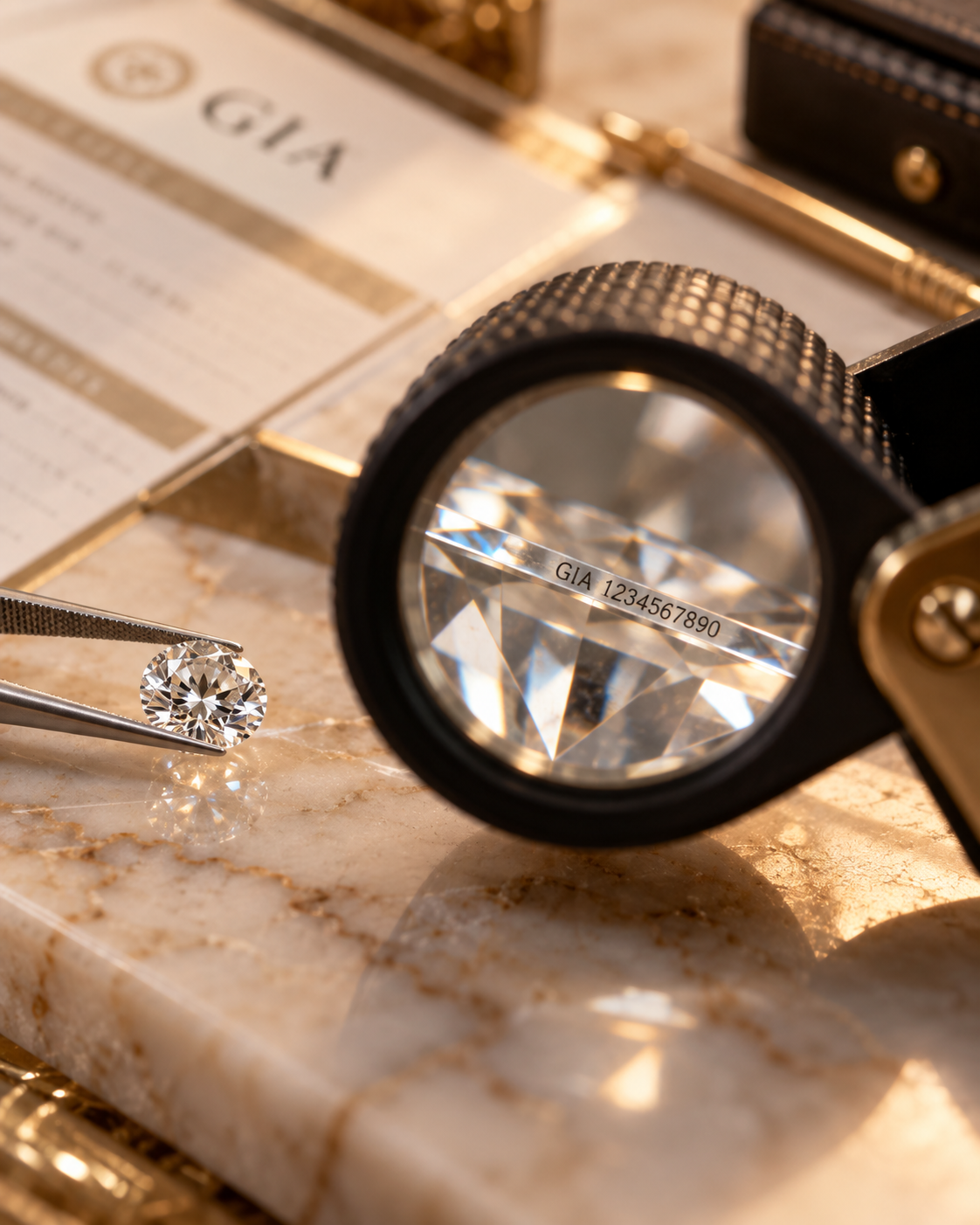
Some GIA-graded diamonds have the report number laser-inscribed on the girdle, the narrow outer edge of the diamond.
The inscription is microscopic and normally requires magnification to read.
GIA explains that report numbers may be laser-inscribed on a diamond to help identify the stone and connect it with its grading information. Certain GIA services include the inscription, while in other cases it may have been requested separately.
Some GIA-graded diamonds have the report number laser-inscribed on the girdle, the narrow outer edge of the diamond.
The inscription is microscopic and normally requires magnification to read.
GIA explains that report numbers may be laser-inscribed on a diamond to help identify the stone and connect it with its grading information. Certain GIA services include the inscription, while in other cases it may have been requested separately.
Can the GIA Report Number Be Recovered From the Diamond?
This is different from losing a report.
If the stone was never submitted to GIA, IGI, or another laboratory, there is no report record to recover.
The buyer then has to begin with the diamond itself.
A professional evaluation may consider:
This is why the absence of a report makes buyer expertise more important, not the diamond automatically worthless.
For a deeper explanation of how those characteristics interact, see What Determines a Diamond's Resale Value?
If the stone was never submitted to GIA, IGI, or another laboratory, there is no report record to recover.
The buyer then has to begin with the diamond itself.
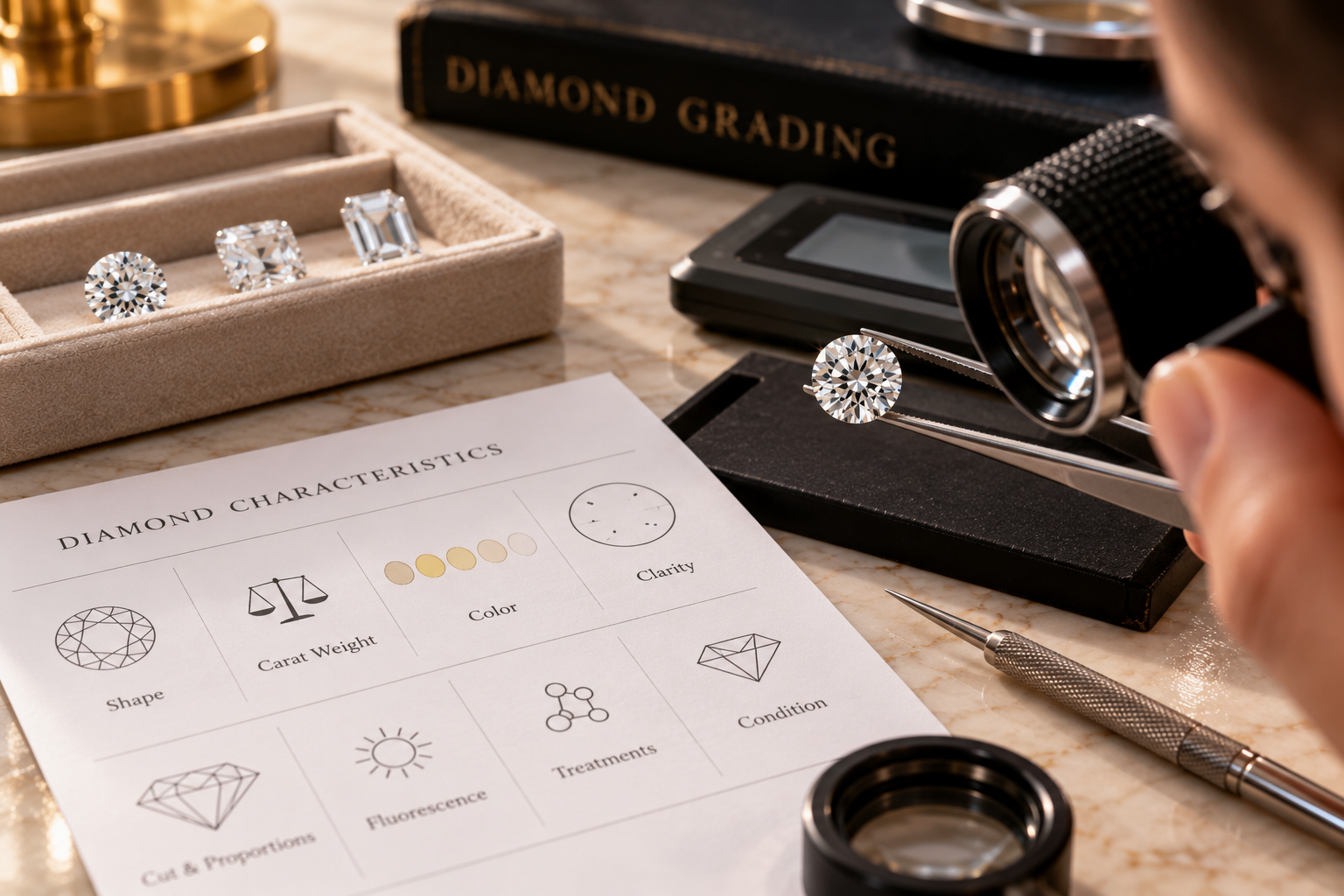
A professional evaluation may consider:
- whether the stone is actually a diamond;
- whether it is natural or laboratory-grown;
- approximate or exact carat weight where possible;
- color;
- clarity;
- cut and proportions;
- shape;
- fluorescence;
- treatments or other relevant characteristics;
- condition;
- current market demand.
This is why the absence of a report makes buyer expertise more important, not the diamond automatically worthless.
For a deeper explanation of how those characteristics interact, see What Determines a Diamond's Resale Value?
What If the Diamond Was Never Graded?
Finally, the buyer compares the diamond's estimated quality profile with current market conditions.
Two diamonds of the same carat weight can have very different selling values because their:
This is why an uncertified diamond is not priced simply by carat weight.
Two diamonds of the same carat weight can have very different selling values because their:
- color;
- clarity;
- cut;
- shape;
- origin;
- condition;
- market demand
This is why an uncertified diamond is not priced simply by carat weight.
7. Current Market Demand
Fluorescence, condition, treatments, and other characteristics may also influence how the stone is positioned.
6. Fluorescence and Other Characteristics
Buyers also consider:
- proportions;
- symmetry;
- polish;
- visual performance;
- shape;
- overall marketability.
5. Cut and Proportions
The buyer examines inclusions and blemishes under magnification.
Their:
A setting may obscure areas of the stone that would be visible if the diamond were loose.
Their:
- size;
- type;
- number;
- position;
- visibility
A setting may obscure areas of the stone that would be visible if the diamond were loose.
4. Clarity
Diamond color is normally graded under standardized conditions.
A buyer examining an uncertified stone can assess color, but the confidence and precision of that assessment depend on the conditions and whether the diamond is loose or mounted.
The metal around a mounted diamond can influence visual perception.
A buyer examining an uncertified stone can assess color, but the confidence and precision of that assessment depend on the conditions and whether the diamond is loose or mounted.
The metal around a mounted diamond can influence visual perception.
3. Color
If the diamond is loose, it can be weighed directly.
If it is mounted, exact weighing of the stone may not be possible without removal, so size and weight may initially need to be estimated from measurements.
That difference matters when deciding whether unsetting is worthwhile.
If it is mounted, exact weighing of the stone may not be possible without removal, so size and weight may initially need to be estimated from measurements.
That difference matters when deciding whether unsetting is worthwhile.
2. Carat Weight
The first issue is identity.
A buyer needs to distinguish between:
Specialized testing may be required.
A buyer needs to distinguish between:
- natural diamond;
- laboratory-grown diamond;
- diamond simulants such as moissanite or cubic zirconia.
Specialized testing may be required.
1. Diamond Identification
An experienced buyer does not simply look at an uncertified diamond and guess.
The evaluation should progressively establish what the stone is and how it fits the resale market.
The evaluation should progressively establish what the stone is and how it fits the resale market.
How Buyers Evaluate an Uncertified Diamond
Do not automatically pay a jeweler to remove the diamond simply because the certificate is missing.
First establish whether removal is actually necessary.
The setting itself may have value from:
Evaluate the complete piece before making an irreversible decision.
First establish whether removal is actually necessary.
The setting itself may have value from:
- gold or platinum;
- side diamonds;
- craftsmanship;
- age;
- a recognized designer.
Evaluate the complete piece before making an irreversible decision.
Do Not Remove the Stone Before Asking
A diamond ring or other mounted piece can still be evaluated and sold without paperwork.
The buyer can examine many characteristics while the stone remains in the setting.
However, certain grades may initially be treated as estimates because parts of the diamond are hidden.
The existing Luxe Brokers diamond-ring page likewise explains that rings can be evaluated without documentation and that reports mainly make verification more standardized.
The buyer can examine many characteristics while the stone remains in the setting.
However, certain grades may initially be treated as estimates because parts of the diamond are hidden.
The existing Luxe Brokers diamond-ring page likewise explains that rings can be evaluated without documentation and that reports mainly make verification more standardized.
Mounted Diamond
A loose stone gives the evaluator direct access to:
- the entire girdle;
- exact carat weight;
- inclusions;
- surface condition;
- measurements;
- proportions.
Loose Diamond
Whether the diamond is loose or mounted has a practical impact on verification.
Mounted vs. Loose Diamonds Without a Certificate
A new laboratory report may add relatively little practical value when:
The right question is therefore not:
“Is certification always better?”
It is:
“Will obtaining this report materially improve the selling decision for this particular diamond?”
- the diamond is small;
- the stone has limited standalone resale value;
- a buyer is already equipped to evaluate it directly;
- the cost, time, shipping, and unsetting involved outweigh the useful benefit;
- the value lies partly in keeping a signed or antique piece intact.
The right question is therefore not:
“Is certification always better?”
It is:
“Will obtaining this report materially improve the selling decision for this particular diamond?”
When It May Matter Less
Independent grading tends to become more relevant when small grade differences could materially change how the diamond trades—for example, with a more significant natural stone or one with particularly strong characteristics.
When Documentation May Matter More
Sometimes the better question is:
Does the report reduce uncertainty enough to improve marketability or pricing?
A grading report does not change the physical diamond.
A G-color diamond does not become better simply because GIA documents it as G.
But independent documentation can make a difference because the buyer does not have to rely solely on an in-house estimate.
A report can help:
This can improve confidence and marketability.
But there is no responsible universal formula such as:
“A GIA report adds 10%.”
The effect depends on the stone.
Does the report reduce uncertainty enough to improve marketability or pricing?
A grading report does not change the physical diamond.
A G-color diamond does not become better simply because GIA documents it as G.
But independent documentation can make a difference because the buyer does not have to rely solely on an in-house estimate.
A report can help:
- verify quality;
- identify natural or laboratory-grown origin;
- standardize comparison with other diamonds;
- document measurements and proportions;
- confirm fluorescence and treatments;
- make the stone easier to position with another buyer.
This can improve confidence and marketability.
But there is no responsible universal formula such as:
“A GIA report adds 10%.”
The effect depends on the stone.
Does Having a GIA Report Increase the Sale Price?
For most sellers, a sensible sequence is:
1. Get an initial professional evaluation.
2. Ask whether a new laboratory report would materially help.
3. Only then decide whether the diamond should be unmounted and submitted.
This avoids spending money before you know whether the additional documentation is economically useful.
1. Get an initial professional evaluation.
2. Ask whether a new laboratory report would materially help.
3. Only then decide whether the diamond should be unmounted and submitted.
This avoids spending money before you know whether the additional documentation is economically useful.
A Better Sequence
For GIA's standard Diamond Grading Report, the stone must be loose.
That means obtaining one for a mounted center diamond may involve:
For a signed, antique, or delicate ring, do not begin this process without first considering the value of the complete piece.
That means obtaining one for a mounted center diamond may involve:
- professional removal from the setting;
- laboratory submission;
- waiting for the report;
- potentially resetting the diamond afterward if you do not sell it loose.
For a signed, antique, or delicate ring, do not begin this process without first considering the value of the complete piece.
3. Is the Diamond Already Mounted?
For a more important natural diamond, precise independent documentation may be economically useful.
For a very small or low-value stone, grading costs and logistics may not make sense relative to the potential benefit.
There is no universal carat threshold that guarantees grading is worthwhile.
For a very small or low-value stone, grading costs and logistics may not make sense relative to the potential benefit.
There is no universal carat threshold that guarantees grading is worthwhile.
2. Is the Diamond Significant Enough for Precise Grading to Matter?
Ask the buyer first.
Some professional diamond buyers evaluate uncertified stones directly and may not require you to obtain a new report before making an offer.
If the intended buyer can already evaluate the stone confidently, getting another report may simply add:
Some professional diamond buyers evaluate uncertified stones directly and may not require you to obtain a new report before making an offer.
If the intended buyer can already evaluate the stone confidently, getting another report may simply add:
- cost;
- time;
- shipping;
- handling;
- possible unsetting/resetting.
1. Does the Buyer Actually Need It?
Not automatically.
This is one of the most important decisions in the entire process.
Before submitting a diamond to a laboratory, consider three questions.
This is one of the most important decisions in the entire process.
Before submitting a diamond to a laboratory, consider three questions.
Should You Pay for a New GIA Report Before Selling?
Even a clear photograph or scan of a lost grading report can provide the report number needed for online verification.
Old Photographs or Report Copies
For a diamond in signed jewelry, bring:
- branded box;
- receipt;
- serial/reference information;
- service records;
- authenticity-related paperwork.
Designer Paperwork
If the diamond has an IGI or another recognized laboratory report rather than GIA, bring it.
Do not assume “not GIA” means “uncertified.”
Do not assume “not GIA” means “uncertified.”
IGI or Other Laboratory Report
A receipt can help establish:
- where the item was purchased;
- date;
- brand;
- model or style;
- original description.
Purchase Receipt
An old appraisal may contain:
- estimated carat weight;
- measurements;
- color/clarity information;
- photographs;
- metal information;
- inscriptions;
- item description.
Previous Appraisal
Do not assume paperwork is useless just because it is not a grading report.
Bring anything connected with the item.
Bring anything connected with the item.
What Documents Are Worth Bringing Even Without a GIA Report?
- the complete ring;
- matching wedding band if applicable;
- branded box or paperwork;
- appraisal;
- receipt;
- service or resizing records;
- any photographs of the original grading report.
Do not worry if none of these exist.
The diamond itself remains the primary evidence.
For a diamond ring, bring:
- the stone in secure packaging;
- any old appraisal;
- receipt;
- photographs of former paperwork;
- any known report number.
For a loose diamond, bring:
If you have no grading report at all, prepare what you can.
What Should You Bring to a Diamond Buyer?
Do not compare a resale offer directly with:
The relevant comparison is the current resale market for a stone with the same or reasonably comparable characteristics.
The broader Diamond Selling Guide explains how documentation, market demand, preparation, and selling channel fit together when you are ready to proceed.
- original retail price;
- insurance appraisal;
- an unrelated certified diamond listing.
The relevant comparison is the current resale market for a stone with the same or reasonably comparable characteristics.
The broader Diamond Selling Guide explains how documentation, market demand, preparation, and selling channel fit together when you are ready to proceed.
Step 6 — Compare the Offer With the Correct Market
Only after the initial evaluation should you decide whether laboratory grading is likely to improve your selling options enough to justify it.
Step 5 — Decide Whether New Grading Is Worthwhile
If the stone is mounted and no report exists, some characteristics may initially be estimated rather than established with laboratory-level precision.
That is not necessarily a problem—provided the buyer explains what is known and what remains uncertain.
That is not necessarily a problem—provided the buyer explains what is known and what remains uncertain.
Step 4 — Understand Whether the Grades Are Estimates
Choose a buyer who is equipped to evaluate uncertified diamonds rather than one who requires the seller to establish the grading first.
Ask how the buyer is assessing:
Ask how the buyer is assessing:
- natural vs. laboratory-grown origin;
- weight;
- color;
- clarity;
- cut;
- shape;
- fluorescence;
- condition;
- current demand.
Step 3 — Get an Item-Specific Evaluation
Unless a qualified professional recommends otherwise, do not remove the stone yet.
Step 2 — Keep the Diamond in Its Current Setting
Search for the original report number.
If it was GIA-graded, check:
If it was GIA-graded, check:
- paper copies;
- photographs;
- email;
- old appraisal;
- laser inscription.
Step 1 — Determine Whether Paperwork Can Be Recovered
A practical process looks like this:
How to Sell a Diamond Without a Certificate
The Bottom Line
You do not need a GIA grading report to sell a diamond.
The report makes important characteristics easier to verify, but the underlying value still comes from the diamond itself and the market for that diamond.
If your paper report is lost:
If the diamond was never graded, a qualified buyer can still evaluate it directly.
And before paying to obtain a new laboratory report, ask whether doing so will materially improve the selling process for your particular stone.
For sellers who are ready for the next step, Luxe Brokers evaluates diamonds without certificates as loose stones or mounted jewelry and explains the characteristics used to arrive at a market-based offer.
The report makes important characteristics easier to verify, but the underlying value still comes from the diamond itself and the market for that diamond.
If your paper report is lost:
- look for the GIA report number;
- check for a laser inscription;
- use GIA Report Check if you find the number;
- bring any appraisal, receipt, photograph, or supporting documentation you still have.
If the diamond was never graded, a qualified buyer can still evaluate it directly.
And before paying to obtain a new laboratory report, ask whether doing so will materially improve the selling process for your particular stone.
For sellers who are ready for the next step, Luxe Brokers evaluates diamonds without certificates as loose stones or mounted jewelry and explains the characteristics used to arrive at a market-based offer.
Have a Diamond but No Certificate?
Missing paperwork does not prevent your diamond from being evaluated.
Send clear photos of the loose stone or complete ring, plus any appraisal, receipt, report number, old report photo, or designer documentation you still have. Luxe Brokers can review the available information and help determine the next practical step before you decide whether new laboratory grading is necessary.
Send clear photos of the loose stone or complete ring, plus any appraisal, receipt, report number, old report photo, or designer documentation you still have. Luxe Brokers can review the available information and help determine the next practical step before you decide whether new laboratory grading is necessary.
Frequently Asked Questions
Yes. A GIA grading report can make the diamond's characteristics easier to verify, but it is not required for a sale. A qualified buyer can evaluate an uncertified diamond directly.
If you know the GIA report number, you can check the report information through GIA Report Check. GIA does not issue duplicate reports, although PDF versions are available online for qualifying report dates.
Possibly. Some diamonds have the report number laser-inscribed on the girdle. The inscription is microscopic and may be difficult to see when the diamond is mounted. GIA
No. A GIA report describes the diamond's gemological characteristics and does not state an appraisal value. An appraisal assigns a monetary value for a defined purpose.
Yes. A diamond ring can be evaluated while mounted. However, some characteristics may initially be estimated because the setting limits access to the stone.
Not automatically. First obtain a professional evaluation and ask whether independent grading is likely to materially improve the selling options. A full GIA Diamond Grading Report requires the diamond to be loose.
No. It can improve verification and marketability, but the offer still depends on the actual diamond quality, condition, origin, shape, and current demand.
Bring any recognized laboratory report you have. IGI reports also document diamond characteristics and can be verified online. The buyer can then determine how that documentation relates to the current resale market.