


Daily 10 am to 7 pm
Daily 10 am to 7 pm

Rolex Appraisal: What Determines Your Watch's Resale Value?
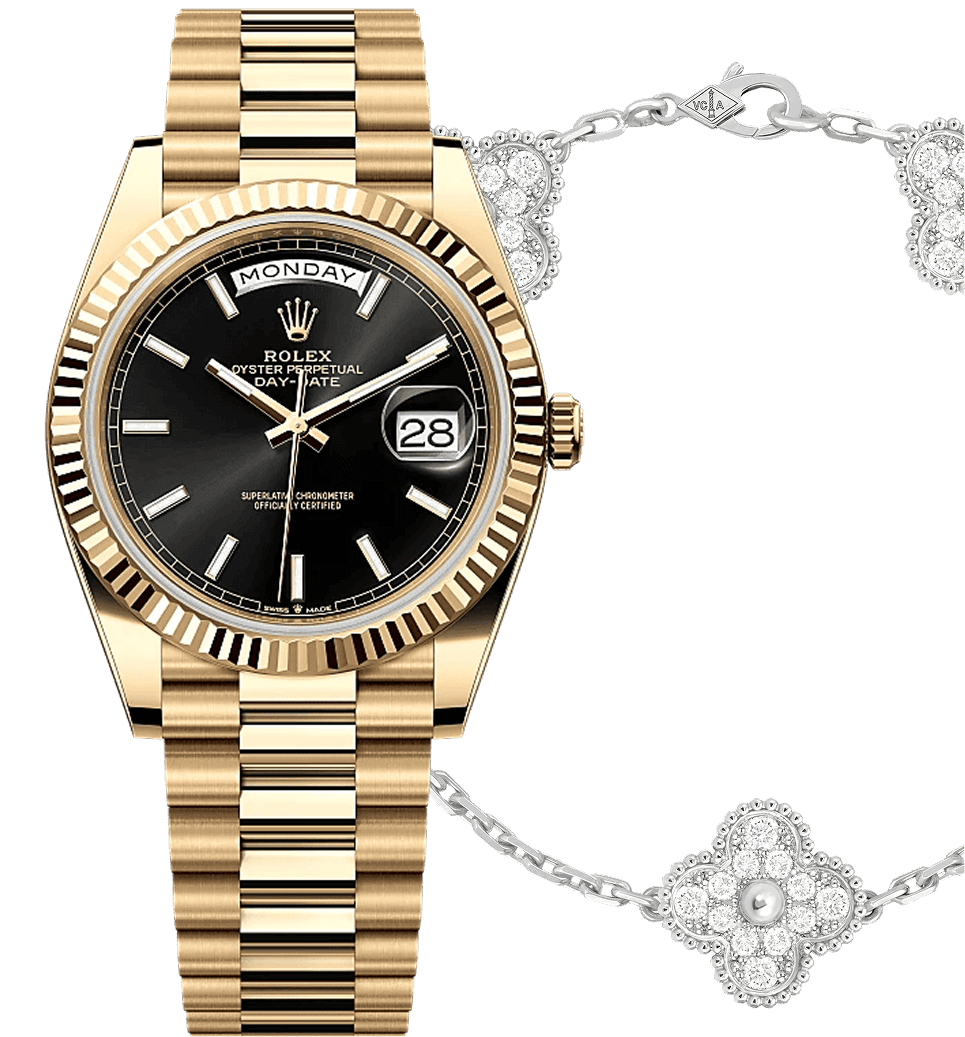
A Rolex appraisal starts with identifying the exact watch—not simply confirming that it is a Rolex. Reference, configuration, production period, condition, originality, dial and bezel, bracelet, documentation, service history, polishing, and current secondary-market demand can all affect resale value.
Two watches from the same model family can therefore be worth very different amounts.
If your goal is to sell, the most useful question is not just “What is my Rolex worth?” It is “What is this exact Rolex worth in its current condition and configuration in today's resale market?”
Two watches from the same model family can therefore be worth very different amounts.
If your goal is to sell, the most useful question is not just “What is my Rolex worth?” It is “What is this exact Rolex worth in its current condition and configuration in today's resale market?”
ROLEX APPRAISAL & RESALE VALUE
First, Know What Kind of Rolex Appraisal You Need
“Rolex appraisal” can describe several different valuations.
They should not be treated as interchangeable.
They should not be treated as interchangeable.
Insurance replacement value
What might it cost to replace the watch with a comparable example?
Current market / resale value
Where does this watch fit in today's secondary market?
Dealer purchase offer
What will a specific buyer pay for the watch now?
Auction estimate
What range might an auction house expect?
Private-sale expectation
What might an end buyer pay directly?
An insurance appraisal can be completely valid while being significantly different from a resale offer because the two valuations answer different questions. Diamond Banc makes the same distinction in its Rolex-selling appraisal guidance: replacement valuation and a current market-based sale estimate should not be used as if they were the same number.
This article focuses primarily on Rolex resale value—the information most relevant when you are considering selling or simply want to understand where your watch currently sits in the secondary market.
What might it cost to replace the watch with a comparable example?
Current market / resale value
Where does this watch fit in today's secondary market?
Dealer purchase offer
What will a specific buyer pay for the watch now?
Auction estimate
What range might an auction house expect?
Private-sale expectation
What might an end buyer pay directly?
An insurance appraisal can be completely valid while being significantly different from a resale offer because the two valuations answer different questions. Diamond Banc makes the same distinction in its Rolex-selling appraisal guidance: replacement valuation and a current market-based sale estimate should not be used as if they were the same number.
This article focuses primarily on Rolex resale value—the information most relevant when you are considering selling or simply want to understand where your watch currently sits in the secondary market.
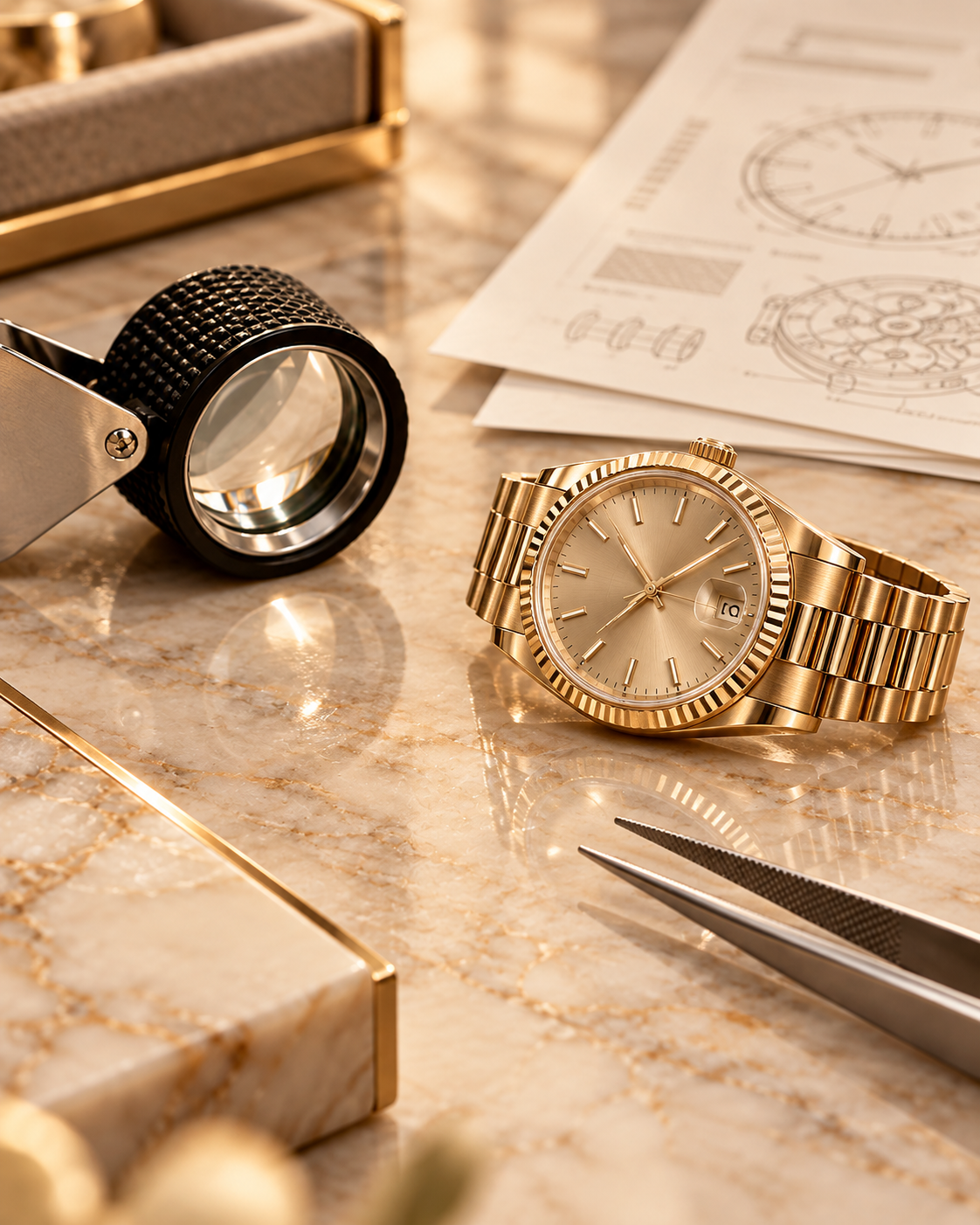
1. Model, Reference Number, and Exact Configuration
The word Rolex tells an appraiser very little about value by itself.
Even model names are too broad.
A Submariner, Daytona, GMT-Master II, Datejust, Day-Date, Explorer, Oyster Perpetual, or Sea-Dweller can exist across multiple generations, materials, dial configurations, bezels, and bracelets.
The starting point is therefore the reference.
Even model names are too broad.
A Submariner, Daytona, GMT-Master II, Datejust, Day-Date, Explorer, Oyster Perpetual, or Sea-Dweller can exist across multiple generations, materials, dial configurations, bezels, and bracelets.
The starting point is therefore the reference.
Model Family vs. Reference
Compare:
Rolex Submariner
with:
Rolex Submariner ref. 126610LN
The second identifies a much narrower market.
A professional evaluation then goes further and confirms whether the watch's visible configuration is consistent with that reference:
Bob's Watches likewise treats exact reference as one of the primary inputs in Rolex valuation because different generations within the same model family trade in different markets.
Rolex Submariner
with:
Rolex Submariner ref. 126610LN
The second identifies a much narrower market.
A professional evaluation then goes further and confirms whether the watch's visible configuration is consistent with that reference:
- case material;
- bezel;
- dial;
- bracelet;
- clasp;
- size;
- generation;
- relevant factory configuration.
Bob's Watches likewise treats exact reference as one of the primary inputs in Rolex valuation because different generations within the same model family trade in different markets.
Configuration Matters Within the Same Reference Family
Even watches that look very similar can have different buyer demand.
Factors can include:
That is why comparing your watch with the first online listing that says “Rolex Datejust” or “Rolex Submariner” is not enough.
A meaningful comparable should be as close as possible to the same reference and configuration.
Factors can include:
- stainless steel vs. precious metal;
- Oyster vs. Jubilee bracelet;
- bezel type;
- dial color;
- factory gem setting;
- discontinued configuration;
- rare or collectible dial variation.
That is why comparing your watch with the first online listing that says “Rolex Datejust” or “Rolex Submariner” is not enough.
A meaningful comparable should be as close as possible to the same reference and configuration.
2. Serial Number and Production Period
The serial number identifies an individual watch, but its role in valuation depends on the era.
For older Rolex watches, serial ranges can help estimate the production period and determine whether the watch's dial, hands, bezel, bracelet, and other characteristics are consistent with that era.
That becomes especially important with collectible watches.
For older Rolex watches, serial ranges can help estimate the production period and determine whether the watch's dial, hands, bezel, bracelet, and other characteristics are consistent with that era.
That becomes especially important with collectible watches.
Modern Rolex Serial Numbers Work Differently
A common appraisal mistake is assuming that every Rolex serial number can be entered into a chart to produce a precise manufacturing year.
That is no longer true.
Around 2010, Rolex moved to randomized alphanumeric serial numbers. For newer watches, the serial itself no longer provides the straightforward approximate production dating available with older sequential systems. Warranty documentation and the production period of the reference can therefore become more useful when placing a modern watch in time.
That is no longer true.
Around 2010, Rolex moved to randomized alphanumeric serial numbers. For newer watches, the serial itself no longer provides the straightforward approximate production dating available with older sequential systems. Warranty documentation and the production period of the reference can therefore become more useful when placing a modern watch in time.
Why Production Period Matters
Production period can help answer questions such as:
For a rare vintage watch, a production-period detail can materially change how collectors view the piece.
- Is the dial consistent with the era?
- Is the bezel appropriate?
- Is the bracelet period-correct?
- Are the hands consistent?
- Was this reference in production at that time?
- Could a particular variation have collector significance?
For a rare vintage watch, a production-period detail can materially change how collectors view the piece.
3. Overall Condition
Condition is one of the largest reasons two otherwise comparable Rolex watches can receive different valuations.
An appraisal may consider:
But condition does not simply mean “how shiny does the watch look?”
That distinction becomes crucial when evaluating vintage pieces.
An appraisal may consider:
- case scratches and dents;
- lug condition;
- crown guards;
- crystal;
- bezel;
- bracelet;
- clasp;
- dial;
- hands;
- winding and crown operation;
- date function;
- timekeeping behavior;
- evidence of moisture or damage.
But condition does not simply mean “how shiny does the watch look?”
That distinction becomes crucial when evaluating vintage pieces.
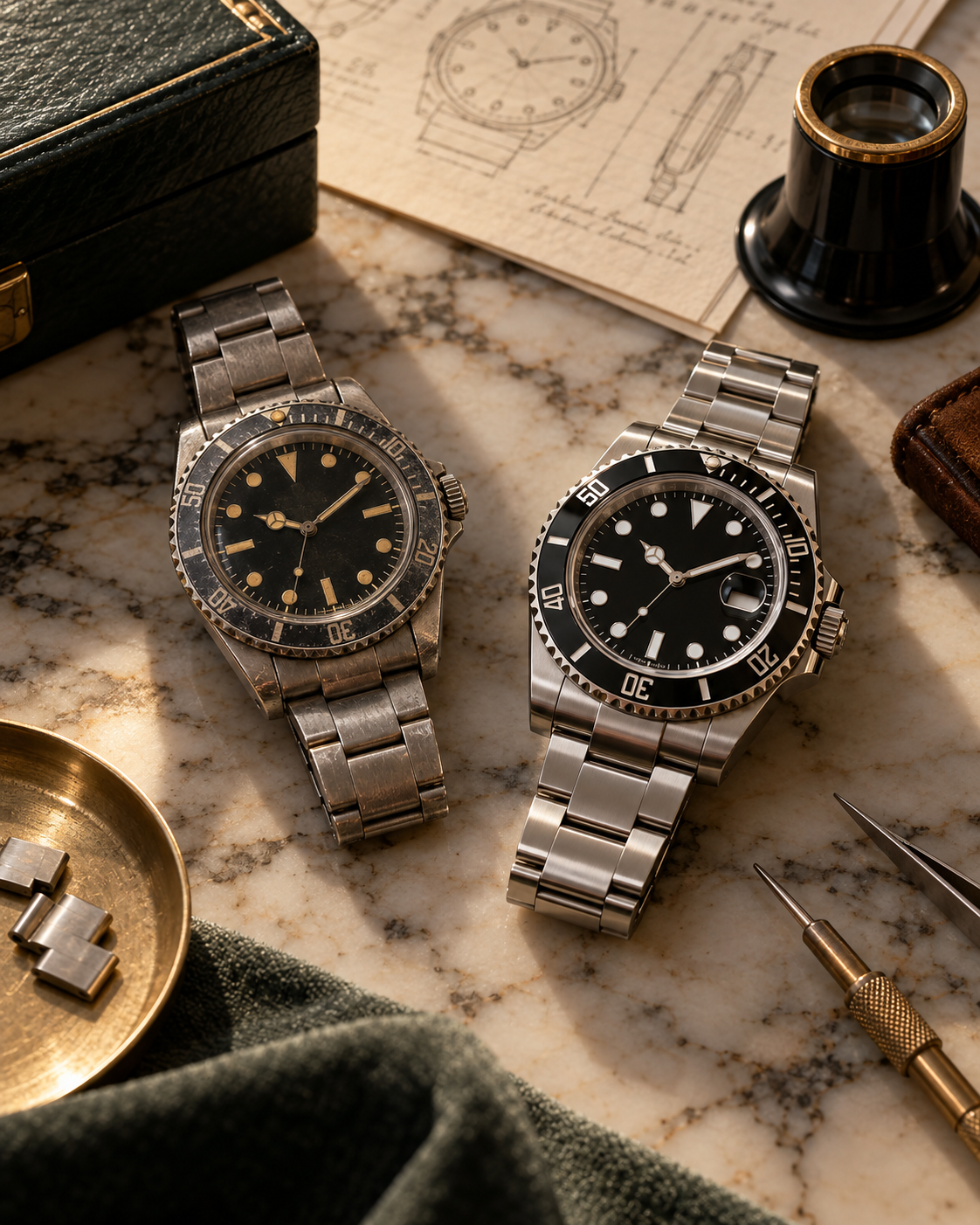
Honest Wear Can Be Better Than Incorrect Restoration
A watch showing normal age can still be desirable.
Trying to make an older watch look brand new can sometimes remove characteristics collectors value.
This is why an appraiser distinguishes between:
honest wear
and
damage, heavy refinishing, or altered components.
With modern Rolex watches, cleaner cosmetic condition often helps.
With vintage Rolex watches, originality may become more important than cosmetic perfection. Bob's Watches specifically distinguishes the modern and vintage markets on this point: collectors may prefer an original vintage case, dial, hands, and aged characteristics over a cosmetically refreshed watch that has lost original features.
Trying to make an older watch look brand new can sometimes remove characteristics collectors value.
This is why an appraiser distinguishes between:
honest wear
and
damage, heavy refinishing, or altered components.
With modern Rolex watches, cleaner cosmetic condition often helps.
With vintage Rolex watches, originality may become more important than cosmetic perfection. Bob's Watches specifically distinguishes the modern and vintage markets on this point: collectors may prefer an original vintage case, dial, hands, and aged characteristics over a cosmetically refreshed watch that has lost original features.
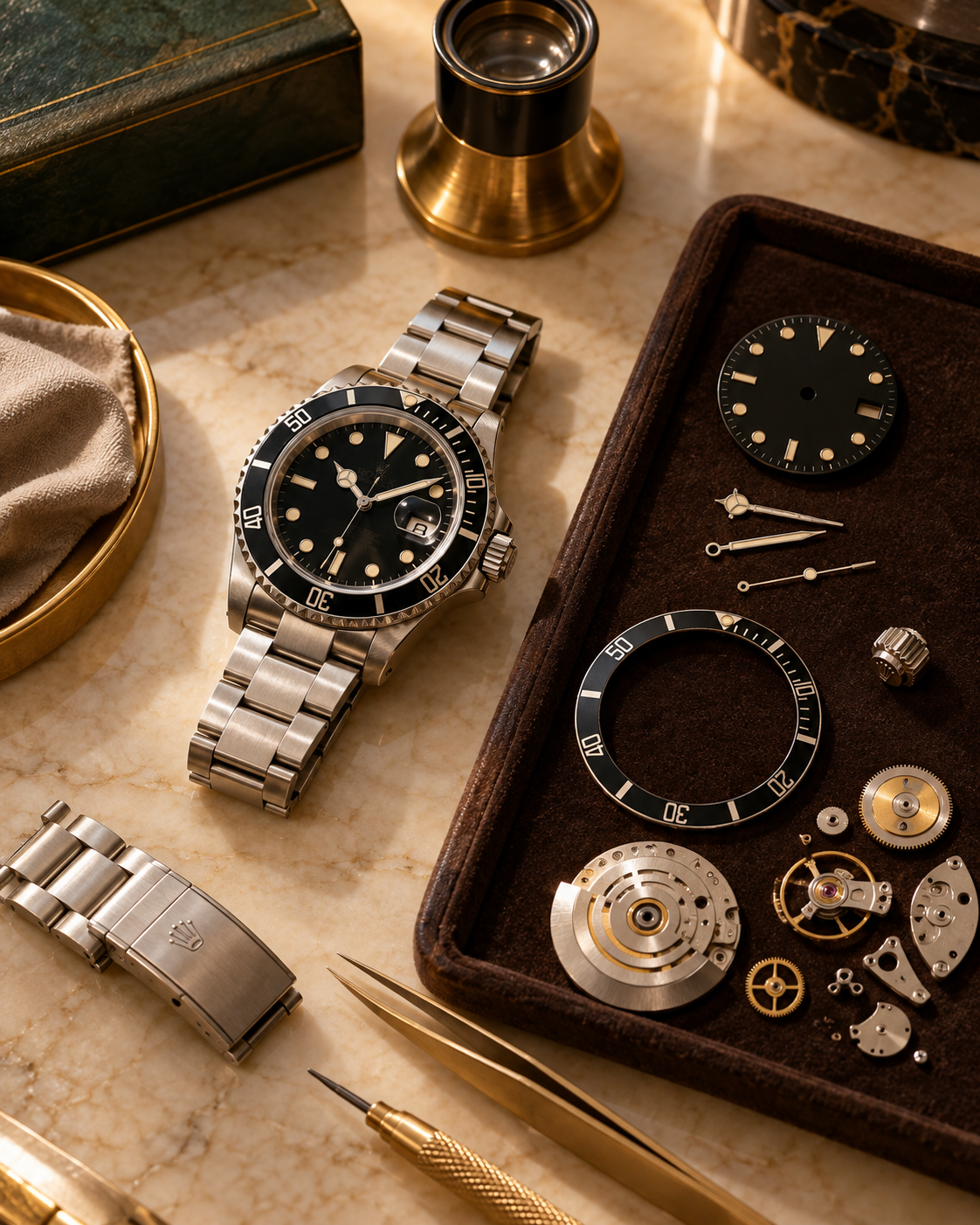
4. Original Components
Originality deserves its own section because it is not the same thing as condition.
A watch can be:
authentic Rolex
but no longer contain all of the components with which that particular example left production.
Over a long ownership period, a watch may have received:
A watch can be:
authentic Rolex
but no longer contain all of the components with which that particular example left production.
Over a long ownership period, a watch may have received:
- replacement dial;
- replacement hands;
- replacement bezel;
- replacement insert;
- replacement bracelet;
- replacement crown;
- replacement movement components;
- aftermarket diamond setting or other modifications.
Service Parts Are Not the Same as Counterfeit Parts
This distinction matters.
A genuine Rolex replacement part installed during legitimate servicing is still a genuine component.
But for some collectible vintage references, an original period dial or bezel may attract more collector interest than a later factory service replacement.
That does not mean every service replacement reduces value.
Its effect depends on:
Rolex itself explains that during authorized servicing, components that no longer meet Rolex requirements may be replaced with genuine Rolex parts. rolex.com
For a modern daily-wear Rolex, this may primarily support functionality.
For a historically important vintage piece, the collector may care much more about preserving original components.
A genuine Rolex replacement part installed during legitimate servicing is still a genuine component.
But for some collectible vintage references, an original period dial or bezel may attract more collector interest than a later factory service replacement.
That does not mean every service replacement reduces value.
Its effect depends on:
- reference;
- age;
- collectability;
- rarity;
- component;
- buyer market.
Rolex itself explains that during authorized servicing, components that no longer meet Rolex requirements may be replaced with genuine Rolex parts. rolex.com
For a modern daily-wear Rolex, this may primarily support functionality.
For a historically important vintage piece, the collector may care much more about preserving original components.
5. Dial and Bezel
The dial is one of the first things an owner notices—and often one of the first things a specialist studies.
Buyers may look at:
Buyers may look at:
- dial color;
- printing;
- lume;
- indices;
- hands;
- date window;
- factory vs. refinished dial;
- service replacement;
- discoloration;
- moisture damage;
- patina;
- uncommon variations.
Not Every “Rare Dial” Is Actually Rare
Online descriptions often use terms such as:
Those terms should not be accepted without evidence.
A naturally aged dial that collectors recognize as an authentic desirable variation is very different from a damaged, refinished, repainted, or artificially altered dial.
- rare;
- tropical;
- vintage;
- collectible;
- original.
Those terms should not be accepted without evidence.
A naturally aged dial that collectors recognize as an authentic desirable variation is very different from a damaged, refinished, repainted, or artificially altered dial.
The Bezel Can Matter Just as Much
Depending on the reference, the appraiser may consider:
On certain vintage sport Rolex references, original bezel inserts have their own collector market.
On modern watches, a damaged bezel can create a more straightforward replacement-cost issue.
Again, the same physical flaw can mean something different depending on the age and collectability of the watch.
- original bezel type;
- insert condition;
- period correctness;
- material;
- factory gem setting;
- replacement history.
On certain vintage sport Rolex references, original bezel inserts have their own collector market.
On modern watches, a damaged bezel can create a more straightforward replacement-cost issue.
Again, the same physical flaw can mean something different depending on the age and collectability of the watch.
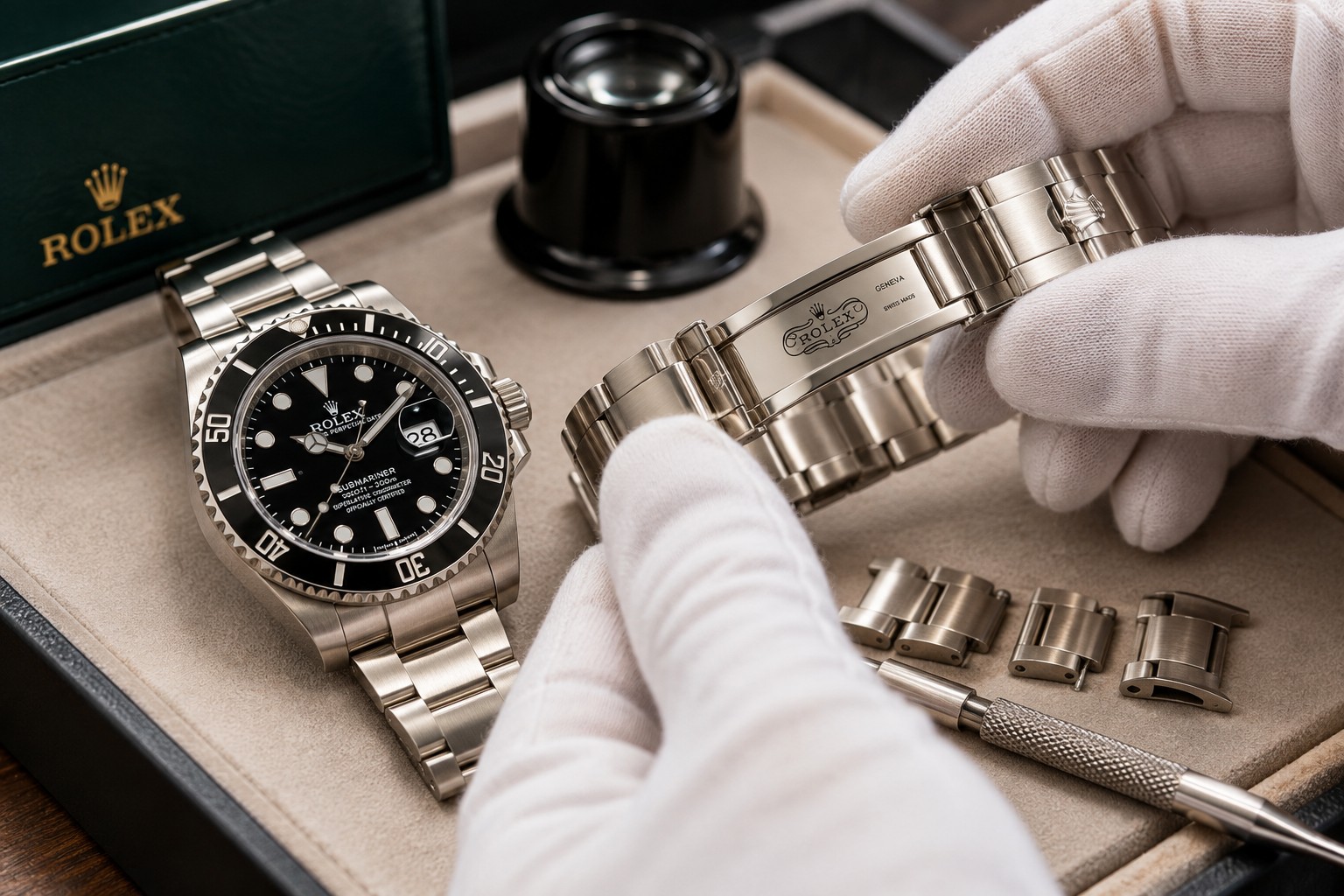
6. Bracelet and Clasp Condition
The bracelet is not an afterthought.
A Rolex appraisal should normally consider:
A Rolex appraisal should normally consider:
- bracelet type;
- whether it is correct for the reference;
- stretch or looseness;
- dents and heavy wear;
- clasp condition;
- clasp function;
- excessive polishing;
- missing links;
- extra links included with the watch.
Missing Links Can Matter
If a bracelet has been sized for a smaller wrist and the removed original links are missing, the next owner may need to source replacements.
That affects completeness and can influence the economics of resale.
If you still have extra links in a drawer, box, or service pouch, bring them to the appraisal.
That affects completeness and can influence the economics of resale.
If you still have extra links in a drawer, box, or service pouch, bring them to the appraisal.
Vintage Bracelet Originality
On vintage watches, an era-appropriate bracelet and clasp can matter beyond basic functionality.
The evaluator may consider whether bracelet details make sense for the production period of the watch.
A replacement bracelet does not necessarily make the watch undesirable, but it changes what is being valued.
The evaluator may consider whether bracelet details make sense for the production period of the watch.
A replacement bracelet does not necessarily make the watch undesirable, but it changes what is being valued.
7. Box, Papers, Warranty Card, and Accessories
A Rolex can absolutely have meaningful resale value without the original box or papers.
The watch itself remains the primary asset.
However, completeness can improve:
Bob's Watches notes that the value effect of missing papers is not a universal percentage; it changes according to reference, age, rarity, condition, warranty status, and provenance.
That is the right way to think about box and papers.
Avoid formulas such as:
“Papers always add X%.”
The effect is watch-specific.
The watch itself remains the primary asset.
However, completeness can improve:
- buyer confidence;
- provenance;
- presentation;
- ease of resale;
- collectability.
- original box;
- warranty card or older papers;
- booklets;
- hang tags;
- bezel protector if appropriate;
- extra bracelet links;
- original receipt;
- service documentation.
Bob's Watches notes that the value effect of missing papers is not a universal percentage; it changes according to reference, age, rarity, condition, warranty status, and provenance.
That is the right way to think about box and papers.
Avoid formulas such as:
“Papers always add X%.”
The effect is watch-specific.
Papers Do Not Authenticate Every Component
Documentation can strengthen provenance, but an appraisal still needs to examine the actual watch.
A correct warranty card does not automatically prove that every visible component remains original or that the watch has never been modified.
The object and the documentation need to make sense together.
A correct warranty card does not automatically prove that every visible component remains original or that the watch has never been modified.
The object and the documentation need to make sense together.
8. Service History
Service records can be valuable context.
Bring documentation from:
Service documentation can help establish:
Rolex states that watches completing its service procedure are returned with an international two-year service guarantee.
Bring documentation from:
- Rolex Service Center;
- an authorized service provider;
- a reputable independent watchmaker;
- previous repairs.
Service documentation can help establish:
- when work was performed;
- whether the movement was maintained;
- which parts may have been replaced;
- whether the watch received official service.
Rolex states that watches completing its service procedure are returned with an international two-year service guarantee.
Service Does Not Automatically Increase Resale Value
A freshly serviced watch is not automatically worth the cost of service plus its previous value.
The effect depends on the watch.
For a modern Rolex needing routine maintenance, recent documented service may make the watch easier to sell.
For a vintage watch, the appraiser may also want to know:
That is why paying for service solely because you intend to sell is not always the best first move.
The existing Luxe Brokers Rolex Selling Guide already recommends obtaining an evaluation before investing in unnecessary service work.
The effect depends on the watch.
For a modern Rolex needing routine maintenance, recent documented service may make the watch easier to sell.
For a vintage watch, the appraiser may also want to know:
- whether original parts were retained;
- whether the dial or hands were replaced;
- whether the case was refinished.
That is why paying for service solely because you intend to sell is not always the best first move.
The existing Luxe Brokers Rolex Selling Guide already recommends obtaining an evaluation before investing in unnecessary service work.
9. Polished vs. Unpolished Rolex
Polishing is one of the most misunderstood Rolex valuation topics.
A professional polish can make a watch look cleaner.
But polishing works by removing a very small amount of material from the case or bracelet.
If it is repeated or performed aggressively, it can change:
A professional polish can make a watch look cleaner.
But polishing works by removing a very small amount of material from the case or bracelet.
If it is repeated or performed aggressively, it can change:
- lug shape;
- case edges;
- crown guards;
- chamfers;
- transitions between brushed and polished surfaces.
Does Polishing Always Reduce Rolex Value?
No.
The correct answer depends on:
A lightly and correctly refinished modern watch is not automatically a problem.
A heavily polished vintage sport Rolex with softened case geometry is a very different situation.
Bob's Watches' 2026 analysis of polished vs. unpolished Rolex watches emphasizes that case condition and originality can produce meaningful differences between examples of the same vintage reference.
The correct answer depends on:
- age;
- degree of polishing;
- quality of the refinishing;
- reference;
- collector expectations.
A lightly and correctly refinished modern watch is not automatically a problem.
A heavily polished vintage sport Rolex with softened case geometry is a very different situation.
Bob's Watches' 2026 analysis of polished vs. unpolished Rolex watches emphasizes that case condition and originality can produce meaningful differences between examples of the same vintage reference.
Do Not Polish a Rolex Just Before Appraisal
If your goal is to determine resale value, leave the watch in its current condition.
The appraiser should see:
Once metal has been removed, it cannot simply be restored by the next appraisal.
The appraiser should see:
- actual wear;
- original finishing where present;
- scratches;
- dents;
- prior refinishing.
Once metal has been removed, it cannot simply be restored by the next appraisal.
10. Current Secondary-Market Demand
A technically excellent Rolex can still have a different resale value from another technically excellent Rolex because the market wants some references and configurations more than others.
This factor is dynamic.
A serious appraisal should therefore not rely only on:
This factor is dynamic.
A serious appraisal should therefore not rely only on:
- original MSRP;
- an appraisal from years ago;
- the highest online asking price;
- a generic “Rolex holds value” assumption.
Asking Price vs. Market Evidence
A listing tells you what a seller is asking.
It does not prove that another buyer has paid that amount.
For resale valuation, stronger evidence can include:
It does not prove that another buyer has paid that amount.
For resale valuation, stronger evidence can include:
- recent completed transactions;
- current dealer buy/sell activity;
- auction results where appropriate;
- depth of demand;
- available inventory;
- how quickly comparable pieces trade.
Why Appraisals Need a Date
Rolex values are not static.
Chrono24's 2026 Rolex report, based on completed marketplace transactions through Q2 2026, shows both ongoing strength of the brand and shifting demand between specific collections and references.
That is why a useful valuation should effectively answer:
What is this watch worth in the relevant market now?
not:
What was this model worth at the peak of a previous market cycle?
Chrono24's 2026 Rolex report, based on completed marketplace transactions through Q2 2026, shows both ongoing strength of the brand and shifting demand between specific collections and references.
That is why a useful valuation should effectively answer:
What is this watch worth in the relevant market now?
not:
What was this model worth at the peak of a previous market cycle?
11. Vintage Rolex vs. Modern Rolex
Vintage and modern Rolex watches should not be evaluated using exactly the same priorities.
Modern Rolex
For many modern examples, value tends to be strongly influenced by:
Consistency and completeness are usually relatively straightforward to establish.
- exact reference;
- current demand;
- overall condition;
- box and warranty card;
- complete bracelet;
- current configuration;
- service status.
Consistency and completeness are usually relatively straightforward to establish.
Vintage Rolex
Vintage appraisal can be much more forensic.
The evaluator may need to consider:
A vintage watch may therefore be less cosmetically perfect but more collectible than another watch that has been heavily restored.
The evaluator may need to consider:
- period-correct dial;
- original hands;
- lume consistency;
- bezel and insert;
- original case geometry;
- bracelet/clasp;
- service replacement components;
- serial range;
- production period;
- unusual variations;
- provenance.
A vintage watch may therefore be less cosmetically perfect but more collectible than another watch that has been heavily restored.
Bob's Watches summarizes the difference well: modern valuation often rewards clean condition, whereas vintage valuation can place substantially more weight on originality and honest aging.
Age Alone Does Not Create Value
An old Rolex is not automatically rare.
A discontinued Rolex is not automatically highly collectible.
A modern Rolex is not automatically worth more because it looks newer.
The appraiser still has to identify the exact reference and evaluate demand for that specific watch.
A discontinued Rolex is not automatically highly collectible.
A modern Rolex is not automatically worth more because it looks newer.
The appraiser still has to identify the exact reference and evaluate demand for that specific watch.
12. Authentication Comes Before Valuation
A reliable valuation assumes that the evaluator first establishes what the watch actually is.
Authentication-related review can include consistency between:
Authentication-related review can include consistency between:
- reference;
- serial;
- case;
- dial;
- bezel;
- bracelet;
- clasp;
- movement;
- paperwork.
Authentication and Appraisal Are Related but Different
An appraisal answers:
What is this watch worth for a stated purpose?
Authentication answers:
Is this watch genuine, and are its components consistent with what it claims to be?
The second question has to come first.
A buyer cannot responsibly price a rare vintage configuration before establishing whether the configuration is credible.
What is this watch worth for a stated purpose?
Authentication answers:
Is this watch genuine, and are its components consistent with what it claims to be?
The second question has to come first.
A buyer cannot responsibly price a rare vintage configuration before establishing whether the configuration is credible.
Rolex Certified Pre-Owned Is a Specific Program
Rolex's own Certified Pre-Owned program is distinct from an independent dealer's authentication or appraisal.
Rolex states that watches in its CPO program return to Rolex workshops, where the original configuration is checked and the watch is authenticated, serviced, tested, and issued with Rolex CPO documentation.
An independent buyer or appraiser can examine authenticity indicators and determine whether a watch appears consistent, but should not describe that process as official Rolex certification unless it actually is part of the Rolex program.
Rolex states that watches in its CPO program return to Rolex workshops, where the original configuration is checked and the watch is authenticated, serviced, tested, and issued with Rolex CPO documentation.
An independent buyer or appraiser can examine authenticity indicators and determine whether a watch appears consistent, but should not describe that process as official Rolex certification unless it actually is part of the Rolex program.
13. What to Bring to a Rolex Appraisal
You do not need a complete set to have a Rolex evaluated.
Bring whatever you have.
Bring whatever you have.
The Watch
Do not polish or modify it first.
If it is not running normally, simply disclose that.
If it is not running normally, simply disclose that.
Box and Papers
Bring:
- warranty card;
- older guarantee papers;
- box;
- booklets;
- hang tags.
Extra Links
These are easy to overlook but can affect completeness.
Service Documentation
Bring:
- Rolex Service Card;
- service receipts;
- independent watchmaker records;
- records showing replaced components where available.
Purchase Receipt
Not required, but it can help establish ownership history and original configuration.
Do not assume the original purchase price equals today's value.
Do not assume the original purchase price equals today's value.
Previous Appraisals
These can contain useful identification information even when their monetary value is no longer current.
Original or Removed Parts
If you retained an original bezel, dial, bracelet, hands, or another component after service, do not throw it away.
It may be relevant to a collector or evaluator, especially on a vintage piece.
It may be relevant to a collector or evaluator, especially on a vintage piece.
How to Prepare Photos for an Online Rolex Appraisal
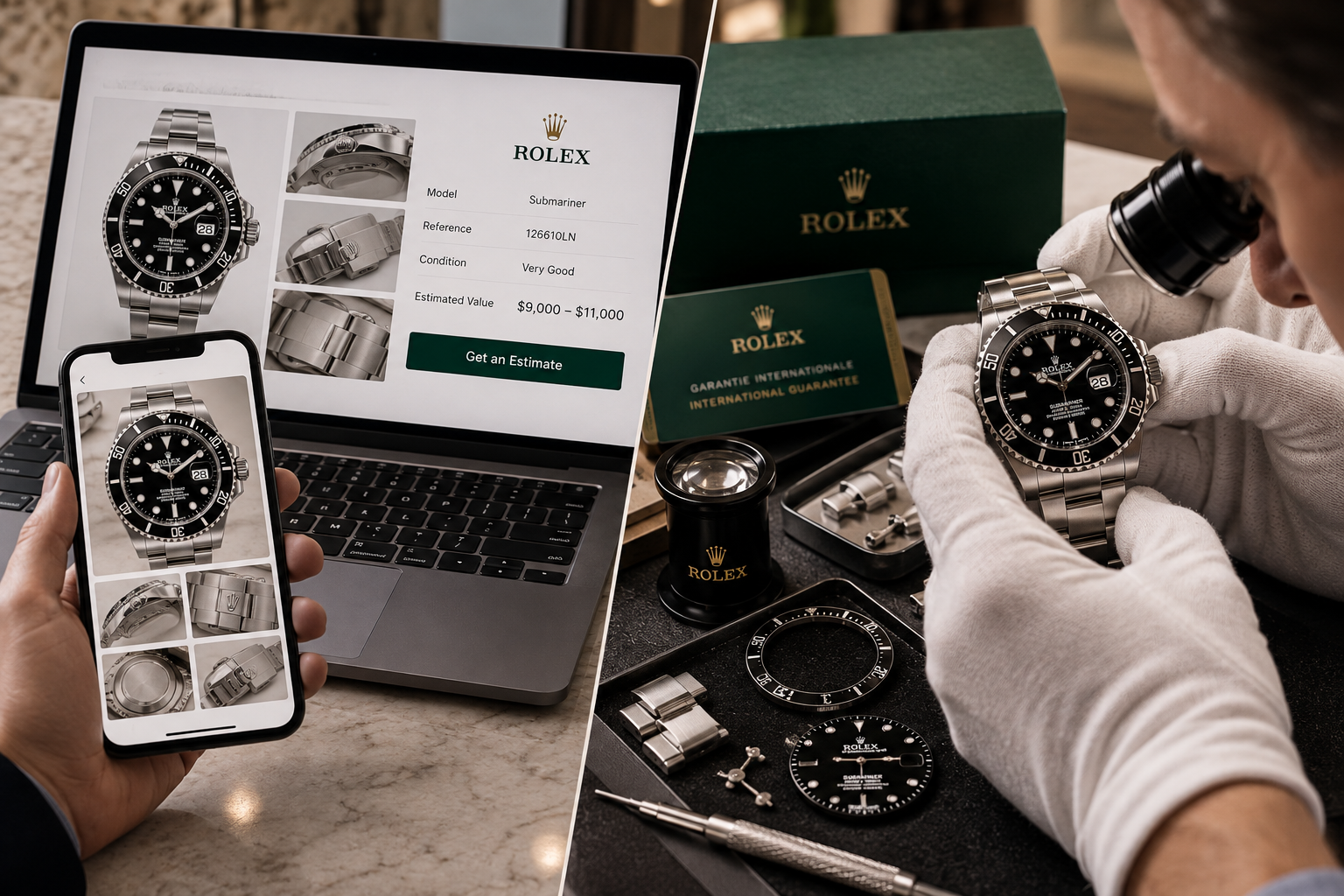
A photo-based valuation can be a useful first step, provided the photos show the details that actually affect value.
Photograph:
The existing Luxe Brokers online appraisal workflow specifically requests dial, caseback, clasp, bracelet, reference information where known, and box/papers photos for luxury watches.
- dial straight-on;
- case from both sides;
- bezel;
- caseback;
- bracelet fully extended;
- clasp inside and outside;
- visible reference or serial information if safely accessible;
- scratches, dents, or damage;
- box and warranty card;
- service records and extra links.
The existing Luxe Brokers online appraisal workflow specifically requests dial, caseback, clasp, bracelet, reference information where known, and box/papers photos for luxury watches.
Do Not Remove the Bracelet or Open the Case Yourself
If identifying marks require disassembly and you do not have the tools and experience, leave that work to a professional.
A damaged lug, scratched case, or compromised seal is not worth obtaining a number one day earlier.
A damaged lug, scratched case, or compromised seal is not worth obtaining a number one day earlier.
Online Estimate vs. In-Person Rolex Appraisal
A good set of photographs can establish a surprising amount:
But photographs cannot always establish:
For:
a hands-on inspection can materially improve accuracy.
That distinction already appears in Luxe Brokers' online process: photo-based estimates are a first step, while high-value watches may require physical verification for the most accurate final offer.
- probable reference;
- visible configuration;
- overall condition;
- bracelet;
- completeness;
- obvious modifications.
But photographs cannot always establish:
- movement condition;
- internal components;
- subtle case refinishing;
- hidden corrosion;
- every originality question;
- exact mechanical state.
For:
- high-value watches;
- rare references;
- vintage Rolex;
- questionable originality;
- unusual dials;
- watches with modification history;
a hands-on inspection can materially improve accuracy.
That distinction already appears in Luxe Brokers' online process: photo-based estimates are a first step, while high-value watches may require physical verification for the most accurate final offer.
How Much Is My Rolex Worth?
There is no responsible Rolex appraisal formula based only on:
model name + age.
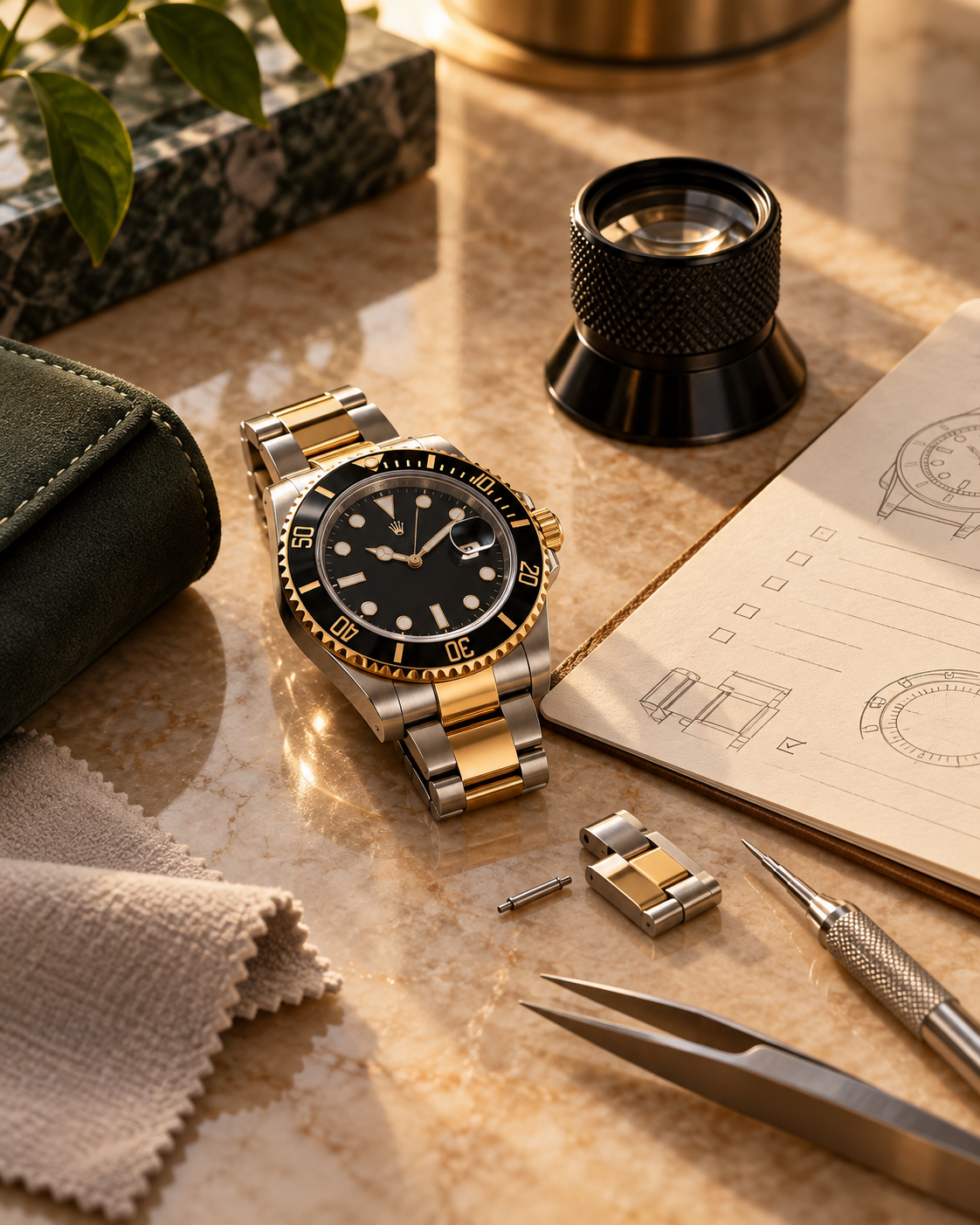
A useful valuation follows this sequence:
model name + age.
A useful valuation follows this sequence:
Step 1 — Identify the exact watch
Establish:
- model;
- reference;
- configuration;
- approximate production period where relevant.
Step 2 — Assess condition
Review:
- case;
- crystal;
- bezel;
- bracelet;
- clasp;
- dial;
- mechanical function.
Step 3 — Establish originality
Determine whether major components are:
- original;
- period-correct;
- service replacements;
- aftermarket;
- modified.
Step 4 — Review completeness and history
Consider:
- box;
- papers;
- extra links;
- service records;
- provenance.
Step 5 — Compare the correct market
Use comparable watches with:
- the same reference;
- similar configuration;
- similar condition;
- similar completeness.
Step 6 — Apply the correct type of value
Do not confuse:
That is how two people can quote different numbers for the same Rolex without either necessarily making a mathematical mistake: they may be describing different transactions.
- retail asking price;
- insurance replacement;
- secondary-market price;
- direct buyer offer.
That is how two people can quote different numbers for the same Rolex without either necessarily making a mathematical mistake: they may be describing different transactions.
The Bottom Line
A Rolex appraisal is not simply a model lookup.
The most important factors typically include:
The strongest appraisal starts by determining exactly what the watch is, then evaluates its condition and originality, and only then compares it with the current market.
If your goal is specifically to sell, the next step is the Rolex Selling Guide, which explains how to prepare the watch and what to expect from the selling process before requesting an item-specific offer.
The most important factors typically include:
- model, reference, and configuration;
- serial and production period where relevant;
- condition;
- original components;
- dial and bezel;
- bracelet and clasp;
- box, papers, and accessories;
- service history;
- polishing and case integrity;
- current secondary-market demand;
- whether the watch is modern or vintage;
- authentication and component consistency.
The strongest appraisal starts by determining exactly what the watch is, then evaluates its condition and originality, and only then compares it with the current market.
If your goal is specifically to sell, the next step is the Rolex Selling Guide, which explains how to prepare the watch and what to expect from the selling process before requesting an item-specific offer.
Want an Item-Specific Rolex Valuation?
A reference number can tell you which watch you have, but resale value still depends on the exact configuration, condition, originality, completeness, service history, and current market.
Send clear photos of the dial, case, bracelet, clasp, and any box, warranty card, extra links, or service records you have. Luxe Brokers can review the watch for a preliminary market-based estimate, with in-person verification available when the details require a closer inspection.
Send clear photos of the dial, case, bracelet, clasp, and any box, warranty card, extra links, or service records you have. Luxe Brokers can review the watch for a preliminary market-based estimate, with in-person verification available when the details require a closer inspection.
Frequently Asked Questions
The value depends on the exact reference and configuration, condition, originality, box and papers, bracelet completeness, service history, polishing, and current market demand. Two watches with the same model name can have very different resale values.
Look for a specialist who regularly evaluates Rolex watches and can identify references, assess condition and originality, and explain which type of value is being provided. Luxe Brokers offers preliminary online estimates and private in-person Rolex evaluations in Beverly Hills.
No. A Rolex can be evaluated without the original box or papers. Documentation can support provenance, completeness, and buyer confidence, but the watch itself still has to be identified and inspected.
It can, especially when repeated or aggressive polishing changes the original shape of the case. The effect is usually more important on vintage and collector watches than on ordinary modern examples. Do not polish a Rolex solely to prepare it for an appraisal.
Not automatically. Documented service can support buyer confidence and mechanical condition, but the financial effect depends on the watch. On collectible vintage references, replacement components or refinishing may also affect originality.
Older Rolex serial numbers can help estimate a production period. Around 2010 Rolex moved to randomized serial numbers, so modern serials cannot be reliably converted into a production year using the old charts.
No. Insurance replacement value estimates replacement cost for insurance purposes. Resale value considers the watch's position in the current secondary market, while a direct purchase offer is the amount a specific buyer is prepared to pay.
Yes, photographs and watch details can provide a useful preliminary estimate for many watches. Rare, vintage, high-value, modified, or difficult-to-authenticate examples may require a hands-on inspection for a more precise final valuation.